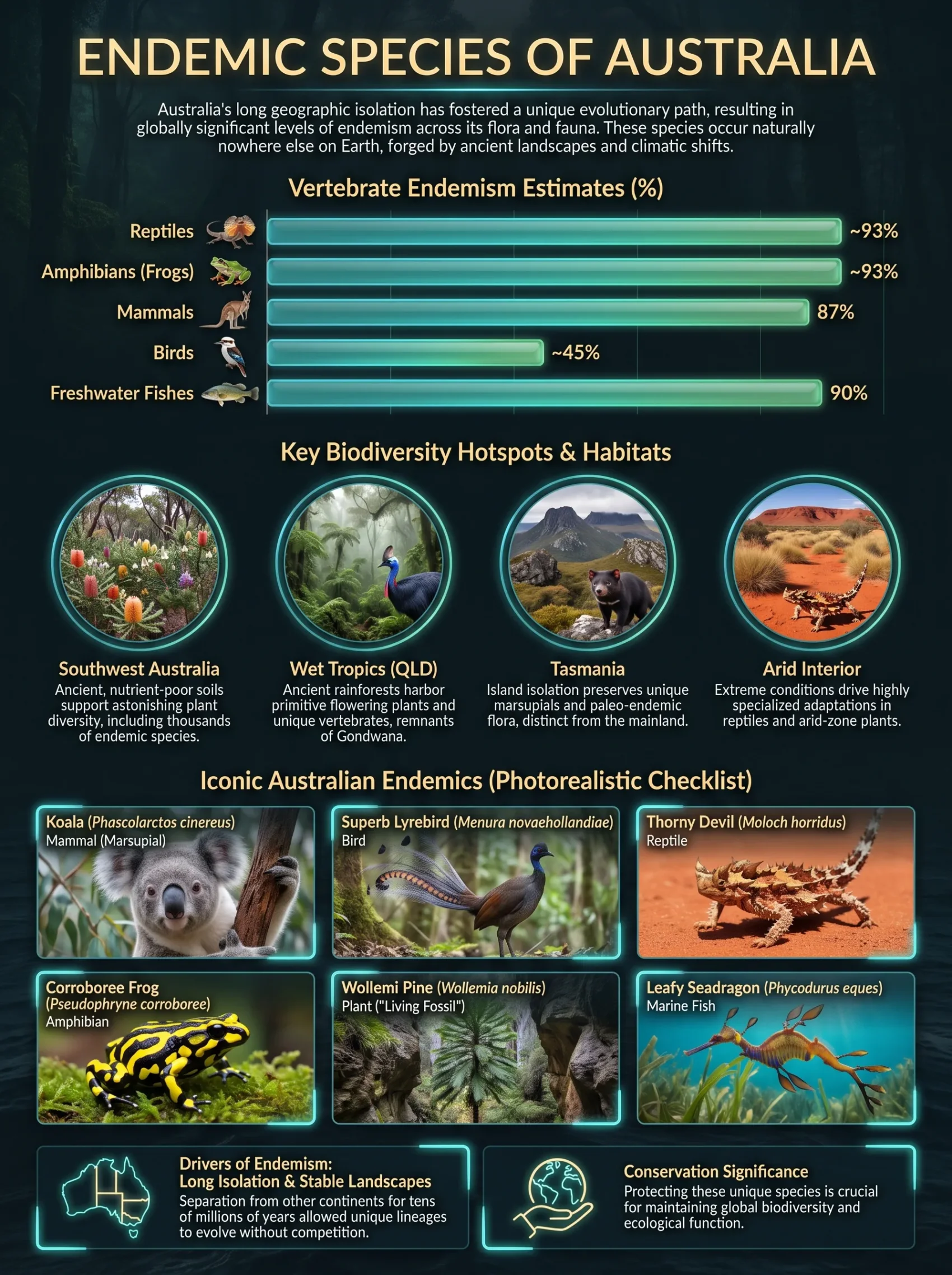
Australia’s federal environment department estimates that the country contains about 600,000–700,000 species. It reports that about 84% of plant species, 83% of mammal species and 45% of bird species are found only in Australia [S1], while a separate department page gives an endemic share of about 89% for reptiles [S2].
| Measure | Value |
|---|---|
| Estimated species in Australia | 600,000–700,000 [S1] |
| Plant species found only in Australia | About 84% [S1] |
| Mammal species found only in Australia | About 83% [S1] |
| Bird species found only in Australia | About 45% [S1] |
| Reptile species found only in Australia | About 89% [S2] |
| Endemic mammal species | 271 [S3] |
| Threatened endemic mammal species | 58 [S3] |
| EX or EW endemic mammal species | 31 [S3] |
| Endemic bird species | 359 [S3] |
| Threatened endemic bird species | 40 [S3] |
| EX or EW endemic bird species | 6 [S3] |
| Endemic reptile species | 934 [S3] |
| Threatened endemic reptile species | 78 [S3] |
| EX or EW endemic reptile species | 0 [S3] |
| Endemic amphibian species | 232 [S3] |
| Threatened endemic amphibian species | 46 [S3] |
| EX or EW endemic amphibian species | 5 [S3] |
| Endemic freshwater fish species | 198 [S4] |
| Threatened endemic freshwater fish species | 89 [S4] |
| EX or EW endemic freshwater fish species | 0 [S4] |
| Endemic conifer species | 37 [S5] |
| Threatened endemic conifer species | 8 [S5] |
| Endemic cycad species | 76 [S5] |
| Threatened endemic cycad species | 28 [S5] |
| Endemic Proteaceae species | 985 [S5] |
| Threatened endemic Proteaceae species | 429 [S5] |
| EX or EW endemic Proteaceae species | 2 [S5] |
| Endemic tree species | 2,147 [S5] |
| Threatened endemic tree species | 275 [S5] |
The percentages above and the IUCN species counts are separate measures and are not added into a single all-taxa total. IUCN Table 8 defines country endemics as species occurring naturally within one country and reports figures only for taxonomic groups with more than 80% of species assessed. In the 2025-2 tables, Christmas Island, Cocos (Keeling) Islands and Norfolk Island are tabulated separately from the Australia row; their values are not added to the national figures shown here [S3] [S4] [S5].
{
  "type": "bar",
  "title": "Country-endemic vertebrates and freshwater fishes in IUCN tables",
  "description": "Species-level counts use the Australia row and the same IUCN 2025-2 country-endemic definition.",
  "unit": "species",
  "orientation": "horizontal",
  "data": [
    {"label": "Reptiles", "value": 934},
    {"label": "Birds", "value": 359},
    {"label": "Mammals", "value": 271},
    {"label": "Amphibians", "value": 232},
    {"label": "Freshwater fishes", "value": 198}
  ],
  "source": "IUCN Red List Tables 8a and 8b, version 2025-2"
}
What the national figures measure
The federal percentage estimates describe broad shares of Australian groups that occur nowhere else. The IUCN tables provide species-level country-endemic counts for groups that meet the Red List assessment-coverage threshold. The two data families therefore answer different questions. The IUCN totals also preserve Red List treatment of extinct and extinct-in-the-wild species, which is why the opening table separates total endemic, threatened endemic and EX/EW endemic records.
Plant figures need the same separation. IUCN’s tree category is a life-form assessment set, while conifers, cycads and Proteaceae are taxonomic groups. These categories can overlap and must not be summed into a synthetic plant total [S5].
Threatened endemic species in assessed groups
Within the IUCN 2025-2 country tables, the threatened share can be calculated directly from the endemic and threatened-endemic values for each group. The percentages below use only numerator and denominator values from the same IUCN table series and retain one decimal place.
| Group | Endemic species | Threatened endemic species | Threatened share |
|---|---|---|---|
| Mammals | 271 | 58 | 21.4% [S3] |
| Birds | 359 | 40 | 11.1% [S3] |
| Reptiles | 934 | 78 | 8.4% [S3] |
| Amphibians | 232 | 46 | 19.8% [S3] |
| Freshwater fishes | 198 | 89 | 44.9% [S4] |
{
  "type": "bar",
  "title": "Threatened share of country-endemic species",
  "description": "Percentage of endemic species classified as Critically Endangered, Endangered or Vulnerable in the IUCN 2025-2 assessed-group tables.",
  "unit": "%",
  "orientation": "horizontal",
  "data": [
    {"label": "Freshwater fishes", "value": 44.9},
    {"label": "Mammals", "value": 21.4},
    {"label": "Amphibians", "value": 19.8},
    {"label": "Birds", "value": 11.1},
    {"label": "Reptiles", "value": 8.4}
  ],
  "source": "Calculated from IUCN Red List Tables 8a and 8b, version 2025-2"
}
The same IUCN release records 985 endemic Proteaceae species, of which 429 are threatened, and 2,147 endemic tree species, of which 275 are threatened [S5]. The table also records 76 endemic cycads with 28 threatened and 37 endemic conifers with 8 threatened.
Geographic concentrations of endemism
Australian endemism is spatially uneven. The Wet Tropics of Queensland contains more than 3,000 vascular plant species, including 576 endemic species and 44 endemic genera. The same official account records 11 endemic mammal species, 11 endemic bird species, 24 endemic reptile species and 22 endemic amphibian species [S6].
| Group | Recorded species | Endemic species |
|---|---|---|
| Vascular plants | >3,000 | 576 [S6] |
| Mammals | 107 | 11 [S6] |
| Birds | 368 | 11 [S6] |
| Reptiles | 113 | 24 [S6] |
| Amphibians | 51 | 22 [S6] |
{
  "type": "bar",
  "title": "Endemic vertebrate species in the Wet Tropics",
  "description": "Regional endemic counts reported for mammals, birds, reptiles and amphibians in the Wet Tropics of Queensland.",
  "unit": "species",
  "orientation": "horizontal",
  "data": [
    {"label": "Reptiles", "value": 24},
    {"label": "Amphibians", "value": 22},
    {"label": "Mammals", "value": 11},
    {"label": "Birds", "value": 11}
  ],
  "source": "Australian Government Wet Tropics of Queensland account"
}
Plant endemism is also concentrated in south-western Australia and the forests of eastern Australia. Australia’s State of the Environment 2021 reports about 21,000 plant species nationally and identifies those two regions as global biodiversity hotspots because they combine high concentrations of endemic plants with extensive habitat loss [S7].
Frog endemism follows a more localized pattern. A continental analysis identified 11 main centres of anuran endemism; the strongest centres in that analysis were the Wet Tropics and the south-west near Bunbury–Augusta and Walpole. Other identified centres included the Mitchell Plateau, Cape York, Kakadu and Eungella [S8].
Verified endemic species reference checklist
Australia’s endemic biota is too large for a single all-taxa species table. The records below form a cross-taxon reference subset at species rank, selected from groups with clear Australian-only native distributions. They are not presented as a full national checklist or as the basis for a synthetic endemic-species total. Animal taxonomy and Australian distribution are aligned to the Australian Faunal Directory [S9]. Plant names follow the Australian Plant Census [S10], with native-range checks against Plants of the World Online [S11]. Introduced, naturalized and translocated occurrences are not treated as extensions of native range. Extinct species are not included in this checklist.
Endemic mammals
The species below have natural or historical native ranges confined to Australia; managed reintroductions do not widen the native range [S9].
| Scientific name | Native endemic range |
|---|---|
| Ornithorhynchus anatinus | Eastern mainland Australia and Tasmania |
| Phascolarctos cinereus | Eastern and south-eastern Australia |
| Vombatus ursinus | South-eastern mainland Australia and Tasmania |
| Lasiorhinus latifrons | Southern mainland Australia |
| Lasiorhinus krefftii | Central Queensland |
| Sarcophilus harrisii | Tasmania |
| Myrmecobius fasciatus | Southern Australia historically; surviving native populations in south-western Western Australia |
| Dasyurus geoffroii | Southern and western Australia historically; surviving native populations centred in south-western Western Australia |
| Dasyurus viverrinus | Tasmania; formerly also south-eastern mainland Australia |
| Dasyurus maculatus | Eastern and south-eastern Australia, including Tasmania |
| Antechinus argentus | Central-eastern Queensland |
| Burramys parvus | Alpine and subalpine New South Wales and Victoria |
| Gymnobelideus leadbeateri | Central Highlands of Victoria |
| Tarsipes rostratus | South-western Western Australia |
| Notoryctes typhlops | Arid central and southern Australia |
| Notoryctes caurinus | Arid north-western and central Australia |
| Macrotis lagotis | Arid and semi-arid inland Australia |
| Perameles gunnii | Tasmania and south-eastern mainland Australia historically |
| Perameles bougainville | Western and southern Australia historically; surviving native populations on islands off Western Australia |
| Setonix brachyurus | South-western Western Australia and nearby islands |
| Bettongia penicillata | Southern Australia historically; surviving native populations centred in south-western Western Australia |
| Bettongia lesueur | Arid and southern Australia historically; surviving native populations on offshore islands and managed mainland sites |
| Potorous longipes | South-eastern Victoria and adjacent New South Wales |
| Potorous gilbertii | South coast of Western Australia |
| Lagorchestes hirsutus | Arid western and central Australia historically; surviving native island populations off Western Australia |
Endemic birds
These species are confined naturally to Australia across their breeding and non-breeding ranges [S9].
| Scientific name | Native endemic range |
|---|---|
| Dromaius novaehollandiae | Mainland Australia and associated Australian islands |
| Leipoa ocellata | Southern and south-western mainland Australia |
| Pedionomus torquatus | Temperate grasslands of south-eastern inland Australia |
| Menura novaehollandiae | South-eastern Australia |
| Menura alberti | South-eastern Queensland and north-eastern New South Wales |
| Atrichornis clamosus | South coast of Western Australia |
| Atrichornis rufescens | South-eastern Queensland and north-eastern New South Wales |
| Corcorax melanorhamphos | Eastern and south-eastern mainland Australia |
| Struthidea cinerea | Inland and eastern mainland Australia |
| Pardalotus punctatus | Eastern and southern Australia, including Tasmania |
| Pardalotus quadragintus | Tasmania |
| Malurus cyaneus | South-eastern Australia, including Tasmania |
| Malurus splendens | Mainland Australia |
| Stipiturus malachurus | Southern Australia, including Tasmania |
| Anthochaera carunculata | Southern and eastern Australia |
| Anthochaera chrysoptera | South-eastern Australia, including Tasmania |
| Manorina melanophrys | South-eastern mainland Australia |
| Xanthomyza phrygia | South-eastern mainland Australia |
| Climacteris picumnus | Eastern and south-eastern mainland Australia |
| Climacteris erythrops | South-eastern mainland Australia |
| Eopsaltria australis | Eastern and south-eastern mainland Australia |
| Petroica phoenicea | South-eastern Australia and Tasmania |
| Pycnoptilus floccosus | South-eastern mainland Australia |
| Psophodes olivaceus | Eastern Australia |
| Callocephalon fimbriatum | South-eastern Australia |
| Lathamus discolor | Tasmania for breeding; south-eastern mainland Australia in the non-breeding season |
| Neophema chrysogaster | South-western Tasmania for breeding; southern mainland Australia in the non-breeding season |
| Strepera graculina | Eastern Australia |
| Strepera versicolor | Southern Australia |
| Corvus coronoides | Eastern and southern mainland Australia |
| Corvus mellori | South-eastern mainland Australia |
Endemic reptiles
The national reptile fauna contains many narrow-range species as well as endemics distributed across several states; the table retains the narrowest practical supported range for each record [S9].
| Scientific name | Native endemic range |
|---|---|
| Crocodylus johnstoni | Tropical northern Australia |
| Moloch horridus | Arid and semi-arid mainland Australia |
| Pogona vitticeps | Eastern and central inland Australia |
| Pogona barbata | Eastern and south-eastern mainland Australia |
| Tiliqua rugosa | Southern and western mainland Australia |
| Tiliqua occipitalis | Southern and western mainland Australia |
| Tiliqua multifasciata | Arid and tropical inland Australia |
| Egernia stokesii | Southern and central mainland Australia |
| Egernia cunninghami | South-eastern mainland Australia |
| Varanus giganteus | Arid and semi-arid mainland Australia |
| Varanus acanthurus | Northern and central mainland Australia |
| Varanus brevicauda | Arid western and central Australia |
| Nephrurus levis | Arid and semi-arid mainland Australia |
| Nephrurus amyae | Central Australia |
| Underwoodisaurus milii | Southern mainland Australia |
| Delma impar | Temperate grasslands of south-eastern mainland Australia |
| Aprasia parapulchella | South-eastern New South Wales and the Australian Capital Territory |
| Lampropholis bellendenkerensis | Bellenden Ker Range and southern Atherton Tablelands, Queensland |
| Lygisaurus rococo | Queensland |
| Menetia maini | Northern Territory, Queensland and Western Australia |
| Pseudechis porphyriacus | Eastern and south-eastern mainland Australia |
| Oxyuranus microlepidotus | Arid central-eastern Australia |
| Notechis scutatus | Southern and south-eastern Australia, including Tasmania |
| Austrelaps superbus | South-eastern mainland Australia and Tasmania |
| Hoplocephalus bungaroides | Sydney Basin, New South Wales |
| Hoplocephalus stephensii | Eastern New South Wales and south-eastern Queensland |
| Furina dunmalli | South-eastern Queensland and north-eastern New South Wales |
| Chelodina longicollis | Eastern and south-eastern mainland Australia |
| Emydura macquarii | Murray-Darling and associated inland eastern drainage systems |
| Rheodytes leukops | Fitzroy River basin, Queensland |
| Elusor macrurus | Mary River system, Queensland |
Endemic amphibians
Many Australian frog endemics are restricted to rainforest massifs, uplands, temperate grasslands or small south-western catchments [S9].
| Scientific name | Native endemic range |
|---|---|
| Assa darlingtoni | Rainforests of south-eastern Queensland and north-eastern New South Wales |
| Assa wollumbin | Wollumbin and nearby ranges, north-eastern New South Wales |
| Pseudophryne corroboree | High country of southern New South Wales and the Australian Capital Territory |
| Pseudophryne pengilleyi | High country of the Australian Capital Territory and New South Wales |
| Pseudophryne australis | Sydney Basin and adjacent ranges, New South Wales |
| Geocrinia alba | South-western Western Australia |
| Geocrinia vitellina | South-western Western Australia |
| Geocrinia rosea | South-western Western Australia |
| Geocrinia lutea | South-western Western Australia |
| Philoria frosti | Baw Baw Plateau, Victoria |
| Philoria kundagungan | South-eastern Queensland and north-eastern New South Wales |
| Philoria loveridgei | South-eastern Queensland and north-eastern New South Wales |
| Philoria pughi | North-eastern New South Wales |
| Philoria sphagnicola | North-eastern New South Wales |
| Mixophyes fleayi | South-eastern Queensland and north-eastern New South Wales |
| Mixophyes iteratus | South-eastern Queensland and north-eastern New South Wales |
| Mixophyes balbus | South-eastern New South Wales and eastern Victoria |
| Taudactylus eungellensis | Eungella region, Queensland |
| Taudactylus rheophilus | Wet Tropics of north-eastern Queensland |
| Heleioporus australiacus | South-eastern New South Wales and eastern Victoria |
| Heleioporus eyrei | South-western Western Australia |
| Crinia georgiana | South-western Western Australia |
| Crinia glauerti | South-western Western Australia |
| Crinia tinnula | South-eastern Queensland and north-eastern New South Wales |
Endemic freshwater fishes
The species below are native to Australian river basins, springs, lakes or groundwater systems and do not use introduced records to define endemic scope [S9].
| Scientific name | Native endemic range |
|---|---|
| Maccullochella peelii | Murray-Darling Basin |
| Maccullochella ikei | Clarence and Richmond river systems, New South Wales |
| Maccullochella mariensis | Mary River system, Queensland |
| Macquaria australasica | Murray-Darling Basin and selected south-eastern coastal drainages |
| Bidyanus bidyanus | Murray-Darling Basin |
| Nannoperca australis | South-eastern mainland Australia and Tasmania |
| Nannoperca oxleyana | Coastal south-eastern Queensland and north-eastern New South Wales |
| Nannoperca obscura | South-eastern mainland Australia |
| Galaxias pedderensis | Tasmania |
| Galaxias fontanus | Tasmania |
| Galaxias tanycephalus | Tasmania |
| Galaxias auratus | Tasmania |
| Scaturiginichthys vermeilipinnis | Edgbaston Springs, central-western Queensland |
| Chlamydogobius micropterus | Elizabeth Springs, central-western Queensland |
| Milyeringa veritas | Cape Range peninsula, Western Australia |
| Ophisternon candidum | Cape Range peninsula, Western Australia |
| Neosilurus gloveri | Dalhousie Springs, South Australia |
| Craterocephalus dalhousiensis | Dalhousie Springs, South Australia |
| Craterocephalus fluviatilis | Lower Murray-Darling system |
Endemic invertebrates
The invertebrate subset spans insects, arachnids, crustaceans and onychophorans with native ranges confined to Australia [S9].
| Scientific name | Native endemic range |
|---|---|
| Dryococelus australis | Lord Howe Island, New South Wales |
| Atrax robustus | Sydney region, New South Wales |
| Hadronyche formidabilis | North-eastern New South Wales and south-eastern Queensland |
| Maratus volans | South-eastern mainland Australia |
| Maratus speciosus | South-western Western Australia |
| Cherax tenuimanus | Margaret River region, Western Australia |
| Euastacus armatus | Murray and Murrumbidgee river systems and tributaries |
| Euastacus sulcatus | South-eastern Queensland and north-eastern New South Wales |
| Euastacus bispinosus | South-western Victoria and south-eastern South Australia |
| Engaeus granulatus | North-western Tasmania |
| Ornithoptera richmondia | South-eastern Queensland and north-eastern New South Wales |
| Synemon plana | Temperate grasslands of south-eastern mainland Australia |
| Petasida ephippigera | Top End of the Northern Territory |
| Tasmanipatus barretti | North-eastern Tasmania |
| Euperipatoides rowelli | Australian Capital Territory and adjacent New South Wales |
Endemic plants
The plant subset uses accepted Australian names and species-level native ranges confined to Australia [S10] [S11].
| Scientific name | Native endemic range |
|---|---|
| Wollemia nobilis | Wollemi region, New South Wales |
| Athrotaxis cupressoides | Tasmania |
| Athrotaxis selaginoides | Tasmania |
| Macrozamia macdonnellii | Central Australian ranges |
| Lepidozamia peroffskyana | South-eastern Queensland and north-eastern New South Wales |
| Banksia coccinea | South coast of Western Australia |
| Banksia serrata | Eastern and south-eastern Australia |
| Banksia prionotes | Western and south-western Western Australia |
| Banksia speciosa | South coast of Western Australia |
| Telopea speciosissima | Eastern New South Wales |
| Telopea mongaensis | South-eastern mainland Australia |
| Telopea truncata | Tasmania |
| Grevillea robusta | Eastern Queensland and north-eastern New South Wales |
| Grevillea caleyi | Northern Sydney region, New South Wales |
| Hakea victoria | South coast of Western Australia |
| Xanthorrhoea glauca | Eastern mainland Australia |
| Xanthorrhoea preissii | South-western Western Australia |
| Anigozanthos manglesii | South-western Western Australia |
| Cephalotus follicularis | South-western Western Australia |
| Kingia australis | South-western Western Australia |
| Doryanthes excelsa | Eastern New South Wales |
| Doryanthes palmeri | South-eastern Queensland and north-eastern New South Wales |
| Richea pandanifolia | Tasmania |
| Nuytsia floribunda | South-western Western Australia |
| Acacia pycnantha | Southern mainland Australia |
| Acacia peuce | Central Australia |
Range scale and nested endemism
National endemism can contain much narrower geographic endemism. A species confined naturally to Tasmania, the Wet Tropics, the Sydney Basin, the Cape Range peninsula or a single spring system is also endemic to Australia when that entire native range lies within the country. The checklist therefore uses the narrowest useful native geographic unit instead of repeating “Australia” in every row.
The range column describes native or historically native distribution rather than every present-day population. Reintroductions of mammals to fenced mainland reserves, conservation translocations to islands, cultivation of plants outside their wild range and naturalized populations abroad do not change the original endemic scope.
Taxonomic and data cautions
- Species and taxa are not interchangeable. Subspecies, varieties, forms and populations are excluded from the main checklist.
- National percentages and IUCN counts are not interchangeable. They use different source systems, coverage rules and taxonomic treatments.
- Territory rows are not silently merged. IUCN 2025-2 lists Christmas Island, Cocos (Keeling) Islands and Norfolk Island separately from Australia in the country-endemic tables [S3] [S4] [S5].
- Occurrence records alone do not establish endemism. Endemic status depends on the natural native range, not on the absence of observations elsewhere.
- Taxonomy changes counts. Species splits, synonymization and revised generic placement can alter group totals and checklist membership without any biological range change.
Sources
[S1] ↩ Australian Government Department of Climate Change, Energy, the Environment and Water — Threatened species & ecological communities. National biodiversity scale and endemism percentages; updated 22 June 2026.
[S2] ↩ Australian Government Department of Climate Change, Energy, the Environment and Water — Protecting biodiversity. National endemism percentage for reptiles and related biodiversity context.
[S3] ↩ IUCN Red List — Table 8a, version 2025-2. Country-endemic mammals, birds, reptiles and amphibians, including threatened and EX/EW counts.
[S4] ↩ IUCN Red List — Table 8b, version 2025-2. Country-endemic freshwater fishes and other assessed fish groups.
[S5] ↩ IUCN Red List — Table 8d, version 2025-2. Country-endemic conifers, cycads, Proteaceae and trees, including threatened and EX/EW counts.
[S6] ↩ Australian Government Department of Climate Change, Energy, the Environment and Water — Wet Tropics of Queensland. Regional species and endemism counts; updated 21 April 2026.
[S7] ↩ Australia State of the Environment 2021 — Flora and fauna. National plant diversity and geographic concentration of endemic flora.
[S8] ↩ Australian Government — An assessment of endemism and species richness patterns in the Australian Anura. Continental analysis of frog endemism centres.
[S9] ↩ Australian Faunal Directory — Main checklist. National taxonomic and distribution reference for Australian fauna.
[S10] ↩ Australian Plant Census. Nationally accepted taxonomy and Australian distribution records for vascular plants.
[S11] ↩ Royal Botanic Gardens, Kew — Plants of the World Online. Global plant taxonomy and native-distribution reference used to check Australian-only native ranges.