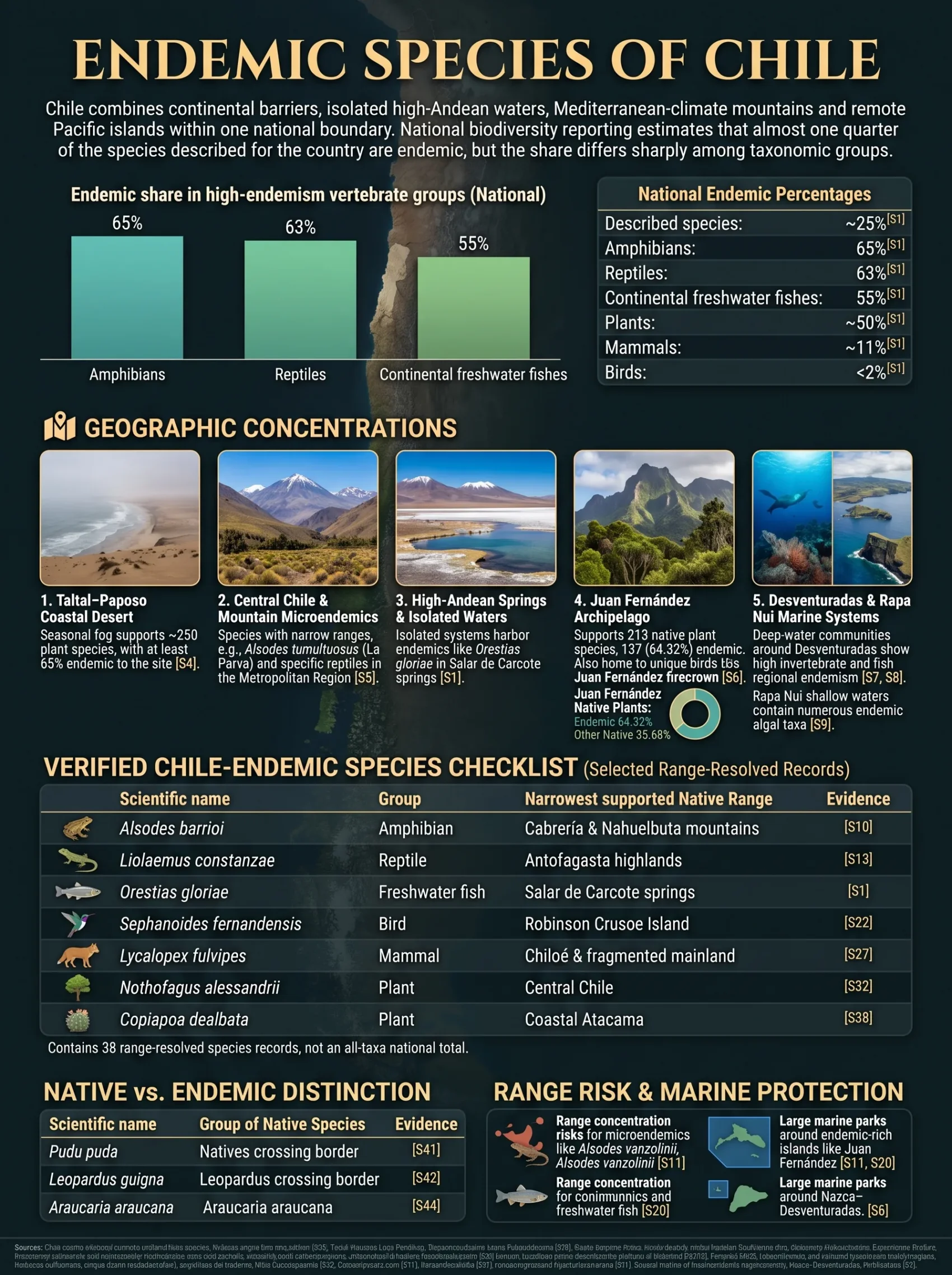
Chile combines continental barriers, isolated high-Andean waters, Mediterranean-climate mountains and remote Pacific islands within one national boundary. National biodiversity reporting estimates that almost one quarter of the species described for the country are endemic, but the share differs sharply among taxonomic groups.[S1]
| Measure | Value |
|---|---|
| Described species endemic | Almost 25% [S1] |
| Amphibian species endemic | 65% [S1] |
| Reptile species endemic | 63% [S1] |
| Continental freshwater fish species endemic | 55% [S1] |
| Plant species endemic | About 50% [S1] |
| Mammal species endemic | About 11% [S1] |
| Bird species endemic | Less than 2% [S1] |
The national percentages describe different biological groups. They are not additive, and they should not be combined with IUCN country tables, island inventories or regional datasets to manufacture a single all-taxa endemic-species total.
{
  "type": "bar",
  "title": "Endemic share in three high-endemism vertebrate groups",
  "description": "National shares reported for Chile from one national biodiversity source.",
  "unit": "percent",
  "orientation": "horizontal",
  "data": [
    {"label": "Amphibians", "value": 65},
    {"label": "Reptiles", "value": 63},
    {"label": "Continental freshwater fishes", "value": 55}
  ],
  "source": "[S1] Ministerio del Medio Ambiente de Chile"
}
Country-endemic vertebrates in the IUCN data
IUCN defines the country-endemic figures in its summary tables as species naturally occurring in only one country and limits the table to groups with more than 80% assessment coverage.[S2] The current Red List release is 2026-1; the Chile counts below come from Table 8a in release 2025-2 and should be read as versioned 2025-2 values, not as 2026-1 counts.[S3]
| Group | Country-endemic species | Threatened endemics | EX/EW endemics |
|---|---|---|---|
| Mammals | 17 [S3] | 4 [S3] | 0 [S3] |
| Birds | 10 [S3] | 4 [S3] | 0 [S3] |
| Reptiles | 74 [S3] | 24 [S3] | 0 [S3] |
| Amphibians | 41 [S3] | 30 [S3] | 0 [S3] |
{
  "type": "bar",
  "title": "Country-endemic and threatened-endemic vertebrates",
  "description": "Both series use the same IUCN country table and release.",
  "unit": "species",
  "orientation": "horizontal",
  "categories": [
    "Mammals",
    "Birds",
    "Reptiles",
    "Amphibians"
  ],
  "series": [
    {
      "name": "Country-endemic",
      "values": [17, 10, 74, 41]
    },
    {
      "name": "Threatened endemic",
      "values": [4, 4, 24, 30]
    }
  ],
  "source": "[S3] IUCN Red List Table 8a, 2025-2"
}
Endemism is concentrated in different geographic systems
Chile does not have one uniform center of endemism. Narrow ranges occur in coastal desert vegetation, isolated Andean waters, central-Chilean mountains, temperate forests and oceanic islands. The biological mechanisms differ among those systems, so regional figures need their own scope.
Taltal–Paposo coastal desert
Along the Taltal–Paposo coast, seasonal fog supplies moisture to vegetation embedded in the hyper-arid Atacama margin. The official Costa de Paposo 1 profile estimates about 250 plant species in the coastal desert flora and reports that at least 65% are endemic.[S4] This is a site-level flora estimate, not a national plant percentage.
Central Chile and mountain microendemics
Central Chile contains species whose natural distributions are much smaller than the country itself. The Metropolitan Region biodiversity service identifies Alsodes tumultuosus as endemic to La Parva and lists the reptiles Pristidactylus volcanensis, Liolaemus moradoensis and Liolaemus frassinetti as regional endemics.[S5] Mountain blocks and separated high-elevation habitats can therefore contain Chile-endemic species with ranges measured at a subregional scale.
High-Andean springs and isolated inland waters
Freshwater isolation is visible in northern Chile. The national biodiversity profile gives Orestias gloriae as an example restricted to springs associated with Salar de Carcote at roughly 3,000 m elevation.[S1] Small spring systems and internally drained basins can hold entire native ranges, which helps explain why the national endemic share is high among continental freshwater fishes.
Juan Fernández Archipelago
CONAF reports 213 native plant species and 137 endemic plant species in Juan Fernández, equivalent to 64.32% endemism in the native plant inventory.[S6] The archipelago also supports island-restricted vertebrates including the Juan Fernández firecrown (Sephanoides fernandensis), Juan Fernández tit-tyrant (Anairetes fernandezianus) and Masafuera rayadito (Aphrastura masafuerae).
| Juan Fernández plant measure | Value |
|---|---|
| Native plant species | 213 [S6] |
| Endemic plant species | 137 [S6] |
| Endemic share of native plant species | 64.32% [S6] |
{
  "type": "donut",
  "title": "Native plant flora of Juan Fernández by endemic status",
  "description": "The endemic count is a subset of 213 native plant species; 76 are other native species.",
  "unit": "species",
  "data": [
    {"label": "Endemic", "value": 137},
    {"label": "Other native", "value": 76}
  ],
  "source": "[S6] CONAF — Parque Nacional Archipiélago Juan Fernández"
}
Desventuradas and oceanic marine endemism
Marine endemism around the Desventuradas depends on depth and the biological assemblage being measured. SIMBIO reports that 41% of fishes and 46% of invertebrates in the deep-water communities of Nazca–Desventuradas are regional endemics.[S7] A 2026 Ministry of the Environment account uses a broader island-fish context and reports 72% endemism for the Nazca–Desventuradas fish fauna.[S8] The figures describe different scopes and should remain separate.
Rapa Nui and Sala y Gómez
The shallow marine biota around Rapa Nui and Sala y Gómez forms another isolated Pacific system. An official protected-area inventory records 144 benthic algal taxa and 14 endemic Rhodophyta species in the shallow flora associated with Easter Island waters.[S9] The two numbers should not be converted into an endemic percentage because the inventory total is reported as taxa while the endemic red-algal figure is reported as species.
Verified Chile-endemic species with range-resolved records
| Scientific name | Group | Narrowest supported native range | Evidence |
|---|---|---|---|
| Alsodes barrioi | Amphibian | Cabrería and the Nahuelbuta mountain system | [S10] |
| Alsodes vanzolinii | Amphibian | Nahuelbuta, western and maritime slope | [S11] |
| Telmatobius halli | Amphibian | High-Andean spring systems around Ollagüe | [S12] |
| Alsodes tumultuosus | Amphibian | La Parva, central Andes | [S5] |
| Telmatobufo venustus | Amphibian | Altos de Vilches, Cordillera de Chillán and Ralco | [S1] |
| Liolaemus constanzae | Reptile | Antofagasta highlands, including San Pedro de Atacama–Peine–Toconao sector | [S13] |
| Liolaemus atacamensis | Reptile | Atacama and Coquimbo regions | [S14] |
| Liolaemus bellii | Reptile | High elevations of Valparaíso and the Metropolitan Region | [S15] |
| Liolaemus nitidus | Reptile | North-central to central Chile, from Atacama south to Biobío | [S16] |
| Liolaemus villaricensis | Reptile | Andean Araucanía | [S17] |
| Phymaturus maulense | Reptile | Andean Maule | [S18] |
| Pristidactylus volcanensis | Reptile | Metropolitan Region mountain habitats | [S5] |
| Liolaemus moradoensis | Reptile | Metropolitan Region mountain habitats | [S5] |
| Liolaemus frassinetti | Reptile | Metropolitan Region mountain habitats | [S5] |
| Orestias gloriae | Freshwater fish | Springs associated with Salar de Carcote | [S1] |
| Percilia irwini | Freshwater fish | Biobío drainage and associated water bodies | [S19] |
| Percilia gillissi | Freshwater fish | Aconcagua basin south to Lake Llanquihue | [S20] |
| Basilichthys microlepidotus | Freshwater fish | Huasco–Elqui–Aconcagua river systems of north-central Chile | [S21] |
| Sephanoides fernandensis | Bird | Robinson Crusoe Island | [S22] |
| Aphrastura masafuerae | Bird | Alejandro Selkirk Island | [S23] |
| Anairetes fernandezianus | Bird | Juan Fernández Archipelago | [S6] |
| Scelorchilus albicollis | Bird | North-central and central Chile | [S24] |
| Pteroptochos megapodius | Bird | North-central and central Chile | [S25] |
| Nothoprocta perdicaria | Bird | Mainland Chile | [S26] |
| Lycalopex fulvipes | Mammal | Chiloé and fragmented mainland populations in south-central Chile | [S27] |
| Cephalorhynchus eutropia | Mammal | Chilean coastal waters from Concón south to Isla Navarino | [S28] |
| Arctocephalus philippii | Mammal | Juan Fernández and Desventuradas archipelagos | [S29] |
| Chinchilla lanigera | Mammal | North-central Chile | [S30] |
| Chelemys megalonyx | Mammal | Central Chile coastal and adjacent inland habitats | [S31] |
| Nothofagus alessandrii | Plant | Central Chile | [S32] |
| Gomortega keule | Plant | Central and south-central Chile | [S33] |
| Jubaea chilensis | Plant | Central Chile | [S34] |
| Avellanita bustillosii | Plant | Central Chile | [S35] |
| Nothomyrcia fernandeziana | Plant | Robinson Crusoe Island, Juan Fernández | [S36] |
| Juania australis | Plant | Robinson Crusoe Island, Juan Fernández | [S37] |
| Copiapoa dealbata | Plant | Coastal Atacama around Totoral Bajo–Llanos de Challe | [S38] |
| Miqueliopuntia miquelii | Plant | Atacama and Coquimbo, Copiapó to south of La Serena | [S39] |
| Dysopsis hirsuta | Plant | Robinson Crusoe Island, Juan Fernández | [S40] |
Species in the table are counted at species rank only. Narrower endemic subspecies, varieties and populations are not treated as separate species records. The table contains 38 range-resolved species records and does not substitute for the larger national endemic biota.
Native to Chile is not the same as Chile-endemic
Several species closely associated with Chile cross the international boundary in their natural range. Those species remain native to Chile but do not meet a Chile-only endemic definition.
| Species | Common name | Natural native range | Evidence |
|---|---|---|---|
| Pudu puda | Southern pudu | Chile and Argentina | [S41] |
| Leopardus guigna | Kodkod / güiña | Chile and Argentina | [S42] |
| Dromiciops gliroides | Monito del monte | Chile and Argentina | [S43] |
| Araucaria araucana | Monkey puzzle tree | South-central Chile and Argentina | [S44] |
Range concentration changes exposure
For a microendemic, a local disturbance can overlap a large part of the global range. The official account for Alsodes barrioi reports a distribution estimate of about 30.36 km² after excluding a suspected misidentification, while Alsodes vanzolinii is reported from an area of about 9 km².[S10] [S11] These are species-level range estimates, not national amphibian measures.
Freshwater endemics face a similar geographic constraint when their distribution is tied to a basin or short river system. The Chilean accounts for Percilia gillissi and Basilichthys microlepidotus identify habitat degradation, altered water conditions and introduced species among documented pressures.[S20] [S21] In Juan Fernández, the terrestrial-bird recovery plan records pressures from introduced plants and mammals, fire and habitat degradation within small island populations.[S45]
Marine protection around endemic-rich islands
In 2026, Chile approved the Juan Fernández II and Nazca–Desventuradas II marine parks, covering 193,998 km² and 143,323 km² respectively. The same official account reports fish endemism of 87% for Juan Fernández and 72% for Nazca–Desventuradas.[S8] These island-fish figures describe marine faunas and should not be merged with the terrestrial national percentages or the IUCN country-endemic vertebrate counts.
Sources
[S1] ↩ Ministerio del Medio Ambiente de Chile — Biodiversidad y estado de salud de ecosistemas y especies. National biodiversity profile used for country-level endemic shares and selected range examples.
[S2] ↩ IUCN Red List — Summary Statistics. Current Red List release and definitions for country-endemic summary tables.
[S3] ↩ IUCN Red List — Table 8a, version 2025-2. Country-endemic and threatened-endemic counts for selected vertebrate groups.
[S4] ↩ SIMBIO — Costa de Paposo 1. Official biodiversity profile for the Taltal–Paposo coastal desert priority site.
[S5] ↩ Ministerio del Medio Ambiente, Región Metropolitana — Especies en la RM. Regional species profile used for central-Chile microendemics.
[S6] ↩ CONAF — Parque Nacional Archipiélago Juan Fernández. Official park profile used for native and endemic plant counts and island fauna.
[S7] ↩ SIMBIO — Parque Nacional Nazca-Desventuradas. Official marine protected-area profile used for deep-zone regional endemism figures.
[S8] ↩ Ministerio del Medio Ambiente — Chile supera el 50% de protección de su océano. Official 2026 marine-protection announcement with island fish-endemism figures and park areas.
[S9] ↩ SIMBIO — Santuario de la Naturaleza Isla de Sala y Gómez e islotes adyacentes a la Isla de Pascua. Official profile used for the Rapa Nui–Sala y Gómez shallow benthic-algae inventory.
[S10] ↩ SIMBIO — Alsodes barrioi. Official Chilean species account.
[S11] ↩ SIMBIO — Alsodes vanzolinii. Official Chilean species account.
[S12] ↩ SIMBIO — Telmatobius halli. Official Chilean species account.
[S13] ↩ SIMBIO — Liolaemus constanzae. Official Chilean species account.
[S14] ↩ SIMBIO — Liolaemus atacamensis. Official Chilean species account.
[S15] ↩ SIMBIO — Liolaemus bellii. Official Chilean species account.
[S16] ↩ SIMBIO — Liolaemus nitidus. Official Chilean species account.
[S17] ↩ SIMBIO — Liolaemus villaricensis. Official Chilean species account.
[S18] ↩ SIMBIO — Phymaturus maulense. Official Chilean species account.
[S19] ↩ SIMBIO — Percilia irwini. Official Chilean species account.
[S20] ↩ SIMBIO — Percilia gillissi. Official Chilean species account.
[S21] ↩ SIMBIO — Basilichthys microlepidotus. Official Chilean species account.
[S22] ↩ SIMBIO — Sephanoides fernandensis. Official Chilean species account.
[S23] ↩ SIMBIO — Aphrastura masafuerae. Official Chilean species account.
[S24] ↩ SIMBIO — Scelorchilus albicollis. Official Chilean species account.
[S25] ↩ SIMBIO — Pteroptochos megapodius. Official Chilean species account.
[S26] ↩ SIMBIO — Nothoprocta perdicaria. Official Chilean species account.
[S27] ↩ SIMBIO — Lycalopex fulvipes. Official Chilean species account.
[S28] ↩ SIMBIO — Cephalorhynchus eutropia. Official Chilean species account.
[S29] ↩ SIMBIO — Arctocephalus philippii. Official Chilean species account.
[S30] ↩ SIMBIO — Chinchilla lanigera. Official Chilean species account.
[S31] ↩ SIMBIO — Chelemys megalonyx. Official Chilean species account.
[S32] ↩ Royal Botanic Gardens, Kew — Plants of the World Online: Nothofagus alessandrii. Accepted name and native range.
[S33] ↩ Royal Botanic Gardens, Kew — Plants of the World Online: Gomortega keule. Accepted name and native range.
[S34] ↩ Royal Botanic Gardens, Kew — Plants of the World Online: Jubaea chilensis. Accepted name and native range.
[S35] ↩ Royal Botanic Gardens, Kew — Plants of the World Online: Avellanita bustillosii. Accepted name and native range.
[S36] ↩ Royal Botanic Gardens, Kew — Plants of the World Online: Nothomyrcia fernandeziana. Accepted name and native range.
[S37] ↩ Royal Botanic Gardens, Kew — Plants of the World Online: Juania australis. Accepted name and native range.
[S38] ↩ SIMBIO — Copiapoa dealbata. Official Chilean species account.
[S39] ↩ SIMBIO — Miqueliopuntia miquelii. Official Chilean species account.
[S40] ↩ SIMBIO — Dysopsis hirsuta. Official Chilean species account.
[S41] ↩ SIMBIO — Pudu puda. Official Chilean species account showing a native range shared with Argentina.
[S42] ↩ SIMBIO — Leopardus guigna. Official Chilean species account showing a native range shared with Argentina.
[S43] ↩ SIMBIO — Dromiciops gliroides. Official Chilean species account showing a native range shared with Argentina.
[S44] ↩ Royal Botanic Gardens, Kew — Plants of the World Online: Araucaria araucana. Accepted name and native range extending from south-central Chile into Argentina.
[S45] ↩ SIMBIO — Plan RECOGE Aves terrestres de Juan Fernández. Official recovery-plan profile for Juan Fernández terrestrial birds and their documented pressures.