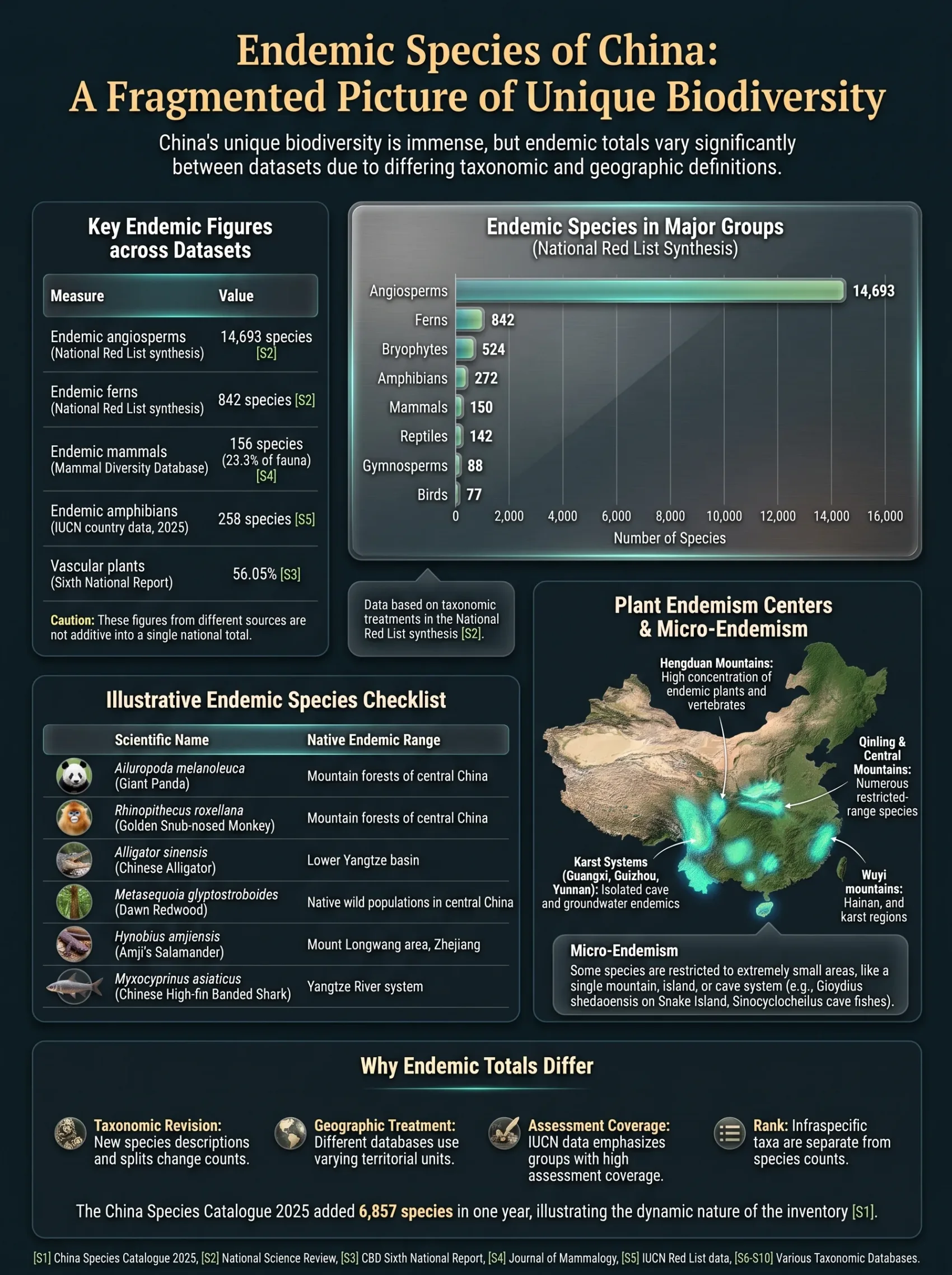
China supports thousands of species whose natural ranges are confined to the country, but no single current dataset provides a defensible all-taxa endemic-species total. National inventories, Red List datasets and specialist taxonomic databases use different scopes and taxonomic treatments, so their figures are presented separately rather than added together.
| Measure | Value |
|---|---|
| Species recorded in the China Species Catalogue, 2025 | 148,341 species [S1] |
| Animal species in the 2025 national catalogue | 74,401 species [S1] |
| Plant species in the 2025 national catalogue | 40,355 species [S1] |
| Vascular plant species in the 2025 national catalogue | 36,504 species [S1] |
| Endemic angiosperms in the national Red List synthesis | 14,693 species [S2] |
| Endemic ferns in the national Red List synthesis | 842 species [S2] |
| Endemic bryophytes in the national Red List synthesis | 524 species [S2] |
| Endemic gymnosperms in the national Red List synthesis | 88 species [S2] |
| Vascular plants reported as endemic in the Sixth National Report | 56.05% [S3] |
| Endemic mammals in Mammal Diversity Database-based country data | 156 species [S4] |
| Endemic share of China’s mammals in the same mammal dataset | 23.3% [S4] |
| Endemic amphibians in IUCN country data, 2025 | 258 species [S5] |
The figures above are not components of one national total. The China Species Catalogue measures recorded taxonomic diversity, while the endemic counts come from datasets with different taxonomic coverage, dates and species concepts. The national Red List synthesis, Mammal Diversity Database and IUCN country tables should therefore be read as separate quantitative views of endemism.
Endemism across major taxonomic groups
Plant endemism accounts for a large share of China’s documented endemic biota. A synthesis comparing China’s national Red List with global assessments reported 14,693 endemic angiosperms, 842 endemic ferns, 524 endemic bryophytes and 88 endemic gymnosperms in the national dataset. The same synthesis listed 272 endemic amphibians, 150 endemic mammals, 142 endemic reptiles and 77 endemic birds under the taxonomic treatments used by those assessments. [S2]
Those vertebrate values should not be treated as fixed modern totals. Taxonomic splitting, newly described species and revised range information continue to change country-endemic counts. Mammal Diversity Database-based work published in 2025, for example, recognized 671 mammal species occurring in China and classified 156 of them as country endemics, equivalent to 23.3% of the mammal fauna in that treatment. [S4]
{
  "type": "bar",
  "title": "Endemic species in major groups in China's national Red List synthesis",
  "description": "Species-level endemic counts reported for taxonomic groups evaluated in the national Red List synthesis. These values belong to the same published comparison but reflect its taxonomy and assessment period.",
  "unit": "species",
  "orientation": "horizontal",
  "data": [
    {"label": "Angiosperms", "value": 14693},
    {"label": "Ferns", "value": 842},
    {"label": "Bryophytes", "value": 524},
    {"label": "Amphibians", "value": 272},
    {"label": "Mammals", "value": 150},
    {"label": "Reptiles", "value": 142},
    {"label": "Gymnosperms", "value": 88},
    {"label": "Birds", "value": 77}
  ],
  "source": "[S2] National Red List synthesis reported in National Science Review"
}
IUCN’s 2025 country table gives 258 endemic amphibian species for China among the comprehensively assessed vertebrate groups covered by that dataset. [S5] The difference from older national estimates illustrates why endemic totals should retain their dataset and taxonomic context.
Plant endemism and floristic centers
China’s Sixth National Report to the Convention on Biological Diversity reported that 56.05% of the country’s vascular plants were endemic under the floristic treatment used for the report. It also identified three concentrations of endemic plant genera: the East Sichuan–West Hubei center, the West Sichuan–Northwest Yunnan center and the Southeastern Yunnan–West Guangxi center. [S3]
These regions combine steep elevational gradients, isolated mountain systems and long-term habitat continuity. Endemic plants are therefore unevenly distributed across China rather than forming a uniform national pattern. Taxonomic verification is particularly important for plants because species, subspecies and varieties are not interchangeable units, and historical floras may use names that have since been synonymized.
Mountain and regional concentration
Mountain systems in central, southwestern and southern China contain major concentrations of restricted-range species. The Hengduan Mountains and adjacent western Sichuan and northwestern Yunnan support numerous endemic plants, amphibians, mammals and freshwater taxa, while the Qinling, Minshan, Daba and Wuyi mountains contain additional concentrations of narrow-range species. Hainan and isolated karst systems of Guangxi, Guizhou and Yunnan add different forms of geographic isolation.
The Sixth National Report identifies the Hengduan Mountains, Gaoligong Mountains, southeastern Tibet, Xishuangbanna, Qinling, Daba, Minshan and Qionglai mountain systems among areas of high terrestrial species richness. [S3] Endemism is often even more geographically restricted than general species richness because individual species may be confined to one mountain chain, lake, cave system or river basin.
Verified endemic species reference checklist
The table below is a species-rank reference subset rather than a claim to list every endemic species in China. China’s endemic biota is too large and taxonomically dynamic for a single mixed-taxon table to function as an exhaustive national checklist. The records emphasize species with well-defined Chinese native ranges across mammals, birds, reptiles, amphibians, freshwater fishes and plants.
Mammals
Mammal nomenclature and country-level distributions are aligned with current Mammal Diversity Database-based treatment, which recognizes 156 mammals occurring naturally in only one country for China. [S4]
| Scientific name | Native endemic range |
|---|---|
| Ailuropoda melanoleuca | Mountain forests of central China |
| Felis bieti | Tibetan Plateau and adjacent western China |
| Rhinopithecus roxellana | Mountain forests of central China |
| Rhinopithecus bieti | Northwestern Yunnan and southeastern Tibet |
| Rhinopithecus brelichi | Fanjing Mountains, Guizhou |
| Procapra przewalskii | Qinghai Lake region |
| Cervus albirostris | Tibetan Plateau and adjoining Chinese mountains |
| Ochotona iliensis | Tianshan Mountains, Xinjiang |
| Moschus anhuiensis | Dabie Mountains of eastern China |
| Myospalax fontanierii | Northern and north-central China |
Birds
Bird names require an explicit taxonomic reference because species limits continue to change. BirdLife maintains an annually updated global checklist and associated distribution datasets used in Red List work. [S6]
| Scientific name | Native endemic range |
|---|---|
| Arborophila ardens | Hainan |
| Arborophila rufipectus | Central Sichuan |
| Arborophila gingica | Southeastern China |
| Alectoris magna | North-central China and northeastern Tibetan Plateau |
| Lophophorus lhuysii | High mountains of central China |
| Tragopan caboti | Montane forests of southeastern China |
| Syrmaticus ellioti | Southeastern China |
| Syrmaticus reevesii | Central and eastern China |
| Chrysolophus pictus | Central China; introduced populations elsewhere do not alter native endemism |
| Crossoptilon auritum | Mountain regions of central China |
| Crossoptilon mantchuricum | North-central China |
| Certhia tianquanensis | Mountain forests of Sichuan |
| Liocichla omeiensis | Mountain forests of Sichuan |
| Phoenicurus alaschanicus | Mountain systems of north-central China |
Reptiles
Reptile names and distributions are checked against the current Reptile Database, whose online taxonomy was updated in 2026. [S7]
| Scientific name | Native endemic range |
|---|---|
| Alligator sinensis | Lower Yangtze basin |
| Cuora aurocapitata | Anhui |
| Cuora mccordi | Guangxi |
| Cuora pani | Central China |
| Cuora yunnanensis | Yunnan |
| Gloydius shedaoensis | Snake Island, Liaoning |
| Diploderma flaviceps | Western and central China |
| Achalinus jinggangensis | Jinggang Mountains, Jiangxi |
| Pelodiscus axenaria | Central China |
Amphibians
Amphibians are especially dynamic taxonomically. AmphibiaChina, maintained by the Kunming Institute of Zoology of the Chinese Academy of Sciences, listed 759 amphibian species for China in July 2026 and provides current national taxonomic and distribution treatments. [S8]
| Scientific name | Native endemic range |
|---|---|
| Hynobius amjiensis | Mount Longwang area, Zhejiang |
| Echinotriton chinhaiensis | Ningbo region, Zhejiang |
| Tylototriton hainanensis | Hainan |
| Tylototriton wenxianensis | Central China |
| Tylototriton kweichowensis | Guizhou and adjacent southwestern China |
| Batrachuperus pinchonii | Mountain streams of central China |
| Batrachuperus yenyuanensis | Southwestern Sichuan |
| Pachyhynobius shangchengensis | Dabie Mountains |
| Liua shihi | Central Chinese mountain systems |
| Bombina fortinuptialis | Central China |
Freshwater fishes
China’s isolated lakes, karst groundwater systems and large river basins support many fishes with narrow native ranges. Current fish nomenclature can change rapidly, especially within species-rich cave-fish radiations; Eschmeyer’s Catalog of Fishes provides current accepted-name treatment and distribution records for these taxa. [S9]
| Scientific name | Native endemic range | Range context |
|---|---|---|
| Myxocyprinus asiaticus | Yangtze River system | River-basin endemic |
| Acipenser dabryanus | Yangtze River system | River-basin endemic |
| Psephurus gladius | Yangtze River system | Extinct |
| Gymnocypris przewalskii | Qinghai Lake basin | Lake-basin endemic |
| Sinocyclocheilus grahami | Dianchi basin, Yunnan | Restricted freshwater endemic |
| Sinocyclocheilus rhinocerous | Yunnan | Karst-water endemic |
| Sinocyclocheilus anophthalmus | Yunnan karst systems | Cave-associated endemic |
| Leptobotia elongata | Upper and middle Yangtze system | River-basin endemic |
| Coreius heterodon | Yangtze River system | River-basin endemic |
Plants
Plant names require accepted-name and native-range verification because cultivated occurrences outside China do not expand a species’ natural range. Plants of the World Online provides current nomenclatural and distribution treatments used here as the plant taxonomic reference. [S10]
| Scientific name | Native endemic range |
|---|---|
| Metasequoia glyptostroboides | Native wild populations in central China |
| Cathaya argyrophylla | Mountain forests of southern China |
| Pseudolarix amabilis | Eastern and southeastern China |
| Davidia involucrata | Montane forests of central and southwestern China |
| Abies beshanzuensis | Baishanzu, Zhejiang |
| Abies fanjingshanensis | Fanjing Mountains, Guizhou |
| Abies ziyuanensis | Mountain areas of Guangxi, Hunan and adjacent regions |
| Pinus squamata | Northeastern Yunnan |
| Picea neoveitchii | Scattered mountain localities in central China |
| Heptacodium miconioides | Eastern China |
| Kingdonia uniflora | High mountains of central and western China |
| Taihangia rupestris | Taihang Mountains |
| Sinowilsonia henryi | Central China |
| Dipteronia sinensis | Central and southwestern China |
| Camellia azalea | Guangdong |
Micro-endemism in lakes, caves and mountains
Some Chinese endemics occupy geographic units far smaller than the country itself. Gloydius shedaoensis is restricted to Snake Island off Liaoning; Abies beshanzuensis is associated with Baishanzu in Zhejiang; Ochotona iliensis is confined to parts of the Tianshan Mountains; and several Sinocyclocheilus fishes occur in individual karst drainage or cave systems.
Such species illustrate nested endemism: a species restricted to one Chinese mountain, island, cave or lake basin is also endemic at the national scale, provided its natural native range does not extend beyond China. Introduced populations, botanical cultivation and conservation translocations do not change that native-range definition.
Why China’s endemic totals differ between datasets
Taxonomic revision: Newly described species and species splits can increase an endemic count even when no biological range has changed.
Geographic treatment: International databases do not always use the same territorial units as Chinese national inventories. Figures from different geographic coding systems should not be combined without checking their boundaries.
Assessment coverage: IUCN country summary tables emphasize groups with high assessment coverage; they are not an inventory of every endemic plant, animal, fungus and microorganism.
Rank: Species, subspecies, varieties and other infraspecific taxa must remain separate. The 2025 China Species Catalogue, for example, records 148,341 species and another 14,376 infraspecific units rather than treating all 162,717 entries as species. [S1]
The 2025 national catalogue also shows how quickly the documented inventory is expanding. It added 6,857 species compared with the 2024 edition, including 4,994 animal species, 458 plant species and 1,405 fungal species. [S1] Changes of this scale make a permanently fixed all-taxa endemic number scientifically unreliable unless the number is tied to a specific dataset release.
Sources
[S1] ↩ Chinese Academy of Sciences — China Species Catalogue 2025 release. National catalogue totals and annual additions.
[S2] ↩ National Science Review — Applied biodiversity science in China in the global context. Comparative national and global Red List species, endemic and threatened-species statistics.
[S3] ↩ Convention on Biological Diversity — China’s Sixth National Report. Vascular-plant endemism and geographic patterns of biodiversity.
[S4] ↩ Journal of Mammalogy — How many mammal species are there now?. Mammal Diversity Database-based country richness and endemism statistics.
[S5] ↩ IUCN Red List data via Our World in Data — Endemic amphibian species by country, 2025. Processed presentation of IUCN Red List country summary data.
[S6] ↩ BirdLife International DataZone — Taxonomy. Current BirdLife checklist system and taxonomic basis used for global bird assessments and distribution data.
[S7] ↩ The Reptile Database. Current reptile taxonomy and species distribution treatments, 2026 edition.
[S8] ↩ Kunming Institute of Zoology, Chinese Academy of Sciences — AmphibiaChina. Current Chinese amphibian taxonomy and distribution database.
[S9] ↩ California Academy of Sciences — Eschmeyer’s Catalog of Fishes. Current fish nomenclature, validity and distribution records.
[S10] ↩ Royal Botanic Gardens, Kew — Plants of the World Online. Accepted plant names, synonymy and native distributions.