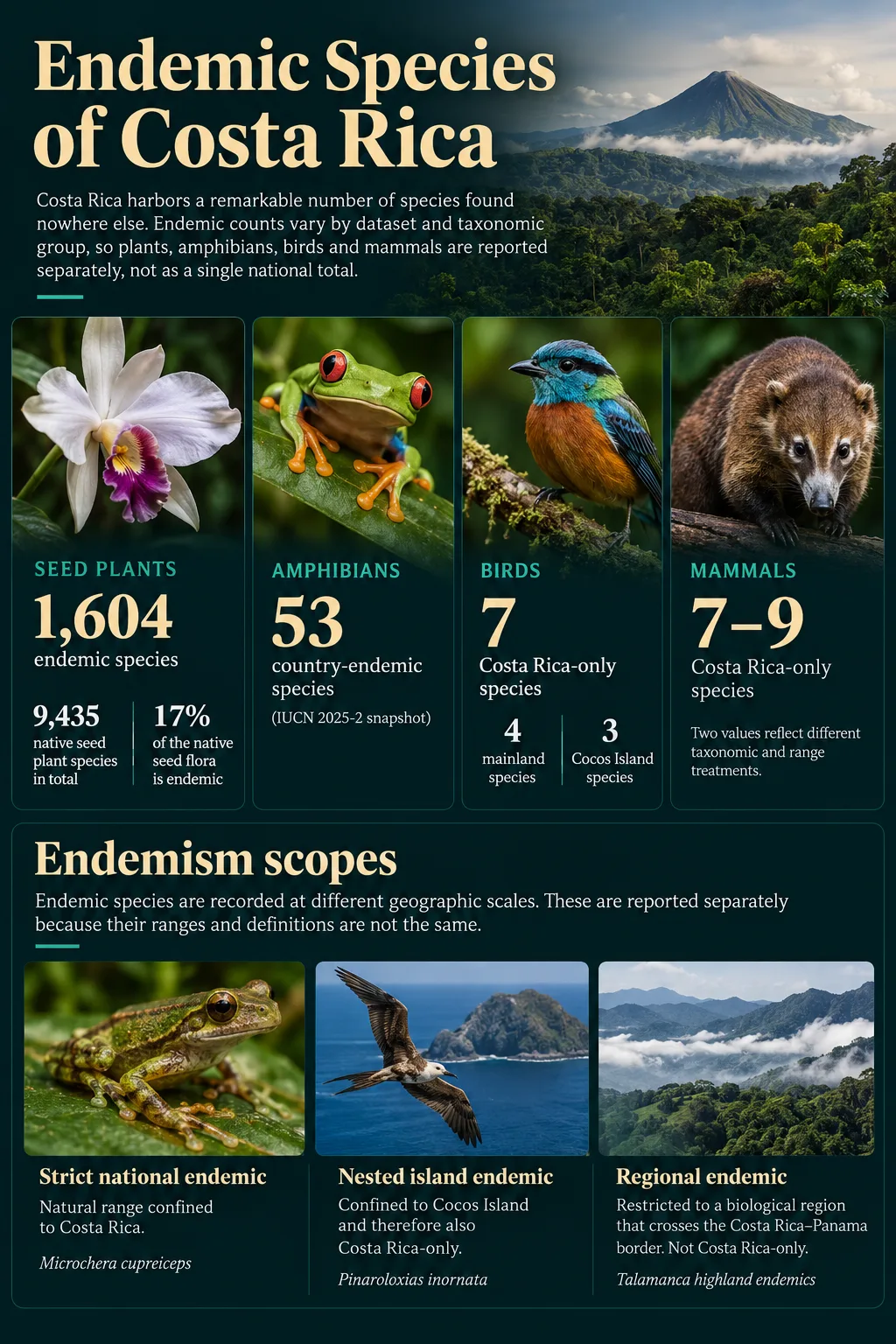
Costa Rica does not have one defensible all-taxa endemic-species total. National datasets differ in taxonomic scope, rank, coverage and range treatment, so strict country endemics, Cocos Island endemics and Costa Rica–western Panama regional endemics are kept as separate records.
| Measure | Value |
|---|---|
| Endemic seed plant species | 1,604 species [S1] |
| Native seed plant species in the same catalogue | 9,435 species [S1] |
| Share of native seed flora endemic | 17% [S1] |
| Families with endemic seed plants | 108 families [S1] |
| Endemic dicotyledon species | 880 species [S1] |
| Endemic monocotyledon species | 722 species [S1] |
| Endemic gymnosperm species | 2 species [S1] |
| Endemic seed plants evaluated under IUCN criteria | 367 species [S1] |
| Seed-plant endemic assessment coverage | 22.8% [S1] |
| Country-endemic amphibian species, IUCN 2025-2 snapshot | 53 species [S2] |
| Strict Costa Rica-only bird species | 7 species [S3] |
| Mainland strict endemic bird species | 4 species [S3] |
| Cocos Island strict endemic bird species | 3 species [S3] |
| Strict Costa Rica-only mammal species, regional-analysis treatment | 7 species [S4] |
| Strict Costa Rica-only mammal species, checklist treatment | 9 species [S5] |
These rows are dataset-specific and are not components of a national sum. The 53-amphibian figure is a 2025-2 IUCN snapshot; the Red List has since moved to release 2026-1. [S6] The two mammal values are alternative taxonomic and range treatments, not additive counts.
National, regional and island endemism are separate records
A species is treated as Costa Rica-endemic when its natural native range is confined to Costa Rican territory. A species restricted to Cocos Island therefore qualifies as a Costa Rica country endemic as well as an island endemic. A species shared naturally between Costa Rica and western Panama is a regional endemic, but it is not Costa Rica-only.
| Endemic scope | How it is treated here | Costa Rican example |
|---|---|---|
| Strict national endemic | Natural range confined to Costa Rica | Microchera cupreiceps |
| Nested island endemic | Confined to Cocos Island and therefore also Costa Rica-only | Pinaroloxias inornata |
| Regional endemic | Restricted to a biological region crossing the Costa Rica–Panama border | Talamanca highland endemics |
The official Costa Rican bird-endemism list illustrates the distinction numerically: it separates four mainland Costa Rica-only species, three Cocos Island-only species and 50 highland regional endemics shared mainly by Costa Rica and western Panama. [S3]
Seed plants: 1,604 country endemics in the 2026 catalogue
The 2026 national catalogue records 1,604 formally published seed plant species endemic to Costa Rica from a native seed flora of 9,435 species. Its underlying database was current to July 2025. The catalogue excludes about 112 additional endemic candidates that were known only to genus or otherwise lacked a resolved, validly published species identity. [S1]
Five families contain most of the named seed-plant endemics in the catalogue. [S1]
| Plant family | Endemic species |
|---|---|
| Orchidaceae | 533 |
| Piperaceae | 219 |
| Araceae | 72 |
| Rubiaceae | 54 |
| Asteraceae | 53 |
{
  "type": "bar",
  "title": "Largest families by endemic seed-plant species",
  "description": "Five plant families with the highest country-endemic species counts in the 2026 catalogue.",
  "unit": "species",
  "orientation": "horizontal",
  "data": [
    {"label": "Orchidaceae", "value": 533},
    {"label": "Piperaceae", "value": 219},
    {"label": "Araceae", "value": 72},
    {"label": "Rubiaceae", "value": 54},
    {"label": "Asteraceae", "value": 53}
  ],
  "source": "[S1] Lobo-Cabezas 2026"
}
The same catalogue shows an uneven conservation-assessment record. Of the 1,604 endemic seed plants, 367 had been evaluated under IUCN criteria, giving 22.8% assessment coverage and leaving 1,237 without an IUCN-criteria evaluation in that catalogue. Of the assessed subset, 73% was classified in threatened categories. Coverage is especially sparse in two of the largest endemic families: 3.2% of endemic Piperaceae and 0.9% of endemic Orchidaceae had been evaluated. [S1]
{
  "type": "donut",
  "title": "IUCN assessment coverage of endemic seed plants",
  "description": "Species evaluated under IUCN criteria versus the remaining endemic seed-plant catalogue.",
  "unit": "species",
  "data": [
    {"label": "Evaluated", "value": 367},
    {"label": "Not evaluated", "value": 1237}
  ],
  "source": "[S1] Lobo-Cabezas 2026"
}
An unevaluated endemic species is not equivalent to a species assessed as non-threatened. The catalogue’s assessment percentages describe coverage of the endemic flora, not a complete national risk classification.
Talamanca: regional endemism across a political border
The Talamanca Range extends across Costa Rica and Panama. Its high peaks, cloud forests, oak forests and páramo form a steep elevational system in which isolated upper zones can hold restricted-range lineages. UNESCO treats La Amistad as a transboundary property, so a Talamanca-restricted species must not automatically be counted as Costa Rica-only. [S7]
Páramo plants show the regional concentration
The Museo Nacional de Costa Rica records 528 vascular plant species in the Talamanca páramos. Thirty-eight are exclusive to the páramo ecosystem of Costa Rica and Panama, while another 86 Costa Rica–Panama endemic species occur in the páramo but also extend below 3,000 m. Together, those two regional sets comprise 124 species, or 23.4% of the recorded páramo flora. [S8]
| Talamanca páramo measure | Value |
|---|---|
| Recorded vascular plant species | 528 |
| Páramo-exclusive Costa Rica–Panama endemics | 38 species (7%) |
| Other Costa Rica–Panama endemics present in páramo | 86 species (16%) |
| Combined regional endemic component | 124 species (23.4%) |
| Approximate páramo area | 152 km² |
Examples in this regional flora include Gentiana bicentenaria, Myrrhidendron chirripoense, Phlegmariurus talamancanus and Polystichum talamancanum. [S8]
A Chirripó salamander with a very narrow known range
Bolitoglossa chirripoensis, described in 2025, is known from the Chirripó National Park páramo at roughly 3,320–3,600 m. Amphibian Species of the World lists it as endemic to Costa Rica and known only from the type locality. [S9] Its recorded distribution provides a species-level example of high-elevation microendemism without converting the wider Talamanca regional flora into a national endemic count.
Amphibian and reptile inventories remain version-sensitive
A 2025 review of Costa Rica’s herpetofauna recognized 221 amphibian species and 257 reptile species. [S10] The IUCN-derived figure of 53 country-endemic amphibians shown in the national table comes from a separate 2025-2 global assessment dataset. Those figures should not be combined to calculate an endemic percentage because the datasets use different purposes, versions and taxonomic treatments.
The description of Bolitoglossa chirripoensis during 2025 also shows why fixed national herpetofauna totals need a version label. New species descriptions, synonymies and revised ranges can change both the national inventory and the subset that qualifies as country-endemic.
The seven strict national bird endemics
The Costa Rican ornithological association’s endemic list defines seven bird species restricted to Costa Rican territory: four on the mainland and three on Cocos Island. [S3] Scientific and English names below follow the official Costa Rica bird list updated in June 2026. [S11]
| Scientific name | English name | Native endemic range |
|---|---|---|
| Microchera cupreiceps | Coppery-headed Emerald | Mainland Costa Rica |
| Chrysuronia boucardi | Mangrove Hummingbird | Mainland Costa Rica |
| Melozone cabanisi | Cabanis’s Ground-Sparrow | Mainland Costa Rica |
| Driophlox atrimaxillaris | Black-cheeked Ant-Tanager | Mainland Costa Rica |
| Coccyzus ferrugineus | Cocos Cuckoo | Cocos Island |
| Nesotriccus ridgwayi | Cocos Tyrannulet | Cocos Island |
| Pinaroloxias inornata | Cocos Finch | Cocos Island |
The current checklist uses Chrysuronia boucardi and Driophlox atrimaxillaris; older endemic-list treatments used Amazilia boucardi and Habia atrimaxillaris. This is a nomenclatural change, not an increase in the number of strict national bird endemics. [S11]
Cocos Island is a nested endemic system
The island’s 2026 bird list records 188 species from Cocos Island and surrounding oceanic waters through May 2026, with three endemic island taxa. [S12]
Cocos Island lies more than 500 km from the continental coast. Its oceanic isolation produces an endemic biota that is geographically nested within Costa Rica’s national endemic set. UNESCO reports about 70 endemic vascular plant species, three endemic bird species, two endemic reptile species and two endemic freshwater fish species for the island. [S13] SINAC separately reports 400 insect species on Cocos, 65 of them endemic, along with five reptile species of which two terrestrial species are endemic. [S14]
| Cocos Island measure | Source-defined value |
|---|---|
| Bird species recorded through May 2026 | 188 [S12] |
| Endemic bird taxa in the 2026 island list | 3 [S12] |
| Endemic vascular plant species | About 70 [S13] |
| Endemic reptile species | 2 [S13] |
| Endemic freshwater fish species | 2 [S13] |
| Endemic insect species | 65 of 400 [S14] |
The two terrestrial endemic reptiles
Cocos freshwater fish counts differ by source
UNESCO’s Cocos Island profile reports two endemic freshwater fish species. [S13] A specialist Costa Rican freshwater-fish checklist uses an endemic designation for three named Cocos Island species. [S17]
| Scientific name | Native endemic range |
|---|---|
| Eleotris tubularis | Cocos Island |
| Gobiesox fulvus | Cocos Island |
| Sicydium cocoense | Cocos Island |
The two source-defined totals are left unreconciled. A specialist taxonomic checklist and a World Heritage property profile do not necessarily share the same date, taxonomic treatment or freshwater boundary.
Mammal endemism changes with taxonomic treatment
A 2023 mammal analysis identified 30 species with ranges restricted to Costa Rica and an adjacent country or to Costa Rica alone: 20 shared with Panama, three shared with Nicaragua and seven restricted to Costa Rica. [S4] A separate 2023 checklist reported nine Costa Rica-endemic mammal species. [S5] The two strict counts therefore remain separate treatments.
| Range category in the 2023 regional analysis | Species |
|---|---|
| Costa Rica and Panama | 20 |
| Costa Rica and Nicaragua | 3 |
| Costa Rica only | 7 |
{
  "type": "bar",
  "title": "Restricted-range mammals by geographic treatment",
  "description": "Species counts in the 2023 regional mammal analysis.",
  "unit": "species",
  "orientation": "horizontal",
  "data": [
    {"label": "Costa Rica and Panama", "value": 20},
    {"label": "Costa Rica and Nicaragua", "value": 3},
    {"label": "Costa Rica only", "value": 7}
  ],
  "source": "[S4] Ramírez-Fernández et al. 2023"
}
Under the seven-species strict treatment, the Costa Rica-only set is dominated by small terrestrial mammals. [S4]
| Scientific name | Order | Endemic scope |
|---|---|---|
| Heterogeomys heterodus | Rodentia | Costa Rica only |
| Heteromys nubicolens | Rodentia | Costa Rica only |
| Heteromys oresterus | Rodentia | Costa Rica only |
| Reithrodontomys cherrii | Rodentia | Costa Rica only |
| Reithrodontomys musseri | Rodentia | Costa Rica only |
| Reithrodontomys rodriguezi | Rodentia | Costa Rica only |
| Cryptotis monteverdensis | Eulipotyphla | Costa Rica only |
Freshwater fish endemism is sensitive to range and species-rank treatment
The updated Costa Rican freshwater-fish checklist published in 2021 recognized 283 species, including 13 exotic species. [S17] Its endemic records are not all interchangeable with a clean list of accepted, named species: one endemic entry is an unresolved Brachyrhaphis species from Isla del Caño rather than a formally named species-rank record. [S17] The paper also documents how new country records, range extensions and taxonomic changes alter the national fish inventory.
For that reason, a freshwater endemic figure from this treatment is kept out of the opening national species table unless the species-rank identities and current ranges can be reconciled under one consistent treatment.
New descriptions can change an endemic catalogue after its data cutoff
Cryptocarya costaricana was described in 2026 from the Guanacaste Cordillera and is known from four localities, at roughly 459–1,000 m with records extending to about 1,500 m. [S18] Its publication postdates the July 2025 data cutoff of the 1,604-species seed-plant catalogue. [S1] It should not simply be added arithmetically to produce a new national total: subsequent catalogue revisions can also synonymize names, revise native ranges or change accepted species limits.
The same version issue appears in the herpetofauna and bird lists. Costa Rica’s endemic inventory is best represented as versioned taxon-specific lists with explicit native-range scope, while regional Talamanca records and nested Cocos Island records remain visible without being collapsed into a synthetic national sum.
Sources
[S1] ↩ Lobo-Cabezas — Richness, diversity, and conservation status of endemic plant species (Spermatophyta) in Costa Rica. UNED Research Journal, 2026; catalogue data current to July 2025.
[S2] ↩ Our World in Data / IUCN — Endemic amphibian species. Country-endemic amphibian count adapted from IUCN Red List Summary Statistics 2025-2.
[S3] ↩ Asociación Ornitológica de Costa Rica — Lista Oficial de Aves Endémicas para Costa Rica y la Región. Separates Costa Rica-only mainland, Cocos Island and Costa Rica–western Panama regional endemics.
[S4] ↩ Ramírez-Fernández et al. — Revised checklist and conservation status of the mammals of Costa Rica. THERYA, 2023; includes strict and regional endemic-range treatments.
[S5] ↩ Mora & Ruedas — Updated list of the mammals of Costa Rica, with notes on recent taxonomic changes. Zootaxa, 2023; reports an alternative strict endemic count.
[S6] ↩ IUCN Red List — What’s New. Red List release information, including version 2026-1.
[S7] ↩ UNESCO World Heritage Centre — Talamanca Range-La Amistad Reserves / La Amistad National Park. Transboundary mountain geography and biological context.
[S8] ↩ Museo Nacional de Costa Rica — Biodiversidad en Páramos de Talamanca: Plantas. Vascular-plant richness and Costa Rica–Panama regional endemism in the páramo.
[S9] ↩ Amphibian Species of the World — Bolitoglossa chirripoensis. Species account, accepted name and known distribution.
[S10] ↩ Sasa, Arias & Chaves — Annotated list of amphibians and reptiles of Costa Rica: The role of the Museum of Zoology in cataloging the country’s herpetological diversity. Revista de Biología Tropical, 2025.
[S11] ↩ Asociación Ornitológica de Costa Rica — Lista Oficial de las Aves de Costa Rica 2025-2026. Online list updated June 2026; used for current bird nomenclature and English names.
[S12] ↩ Arias et al. — Lista de las Aves de la Isla del Coco, Actualización 2026. Cocos Island bird inventory through May 2026.
[S13] ↩ UNESCO World Heritage Centre — Cocos Island National Park. Island geography and source-defined endemic plant, bird, reptile and freshwater-fish figures.
[S14] ↩ SINAC — Cocos Marine Conservation Area. Cocos Island biological inventory, including insect and reptile endemism.
[S15] ↩ The Reptile Database — Anolis townsendi. Accepted species account and Cocos Island distribution.
[S16] ↩ The Reptile Database — Sphaerodactylus pacificus. Accepted species account and Cocos Island distribution.
[S17] ↩ Angulo — New records and range extensions to the Costa Rican freshwater fish fauna, with an updated checklist. Zootaxa, 2021.
[S18] ↩ de Moraes & Zamora — Cryptocarya costaricana (Lauraceae), a new species from Mesoamerica. Kew Bulletin, 2026; species description and known range.