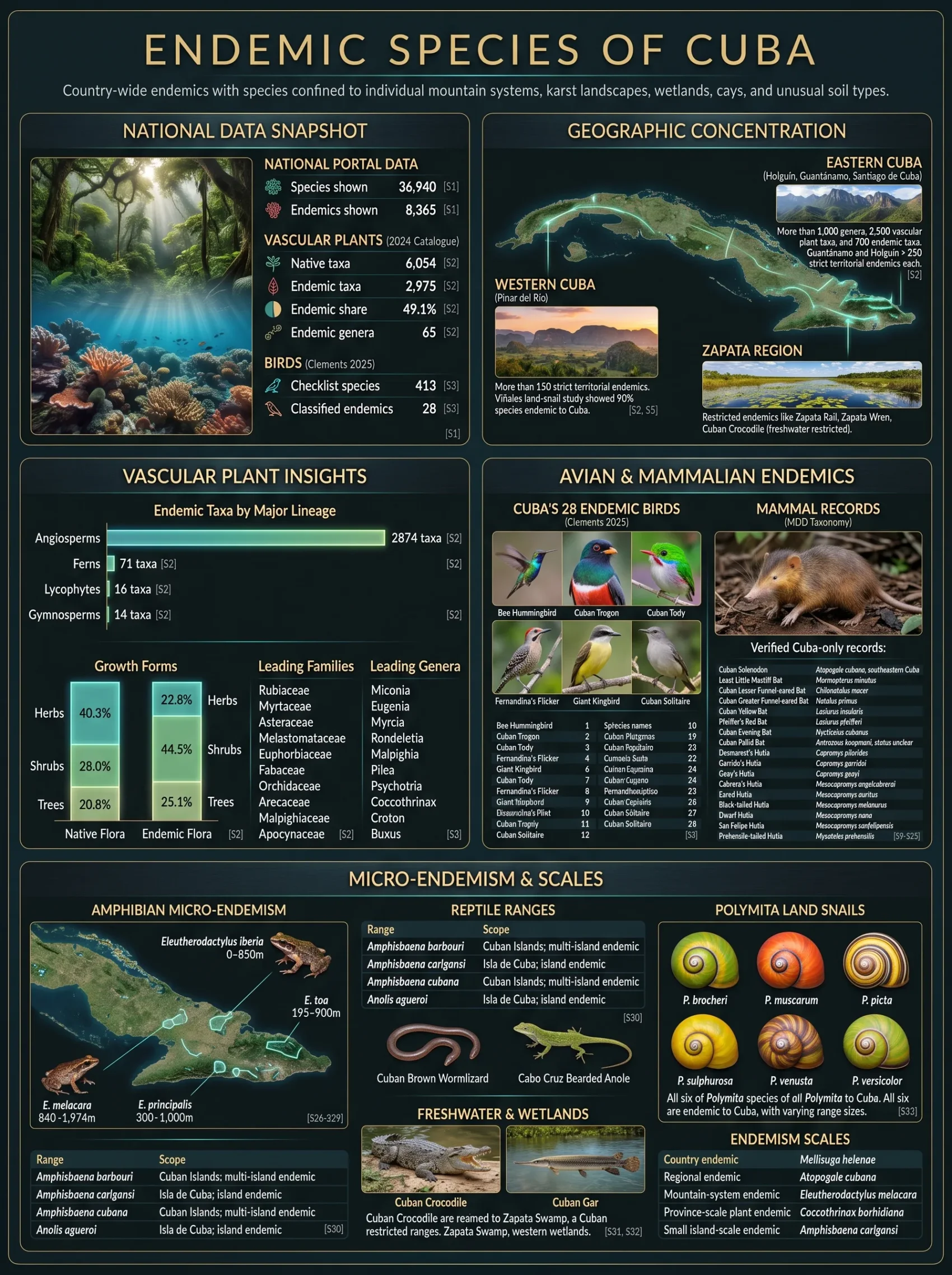
Cuba combines country-wide endemics with species confined to individual mountain systems, karst landscapes, wetlands, cays, and unusual soil types. The strongest national datasets use different taxonomic units, so species counts, vascular-plant taxa, database counters, and checklist-defined endemics need to remain separate.
| Measure | Value |
|---|---|
| Species shown in national biodiversity portal | 36,940 species [S1] |
| Endemics shown in national biodiversity portal | 8,365 [S1] |
| Native vascular plant species | 5,899 species [S2] |
| Native vascular plant taxa | 6,054 taxa [S2] |
| Endemic vascular plant taxa | 2,975 taxa [S2] |
| Endemic share of native vascular plant taxa | 49.1% [S2] |
| Endemic vascular plant genera | 65 genera [S2] |
| Endemic angiosperm taxa | 2,874 taxa [S2] |
| Endemic fern taxa | 71 taxa [S2] |
| Endemic lycophyte taxa | 16 taxa [S2] |
| Endemic gymnosperm taxa | 14 taxa [S2] |
| Bird species in Cuba checklist | 413 species [S3] |
| Bird species classified as Cuban endemics | 28 species [S3] |
| Globally threatened birds in Cuba checklist | 26 species [S3] |
{
  "type": "bar",
  "title": "Endemic vascular plant taxa by major lineage",
  "description": "Endemic taxa in the 2024 Cuban vascular-plant catalogue. Angiosperms account for most of the 2,975 endemic vascular plant taxa.",
  "unit": "taxa",
  "orientation": "horizontal",
  "data": [
    {"label": "Angiosperms", "value": 2874},
    {"label": "Ferns", "value": 71},
    {"label": "Lycophytes", "value": 16},
    {"label": "Gymnosperms", "value": 14}
  ],
  "source": "[S2] Catálogo de las Plantas de Cuba, 2024"
}
What the national numbers represent
The 8,365 figure is the value displayed under “Endémicas” by the Biodiversidad Cubana portal. The same portal displays 36,940 species across Animalia, Plantae, Fungi, Chromista, Bacteria, and Protozoa. It is therefore retained as a portal-wide statistic rather than converted into a new species-rank national total. [S1]
The vascular-plant figures have a narrower and more explicit definition. The 2024 catalogue recognizes 7,088 vascular plant species but 7,251 vascular plant taxa, because its taxonomic scope includes species and subspecies. Of the 6,054 native taxa, 2,975 are endemic to Cuba. Those 2,975 taxa must not be rewritten as 2,975 species. [S2]
The portal counter, vascular-plant taxa, bird species, mammal records, and other group-specific datasets are not added together. They differ in rank, taxonomic treatment, coverage, and database structure.
The bird figures use the Clements 2025 taxonomic treatment in Avibase. Avibase also marks some birds as “Endemic (country/region),” reflecting a wider regional form of endemism. The 28-species table below uses the records classified simply as “Endemic” in the Cuba checklist. [S3]
Where Cuban endemism is concentrated
Endemic diversity is not distributed evenly across the Cuban archipelago. The 2024 vascular-plant catalogue identifies Holguín, Guantánamo, Santiago de Cuba, and Pinar del Río as the only Cuban provinces exceeding 1,000 genera, 2,500 vascular plant taxa, 2,000 native taxa, and 700 endemic taxa. Guantánamo and Holguín each contain more than 250 strict territorial endemics in that dataset, while Pinar del Río contains more than 150. [S2]
| Province | Endemic vascular plant pattern |
|---|---|
| Holguín | More than 700 endemic taxa; more than 250 strict territorial endemics |
| Guantánamo | More than 700 endemic taxa; more than 250 strict territorial endemics |
| Santiago de Cuba | More than 700 endemic taxa |
| Pinar del Río | More than 700 endemic taxa; more than 150 strict territorial endemics |
Nipe–Sagua–Baracoa and eastern Cuba
Alejandro de Humboldt National Park lies in the Nipe–Sagua–Baracoa Mountains of eastern Cuba. UNESCO links its high endemism to a combination of complex topography, varied geology, altitudinal range, and soils derived partly from serpentines and peridotites. Those substrates can be chemically difficult for plants, creating strong environmental filtering and localized adaptation. [S4]
This eastern concentration is visible across taxonomic groups. The endemic frogs Eleutherodactylus iberia, E. toa, and E. principalis occupy separate portions of Holguín and Guantánamo, while E. melacara is associated with the Sierra Maestra farther south. The result is a pattern in which “endemic to Cuba” can still describe a species whose actual natural range occupies only one mountain block or a small set of localities.
Pinar del Río and the Viñales karst
Pinar del Río forms a second major concentration of restricted biota. A study of the limestone highlands of Viñales recorded 136 land-snail species in 49 genera and 19 families; 90% of the recorded species were endemic to Cuba. Within that study, 57% were categorized as national endemics, 20% as regional endemics, and 13% as local endemics. These are regional study values published in 2009, not current national mollusk totals. [S5]
| Viñales land-snail measure | Study value |
|---|---|
| Species recorded | 136 |
| Genera | 49 |
| Families | 19 |
| Species endemic to Cuba | 90% |
| National endemics | 57% |
| Regional endemics | 20% |
| Local endemics | 13% |
Zapata and western wetland ranges
The Zapata region contains several endemics with much narrower distributions than the Cuban national boundary suggests. The Clements 2025 bird list includes the Zapata Rail, Zapata Wren, and Zapata Sparrow among Cuba’s endemic birds. The Cuban gar occurs in western Cuba and Isla de la Juventud, with records centered on wetlands including Ciénaga de Zapata and Ciénaga de Lanier. Recent genomic literature describes the Cuban crocodile’s natural range as restricted to the freshwater system of Zapata Swamp.
Vascular plants: 2,975 endemic native taxa
The 2024 Cuban plant catalogue provides one of the clearest national measures of endemism. It recognizes 6,054 native vascular plant taxa, of which 2,975 are endemic, giving an endemic share of 49.1%. It also recognizes 65 endemic vascular plant genera. [S2]
Families and genera concentrating endemic plant diversity
Endemic vascular plant diversity is taxonomically concentrated. Ten families contain 50.7% of Cuba’s endemic vascular plant taxa, while ten genera contain 22.2%. [S2]
| Level | Taxa named by the catalogue | Share of endemic vascular plant taxa |
|---|---|---|
| Ten leading families | Rubiaceae, Myrtaceae, Asteraceae, Melastomataceae, Euphorbiaceae, Fabaceae, Orchidaceae, Arecaceae, Malpighiaceae, Apocynaceae | 50.7% |
| Ten leading genera | Miconia, Eugenia, Myrcia, Rondeletia, Malpighia, Pilea, Psychotria, Coccothrinax, Croton, Buxus | 22.2% |
Endemic flora has a different growth-form balance
Herbs are the largest growth-form category across Cuba’s native vascular flora, but shrubs form the largest category within the endemic flora. Trees also account for a larger share of endemic taxa than of the native flora as a whole. [S2]
| Growth form | Share of native flora | Share of endemic flora |
|---|---|---|
| Herbs | 40.3% | 22.8% |
| Shrubs | 28.0% | 44.5% |
| Trees | 20.8% | 25.1% |
{
  "type": "bar",
  "title": "Growth forms in native and endemic Cuban vascular plants",
  "description": "Shares for the three leading growth forms reported in the 2024 Cuban vascular-plant catalogue.",
  "unit": "percent",
  "orientation": "horizontal",
  "categories": [
    "Herbs",
    "Shrubs",
    "Trees"
  ],
  "series": [
    {
      "name": "Native flora",
      "values": [40.3, 28.0, 20.8]
    },
    {
      "name": "Endemic flora",
      "values": [22.8, 44.5, 25.1]
    }
  ],
  "source": "[S2] Catálogo de las Plantas de Cuba, 2024"
}
Current accepted plant records with narrow Cuban ranges
The national count is too large for a useful 2,975-row article table. Current taxonomic records can still show how country endemism narrows to western Cuba, central Cuba, or a single province.
| Scientific name | Family | Native range | Range note |
|---|---|---|---|
| Microcycas calocoma | Zamiaceae | Western Cuba | Sole accepted species of Microcycas, a genus native only to Cuba [S6] |
| Hemithrinax ekmaniana | Arecaceae | Central Cuba (Las Villas) | Accepted species native only to Cuba [S7] |
| Coccothrinax borhidiana | Arecaceae | Matanzas | Accepted species with its native range confined to Matanzas, Cuba [S8] |
Cuba’s 28 endemic birds under Clements 2025
Avibase’s Cuba checklist contains 413 species under Clements 2025 and classifies 28 species as Cuban endemics. The table reproduces that complete source-defined endemic set at species rank. Birds marked by Avibase as “Endemic (country/region)” are not included because that label covers a broader regional distribution concept. [S3]
| Common name | Scientific name |
|---|---|
| Blue-headed Quail-Dove | Starnoenas cyanocephala |
| Gray-fronted Quail-Dove | Geotrygon caniceps |
| Cuban Nightjar | Antrostomus cubanensis |
| Bee Hummingbird | Mellisuga helenae |
| Zapata Rail | Mustelirallus cerverai |
| Cuban Kite | Chondrohierax wilsonii |
| Gundlach’s Hawk | Astur gundlachi |
| Cuban Black Hawk | Buteogallus gundlachii |
| Bare-legged Owl | Margarobyas lawrencii |
| Cuban Pygmy-Owl | Glaucidium siju |
| Cuban Trogon | Priotelus temnurus |
| Cuban Tody | Todus multicolor |
| Cuban Green Woodpecker | Xiphidiopicus percussus |
| Fernandina’s Flicker | Colaptes fernandinae |
| Cuban Parakeet | Psittacara euops |
| Giant Kingbird | Tyrannus cubensis |
| Cuban Vireo | Vireo gundlachii |
| Cuban Palm-Crow | Corvus minutus |
| Cuban Gnatcatcher | Polioptila lembeyei |
| Zapata Wren | Ferminia cerverai |
| Cuban Solitaire | Myadestes elisabeth |
| Zapata Sparrow | Torreornis inexpectata |
| Yellow-headed Warbler | Teretistris fernandinae |
| Cuban Oriole | Icterus melanopsis |
| Red-shouldered Blackbird | Agelaius assimilis |
| Cuban Blackbird | Ptiloxena atroviolacea |
| Cuban Bullfinch | Melopyrrha nigra |
| Cuban Grassquit | Phonipara canora |
Cuba-only mammal records under current MDD taxonomy
Mammal taxonomy is especially important for Cuba because recent treatments recognize species that older lists merged with other taxa. The current Mammal Diversity Database, for example, accepts Atopogale cubana for the Cuban solenodon, with Solenodon cubanus retained in its synonymy, and places its distribution in southeastern Cuba. [S9]
The following species-level records have individual MDD accounts showing Cuba as their country distribution. This is a table of verified Cuba-only MDD records, not a separately published MDD national endemism total.
| Group | Scientific name | Common name | MDD range or taxonomic note |
|---|---|---|---|
| Eulipotyphlan | Atopogale cubana | Cuban Solenodon | Southeastern Cuba; formerly Solenodon cubanus [S9] |
| Bat | Mormopterus minutus | Least Little Mastiff Bat | Country distribution: Cuba [S10] |
| Bat | Chilonatalus macer | Cuban Lesser Funnel-eared Bat | Country distribution: Cuba; split from C. micropus [S11] |
| Bat | Natalus primus | Cuban Greater Funnel-eared Bat | Country distribution: Cuba [S12] |
| Bat | Lasiurus insularis | Cuban Yellow Bat | Country distribution: Cuba [S13] |
| Bat | Lasiurus pfeifferi | Pfeiffer’s Red Bat | Country distribution: Cuba [S14] |
| Bat | Nycticeius cubanus | Cuban Evening Bat | Country distribution: Cuba [S15] |
| Bat | Antrozous koopmani | Cuban Pallid Bat | Cuba; MDD recognizes the species but notes that further validation is needed and that it may be extinct [S16] |
| Hutia | Capromys pilorides | Desmarest’s Hutia | Country distribution: Cuba [S17] |
| Hutia | Capromys garridoi | Garrido’s Hutia | Cuba; tentatively retained by MDD as a species distinct from C. pilorides [S18] |
| Hutia | Capromys geayi | Geay’s Hutia | Cuba; split from C. pilorides under the current treatment [S19] |
| Hutia | Mesocapromys angelcabrerai | Cabrera’s Hutia | Country distribution: Cuba [S20] |
| Hutia | Mesocapromys auritus | Eared Hutia | Country distribution: Cuba [S21] |
| Hutia | Mesocapromys melanurus | Black-tailed Hutia | Country distribution: Cuba [S22] |
| Hutia | Mesocapromys nana | Dwarf Hutia | Country distribution: Cuba; MDD retains the spelling nana [S23] |
| Hutia | Mesocapromys sanfelipensis | San Felipe Hutia | Country distribution: Cuba [S24] |
| Hutia | Mysateles prehensilis | Prehensile-tailed Hutia | Country distribution: Cuba [S25] |
Antrozous koopmani illustrates why “recognized species” and “confirmed extant species” cannot always be treated as identical categories. MDD currently recognizes the taxon and gives Cuba as its country distribution, while also recording uncertainty over its validation and possible extinction. [S16]
Amphibian ranges show micro-endemism inside Cuba
Several Cuban frogs occupy ranges far smaller than the country itself. Current Amphibian Species of the World records provide precise examples across eastern mountain systems.
| Scientific name | Native endemic range within Cuba | Elevation |
|---|---|---|
| Eleutherodactylus iberia | Guantánamo and Holguín, including Monte Iberia, Tetas de Julia, Mina La Mercedita, Meseta del Toldo, Yamanigüey, and Bahía de Taco | 0–850 m [S26] |
| Eleutherodactylus toa | Yateras and the Macizo de Sagua–Baracoa in Holguín and Guantánamo | 195–900 m [S27] |
| Eleutherodactylus melacara | Sierra Maestra in Granma and Santiago de Cuba | 840–1,974 m [S28] |
| Eleutherodactylus principalis | Upland Holguín and Guantánamo | 300–1,000 m [S29] |
These records show three nested geographic scales: each species is endemic to Cuba, each is restricted to a smaller portion of the island, and some are further tied to individual mountain systems or sets of localities. Country-level endemism therefore does not describe range size by itself.
Reptile endemism ranges from archipelago-wide to a few hundred square kilometres
Current Caribherp data distinguish island endemics, multi-island Cuban endemics, introduced distributions, and wider Caribbean ranges. That distinction prevents a species from being classified as Cuba-endemic simply because its common name contains “Cuban.” The following records show the range contrast within the current Cuba and islets dataset. [S30]
| Scientific name | Common name | Endemic scope | Displayed range |
|---|---|---|---|
| Amphisbaena barbouri | Cuban Many-ringed Wormlizard | Cuban Islands; multi-island endemic | 26,931.4 km² |
| Amphisbaena carlgansi | Cuban Pink Wormlizard | Isla de Cuba; island endemic | 662 km² |
| Amphisbaena cubana | Cuban Brown Wormlizard | Cuban Islands; multi-island endemic | 108,873.9 km² |
| Anolis agueroi | Cabo Cruz Bearded Anole | Isla de Cuba; island endemic | 543.7 km² |
Caribherp also shows why introduced populations must be separated from native range. Some reptiles native to Cuba occur elsewhere after introduction; those introduced occurrences do not enlarge the species’ original native distribution. [S30]
Freshwater and wetland endemics
Freshwater systems add another form of geographic restriction. Two large vertebrates illustrate different versions of Cuban endemism: one is tied to the Zapata freshwater system, while the other occurs across several western Cuban wetlands and Isla de la Juventud.
| Species | Group | Native-range evidence |
|---|---|---|
| Crocodylus rhombifer | Reptile | Recent genomic literature describes the Cuban crocodile as an island endemic now naturally restricted to Zapata Swamp in southern Matanzas [S31] |
| Atractosteus tristoechus | Freshwater and brackish-water fish | Cuban endemic of western Cuba and Isla de la Juventud, recorded especially in Ciénaga de Zapata, Ciénaga de Lanier, and southern Pinar del Río [S32] |
The Cuban gar is therefore a country endemic without being confined to the main island. Isla de la Juventud and the smaller Cuban islands matter when interpreting national endemism: a species can be absent from most of mainland Cuba and still be endemic to the Cuban archipelago.
All six Polymita land snails are Cuban endemics
The genus Polymita provides a source-defined invertebrate set. The CITES analysis prepared for the genus recognizes six species and states that all six are endemic to Cuba. [S33]
| Scientific name | Endemic scope |
|---|---|
| Polymita brocheri | Cuba |
| Polymita muscarum | Cuba |
| Polymita picta | Cuba |
| Polymita sulphurosa | Cuba |
| Polymita venusta | Cuba |
| Polymita versicolor | Cuba |
The same assessment shows large differences in range size within the genus. Its historical estimates placed P. muscarum and P. venusta across thousands of square kilometres, while P. sulphurosa was associated with only small fragments of potential habitat. Those older range estimates are not used here as current distribution measurements. [S33]
Country endemic, regional endemic, and micro-endemic are different range scales
| Range scale | Cuban example | What the label means |
|---|---|---|
| Country endemic | Mellisuga helenae | The accepted natural species range is confined to Cuba under the cited bird treatment. |
| Regional endemic within Cuba | Atopogale cubana | The species is Cuban-endemic but MDD places its distribution in southeastern Cuba. |
| Mountain-system endemic | Eleutherodactylus melacara | The accepted range lies in the Sierra Maestra rather than across Cuba as a whole. |
| Province-scale plant endemic | Coccothrinax borhidiana | POWO restricts the native range to Matanzas. |
| Small island-scale endemic record | Amphisbaena carlgansi | Caribherp treats it as an Isla de Cuba endemic with a displayed range of 662 km². |
“Endemic to Cuba” therefore answers where a species occurs naturally at the country level, but it does not state how much of Cuba the species occupies. Mountain, province, wetland, karst, cay, and substrate-level ranges provide the finer geographic information needed to distinguish widespread Cuban endemics from micro-endemics.
Taxonomic treatment can change an endemic checklist
Endemic totals can change without any organism changing its geographic range. A species split may convert one broadly defined taxon into two or more restricted species; synonymization can have the opposite effect. Current Cuban mammals provide direct examples. MDD recognizes Capromys geayi after its split from C. pilorides, while C. garridoi is tentatively retained as distinct despite having often been treated as a synonym of C. pilorides. [S18] [S19]
The Cuban solenodon provides a naming example. Older literature commonly uses Solenodon cubanus; MDD currently accepts Atopogale cubana and records the older combination in synonymy. [S9]
Bird counts are similarly tied to a checklist authority. The 28-species endemic-bird figure on this page belongs specifically to the Clements 2025 treatment used by Avibase. A list based on another authority can differ where species limits or geographic treatments differ. [S3]
Species coverage and dataset limits
| Group | Coverage used here |
|---|---|
| Vascular plants | National quantitative dataset covering 2,975 endemic native taxa; three current accepted species illustrate narrow geographic ranges. |
| Birds | All 28 records classified as Cuban endemics in the Clements 2025 Avibase treatment. |
| Mammals | Seventeen current MDD species records individually verified with Cuba-only country distributions or southeastern Cuba for Atopogale cubana; Antrozous koopmani carries an explicit status and validation caveat. |
| Amphibians | Four species-level AMNH records selected for precise subnational ranges in eastern Cuban mountain systems; not a national amphibian total. |
| Reptiles | Current Caribherp range records used to show island and multi-island endemic scales, plus a separate native-range record for the Cuban crocodile; not a national reptile total. |
| Freshwater fishes | The Cuban gar is included as a verified western Cuba and Isla de la Juventud endemic; no synthetic national freshwater-fish total is inferred from it. |
| Land snails | All six species in the cited Polymita assessment, plus a separate regional Viñales dataset used for geographic context. |
Species rank, subspecies rank, regional endemism, introduced occurrence, and historical taxonomic names are kept separate. An introduced or naturalized population outside the original range does not by itself remove a species from a native-range endemism category.
Sources
[S1] ↩ Biodiversidad Cubana — Cuban Biodiversity portal. National biodiversity portal and headline database counters.
[S2] ↩ García-Beltrán et al. — Catálogo de las Plantas de Cuba. 2024 vascular-plant catalogue, version 1, DOI 10.70925/cat.2024.
[S3] ↩ Avibase — Bird Checklist of Cuba. Cuba checklist using Clements version 2025.
[S4] ↩ UNESCO World Heritage Centre — Alejandro de Humboldt National Park. Geography, geology, serpentines, peridotites, and endemism in eastern Cuba.
[S5] ↩ Oliva-Olivera & Real — Land snails from the Viñales limestone highlands, Pinar del Río, Cuba. Revista de Biología Tropical 57(3), 2009.
[S6] ↩ Kew Plants of the World Online — Microcycas. Accepted genus, western Cuban native range, and accepted species count.
[S7] ↩ Kew Plants of the World Online — Hemithrinax ekmaniana. Accepted name and native range.
[S8] ↩ Kew Plants of the World Online — Coccothrinax borhidiana. Accepted name and Matanzas native range.
[S9] ↩ Mammal Diversity Database — Atopogale cubana. Current accepted mammal record, southeastern Cuban distribution, and synonymy.
[S10] ↩ Mammal Diversity Database — Mormopterus minutus. Current species record and country distribution.
[S11] ↩ Mammal Diversity Database — Chilonatalus macer. Current species record, Cuba distribution, and split from C. micropus.
[S12] ↩ Mammal Diversity Database — Natalus primus. Current species record and country distribution.
[S13] ↩ Mammal Diversity Database — Lasiurus insularis. Current Cuban Yellow Bat record and country distribution.
[S14] ↩ Mammal Diversity Database — Lasiurus pfeifferi. Current species record and country distribution.
[S15] ↩ Mammal Diversity Database — Nycticeius cubanus. Current species record and country distribution.
[S16] ↩ Mammal Diversity Database — Antrozous koopmani. Current taxonomic treatment, Cuban distribution, and status caveat.
[S17] ↩ Mammal Diversity Database — Capromys pilorides. Current species record and country distribution.
[S18] ↩ Mammal Diversity Database — Capromys garridoi. Current species treatment and taxonomic caution.
[S19] ↩ Mammal Diversity Database — Capromys geayi. Current species record and split from C. pilorides.
[S20] ↩ Mammal Diversity Database — Mesocapromys angelcabrerai. Current species record and country distribution.
[S21] ↩ Mammal Diversity Database — Mesocapromys auritus. Current species record and country distribution.
[S22] ↩ Mammal Diversity Database — Mesocapromys melanurus. Current species record and country distribution.
[S23] ↩ Mammal Diversity Database — Mesocapromys nana. Current species record, Cuban distribution, and nomenclatural note.
[S24] ↩ Mammal Diversity Database — Mesocapromys sanfelipensis. Current species record and country distribution.
[S25] ↩ Mammal Diversity Database — Mysateles prehensilis. Current species record and country distribution.
[S26] ↩ Amphibian Species of the World — Eleutherodactylus iberia. Accepted taxonomy, Cuban endemic status, and distribution.
[S27] ↩ Amphibian Species of the World — Eleutherodactylus toa. Accepted taxonomy, Cuban endemic status, and distribution.
[S28] ↩ Amphibian Species of the World — Eleutherodactylus melacara. Accepted taxonomy, Cuban endemic status, and Sierra Maestra distribution.
[S29] ↩ Amphibian Species of the World — Eleutherodactylus principalis. Accepted taxonomy, Cuban endemic status, and eastern upland distribution.
[S30] ↩ Caribherp — Cuba & Islets. Current Caribbean herpetofauna range and endemic-scope records.
[S31] ↩ Draft assembly and annotation of the Cuban crocodile (Crocodylus rhombifer) genome. Recent account of the species’ natural Zapata Swamp range.
[S32] ↩ Libro Rojo de los Vertebrados de Cuba — Atractosteus tristoechus account. Cuban gar endemic range and occurrence areas.
[S33] ↩ IUCN/TRAFFIC — CITES CoP17 Proposal 49, Polymita. Six-species genus treatment, Cuban endemic status, and historical range estimates.