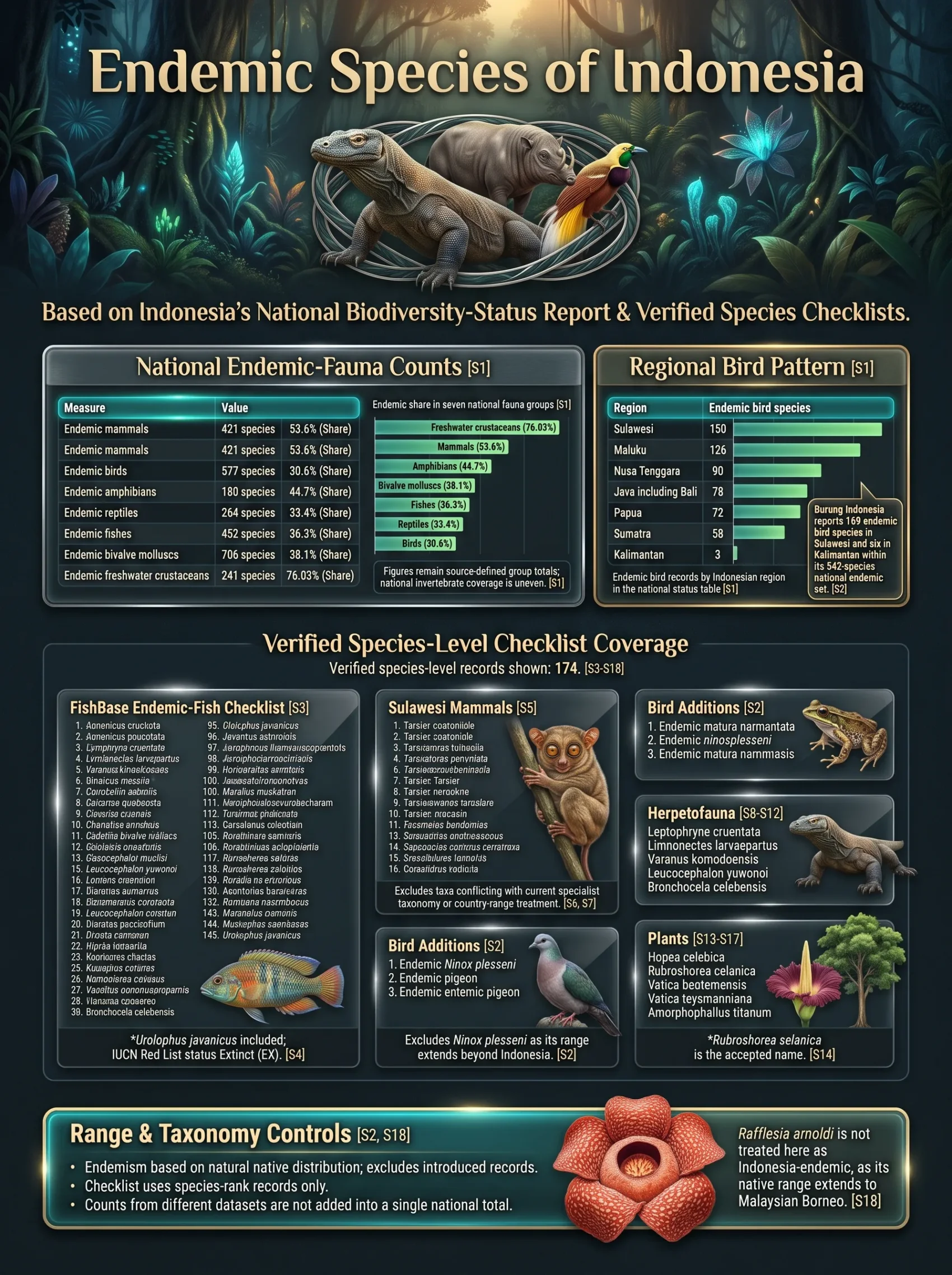
Indonesia’s national biodiversity-status report provides country-scale endemic-fauna counts for seven taxonomic groups, while also stating that national invertebrate coverage remains uneven. The figures below therefore remain source-defined group totals rather than a synthetic all-taxa endemic total. [S1]
| Measure | Value |
|---|---|
| Endemic mammals | 421 species [S1] |
| Endemic share of mammals | 53.6% [S1] |
| Endemic birds | 577 species [S1] |
| Endemic share of birds | 30.6% [S1] |
| Endemic amphibians | 180 species [S1] |
| Endemic share of amphibians | 44.7% [S1] |
| Endemic reptiles | 264 species [S1] |
| Endemic share of reptiles | 33.4% [S1] |
| Endemic fishes | 452 species [S1] |
| Endemic share of fishes | 36.3% [S1] |
| Endemic bivalve molluscs | 706 species [S1] |
| Endemic share of bivalve molluscs | 38.1% [S1] |
| Endemic freshwater crustaceans | 241 species [S1] |
| Endemic share of freshwater crustaceans | 76.03% [S1] |
{
  "type": "bar",
  "title": "Endemic share in seven national fauna groups",
  "description": "Percent of each taxonomic group reported as endemic in the national biodiversity-status table.",
  "unit": "%",
  "orientation": "horizontal",
  "min": 0,
  "max": 100,
  "data": [
    {"label": "Freshwater crustaceans", "value": 76.03},
    {"label": "Mammals", "value": 53.6},
    {"label": "Amphibians", "value": 44.7},
    {"label": "Bivalve molluscs", "value": 38.1},
    {"label": "Fishes", "value": 36.3},
    {"label": "Reptiles", "value": 33.4},
    {"label": "Birds", "value": 30.6}
  ],
  "source": "[S1] Status Kekinian Keanekaragaman Hayati Indonesia 2024"
}
Dataset boundaries
The national table reports 577 endemic birds [S1], while Burung Indonesia’s 2024 treatment reports 542 species restricted to Indonesia’s administrative territory under its HBW/BirdLife International 2023 taxonomic basis. [S2] The two counts should be kept separate because their taxonomic and source treatments are not identical.
No single number on this page is presented as the total endemic biota of Indonesia. Plants, vertebrates, fishes and invertebrates are covered by different datasets, taxonomic backbones and update cycles.
Regional pattern in one national bird dataset
Within the Bappenas–BRIN national table, endemic-bird records are concentrated in Sulawesi, Maluku and Nusa Tenggara. The Java figure explicitly includes Bali. [S1]
| Region | Endemic bird species |
|---|---|
| Sulawesi | 150 |
| Maluku | 126 |
| Nusa Tenggara | 90 |
| Java including Bali | 78 |
| Papua | 72 |
| Sumatra | 58 |
| Kalimantan | 3 |
{
  "type": "bar",
  "title": "Endemic bird records by Indonesian region in the national status table",
  "description": "Source-defined regional counts from the same national table; the Java value includes Bali.",
  "unit": "species",
  "orientation": "horizontal",
  "data": [
    {"label": "Sulawesi", "value": 150},
    {"label": "Maluku", "value": 126},
    {"label": "Nusa Tenggara", "value": 90},
    {"label": "Java including Bali", "value": 78},
    {"label": "Papua", "value": 72},
    {"label": "Sumatra", "value": 58},
    {"label": "Kalimantan", "value": 3}
  ],
  "source": "[S1] Status Kekinian Keanekaragaman Hayati Indonesia 2024"
}
Burung Indonesia uses a different 2024 bird treatment: it reports 169 endemic species in Sulawesi and six in Kalimantan within a 542-species national endemic set. [S2] Those values are not substituted into the Bappenas–BRIN regional series above.
Verified species-level checklist coverage
FishBase endemic-fish checklist
FishBase’s Indonesia endemic filter lists 145 species in the source snapshot used for this checklist. [S3] Because the country checklist is dynamic, this table is treated as a source-bounded checklist rather than a fixed national total.
| No. | Scientific name |
|---|---|
| 1 | Adrianichthys kruyti |
| 2 | Adrianichthys oophorus |
| 3 | Adrianichthys poptae |
| 4 | Adrianichthys roseni |
| 5 | Apristurus sibogae |
| 6 | Barbodes microps |
| 7 | Betta edithae |
| 8 | Betta foerschi |
| 9 | Betta schalleri |
| 10 | Bostrychus aruensis |
| 11 | Callionymus amboina |
| 12 | Callionymus bleekeri |
| 13 | Chaetodontoplus dimidiatus |
| 14 | Chilatherina bleheri |
| 15 | Chilatherina sentaniensis |
| 16 | Chromis athena |
| 17 | Chromis unipa |
| 18 | Chromobotia macracanthus |
| 19 | Chrysiptera pricei |
| 20 | Cirrhilabrus adornatus |
| 21 | Clarias pseudonieuhofii |
| 22 | Doryichthys heterosoma |
| 23 | Ecsenius ops |
| 24 | Fowleria amblyuroptera |
| 25 | Glossamia beauforti |
| 26 | Glossamia timika |
| 27 | Glossogobius flavipinnis |
| 28 | Glossogobius hoesei |
| 29 | Glossogobius intermedius |
| 30 | Glossogobius mahalonensis |
| 31 | Glossogobius matanensis |
| 32 | Glossolepis incisa |
| 33 | Glossolepis pseudoincisa |
| 34 | Glyptothorax schmidti |
| 35 | Grallenia nigrifasciata |
| 36 | Grallenia ornata |
| 37 | Grallenia sundaensis |
| 38 | Gyrinocheilus pustulosus |
| 39 | Helcogramma kranos |
| 40 | Helcogramma solorensis |
| 41 | Helcogramma vulcana |
| 42 | Hemirhamphodon kapuasensis |
| 43 | Hemitrygon longicauda |
| 44 | Hephaestus lineatus |
| 45 | Hephaestus roemeri |
| 46 | Homalopterula gymnogaster |
| 47 | Johnius hypostoma |
| 48 | Kalyptatherina helodes |
| 49 | Kanekonia pelta |
| 50 | Leiocassis rudicula |
| 51 | Lobocheilos kajanensis |
| 52 | Lobocheilos lehat |
| 53 | Lobocheilos schwanenfeldii |
| 54 | Marosatherina ladigesi |
| 55 | Melanotaenia ajamaruensis |
| 56 | Melanotaenia angfa |
| 57 | Melanotaenia arfakensis |
| 58 | Melanotaenia boesemani |
| 59 | Melanotaenia catherinae |
| 60 | Melanotaenia corona |
| 61 | Melanotaenia ericrobertsi |
| 62 | Melanotaenia flavipinnis |
| 63 | Melanotaenia fredericki |
| 64 | Melanotaenia irianjaya |
| 65 | Melanotaenia japenensis |
| 66 | Melanotaenia laticlavia |
| 67 | Melanotaenia maylandi |
| 68 | Melanotaenia misoolensis |
| 69 | Melanotaenia ogilbyi |
| 70 | Melanotaenia parva |
| 71 | Melanotaenia praecox |
| 72 | Melanotaenia salawati |
| 73 | Melanotaenia vanheurni |
| 74 | Melanotaenia veoliae |
| 75 | Melanotaenia wanoma |
| 76 | Microphis caudocarinatus |
| 77 | Mugilogobius amadi |
| 78 | Mugilogobius latifrons |
| 79 | Mugilogobius rexi |
| 80 | Mugilogobius sarasinorum |
| 81 | Nemipterus balinensis |
| 82 | Nemipterus gracilis |
| 83 | Nomorhamphus celebensis |
| 84 | Nomorhamphus megarrhamphus |
| 85 | Nomorhamphus weberi |
| 86 | Oryzias bonneorum |
| 87 | Oryzias celebensis |
| 88 | Oryzias eversi |
| 89 | Oryzias kalimpaaensis |
| 90 | Oryzias marmoratus |
| 91 | Oryzias matanensis |
| 92 | Oryzias nebulosus |
| 93 | Oryzias nigrimas |
| 94 | Oryzias orthognathus |
| 95 | Oryzias profundicola |
| 96 | Oryzias sarasinorum |
| 97 | Osteochilus kappenii |
| 98 | Ostorhinchus microspilos |
| 99 | Oxyeleotris stagnicola |
| 100 | Oxyeleotris wisselensis |
| 101 | Pachyula conorhynchus |
| 102 | Pangasius mahakamensis |
| 103 | Parambassis altipinnis |
| 104 | Parascolopsis qantasi |
| 105 | Paratherina cyanea |
| 106 | Paratherina labiosa |
| 107 | Paratherina striata |
| 108 | Paratherina wolterecki |
| 109 | Parosphromenus deissneri |
| 110 | Parupeneus inayatae |
| 111 | Platygobiopsis akihito |
| 112 | Pomacentrus fakfakensis |
| 113 | Pomacentrus javanicus |
| 114 | Pomacentrus xanthosternus |
| 115 | Poropuntius tawarensis |
| 116 | Pseudanthias mica |
| 117 | Pseudobagarius meridionalis |
| 118 | Pseudochromis ammeri |
| 119 | Pseudogobiopsis tigrellus |
| 120 | Pseudomugil reticulatus |
| 121 | Pseudomystus moeschii |
| 122 | Pterapogon kauderni |
| 123 | Rasbora baliensis |
| 124 | Rasbora subtilis |
| 125 | Rasbora tawarensis |
| 126 | Sargocentron shimizui |
| 127 | Sicyopterus hageni |
| 128 | Silurichthys citatus |
| 129 | Stenogobius lachneri |
| 130 | Stiphodon annieae |
| 131 | Sueviota bryozophila |
| 132 | Telmatherina abendanoni |
| 133 | Telmatherina antoniae |
| 134 | Telmatherina bonti |
| 135 | Telmatherina celebensis |
| 136 | Telmatherina obscura |
| 137 | Telmatherina opudi |
| 138 | Telmatherina prognatha |
| 139 | Telmatherina sarasinorum |
| 140 | Telmatherina wahjui |
| 141 | Urolophus javanicus |
| 142 | Urolophus kaianus |
| 143 | Variichthys jamoerensis |
| 144 | Zenarchopterus alleni |
| 145 | Zenarchopterus ornithocephala |
FishBase includes Urolophus javanicus in the Indonesia endemic checklist. Its species account records an IUCN Red List status of Extinct (EX), assessed on 31 March 2023. [S4]
Taxonomy-controlled records from a Sulawesi mammal table
The Sulawesi biodiversity-status report lists 18 threatened endemic mammals in Table 4.12. [S5] Sixteen accepted species-rank records are retained below after removing two rows that conflict with current specialist taxonomy or country-range treatment.
| No. | Scientific name |
|---|---|
| 1 | Ailurops melanotis |
| 2 | Acerodon humilis |
| 3 | Tarsius niemitzi |
| 4 | Tarsius pelengensis |
| 5 | Tarsius sangirensis |
| 6 | Tarsius tarsier |
| 7 | Tarsius tumpara |
| 8 | Macaca brunnescens |
| 9 | Babyrousa togeanensis |
| 10 | Prosciurillus rosenbergii |
| 11 | Bunomys andrewsi |
| 12 | Melomys caurinus |
| 13 | Melomys talaudium |
| 14 | Rattus facetus |
| 15 | Rattus koopmani |
| 16 | Rattus pelurus |
The Togian macaque taxon listed as Macaca togeanus in the regional report is not counted separately because the Mammal Diversity Database places togeanus names in the synonymy of accepted Macaca tonkeana. [S6] Cheiromeles parvidens is also excluded from the strict Indonesia-endemic subset because the current Mammal Diversity Database lists its country distribution as the Philippines and Indonesia. [S7]
Bird additions with Indonesia-only ranges
Burung Indonesia’s 2024 update identifies four newly added birds as endemic in its treatment. Three have source-stated ranges confined to Indonesian islands and are retained here. [S2]
| Scientific name | Native endemic range |
|---|---|
| Macropygia cinnamomea | Enggano Island, Bengkulu |
| Ninox rotiensis | Rote Island, East Nusa Tenggara |
| Zosterops dehaani | Morotai Island, North Maluku |
Ninox plesseni is not included in this strict-country subset because the same source gives its range as Alor and nearby Pantar and Atauro, extending beyond the Indonesia-only range criterion used here. [S2]
Range-verified amphibians and reptiles
These records use specialist amphibian and reptile databases that explicitly place the native range within Indonesia.
| Group | Scientific name | Native endemic range |
|---|---|---|
| Amphibian | Leptophryne cruentata | Mount Pangrango, Mount Gedeh and Curug Luhur, West Java [S8] |
| Amphibian | Limnonectes larvaepartus | Northern peninsula and west coast of Sulawesi east to the central core [S9] |
| Reptile | Varanus komodoensis | Komodo, Padar, Rinca and Flores, Lesser Sunda region [S10] |
| Reptile | Leucocephalon yuwonoi | Sulawesi [S11] |
| Reptile | Bronchocela celebensis | Sulawesi [S12] |
Endemic plants under the current Kew backbone
The plant records below use accepted names and native ranges in Plants of the World Online rather than cultivated or introduced occurrences.
Rubroshorea selanica is the accepted Kew name; Shorea selanica is treated as a synonym in the same taxonomic record. [S14]
Range and taxonomy controls
- Endemism is based on natural native distribution. Introduced, cultivated, naturalized and translocated records do not enlarge a species’ native range.
- The checklist uses species-rank records; subspecies, varieties and synonyms are not counted as separate species.
- Counts from different datasets are not added to create an Indonesia-wide endemic total.
Rafflesia arnoldi is often associated with Indonesia, but Kew gives its native range as southwestern Sumatra and Borneo, including western Sarawak and western Kalimantan. It is therefore not treated here as a species endemic only to Indonesia. [S18]
Sources
[S1] ↩ Bappenas / BRIN — Status Kekinian Keanekaragaman Hayati Indonesia 2024. National biodiversity-status report; first printed August 2025.
[S2] ↩ Burung Indonesia — Status Burung di Indonesia 2024. Bird diversity, taxonomy and country-endemism update using the HBW/BirdLife International 2023 taxonomic basis.
[S3] ↩ FishBase — List of Endemic Fishes reported from Indonesia. Dynamic Indonesia country checklist filtered for endemic fishes.
[S4] ↩ FishBase — Urolophus javanicus. Species account with Java distribution and IUCN Extinct status.
[S5] ↩ Bappenas / BRIN — Status Keanekaragaman Hayati Ekoregion Sulawesi 2024. Sulawesi biodiversity-status report, including Table 4.12 on threatened endemic mammals.
[S6] ↩ Mammal Diversity Database — Macaca tonkeana. Current accepted mammal treatment; places Togian togeanus names in the synonymy of Macaca tonkeana.
[S7] ↩ Mammal Diversity Database — Cheiromeles parvidens. Current mammal species account; country distribution includes the Philippines and Indonesia.
[S8] ↩ Amphibian Species of the World — Leptophryne cruentata. Accepted species account; endemic to Indonesia and known from western Java localities.
[S9] ↩ Amphibian Species of the World — Limnonectes larvaepartus. Accepted species account; endemic to Indonesia on Sulawesi.
[S10] ↩ The Reptile Database — Varanus komodoensis. Species account with native distribution in the Lesser Sunda region of Indonesia.
[S11] ↩ The Reptile Database — Leucocephalon yuwonoi. Species account with distribution in Sulawesi, Indonesia.
[S12] ↩ The Reptile Database — Bronchocela celebensis. Species account with distribution in Sulawesi, Indonesia.
[S13] ↩ Plants of the World Online — Hopea celebica Burck. Accepted name under the 2026 Kew backbone; native range Sulawesi.
[S14] ↩ Plants of the World Online — Rubroshorea selanica (DC.) P.S.Ashton & J.Heck.. Accepted name under the 2026 Kew backbone; native range Maluku.
[S15] ↩ Plants of the World Online — Vatica bantamensis (Hassk.) Benth. & Hook.f. ex Miq.. Accepted name under the 2026 Kew backbone; native range western Java.
[S16] ↩ Plants of the World Online — Vatica teysmanniana Burck. Accepted name under the 2026 Kew backbone; native range eastern Sumatra.
[S17] ↩ Plants of the World Online — Amorphophallus titanum (Becc.) Becc.. Accepted name under the 2026 Kew backbone; native range western Sumatra.
[S18] ↩ Plants of the World Online — Rafflesia arnoldi R.Br.. Accepted species account; native range extends across Sumatra and Borneo, including western Sarawak.