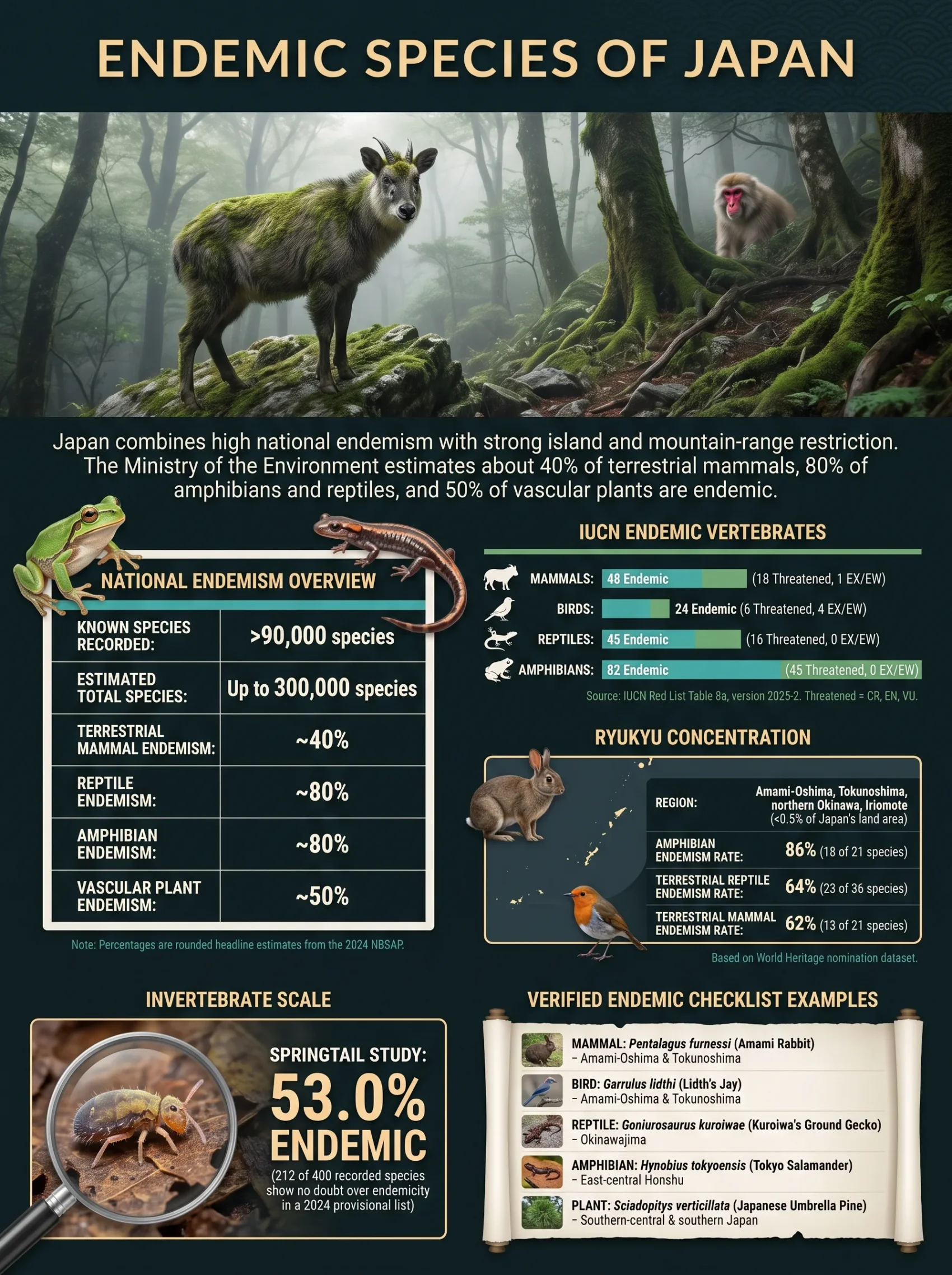
Japan combines high national endemism with strong island and mountain-range restriction. The Ministry of the Environment reports more than 90,000 known species in the country and estimates that about 40% of terrestrial mammals, 80% of amphibians and reptiles, and 50% of vascular plants are endemic. [S1]
| Measure | Value |
|---|---|
| Known species recorded in Japan | >90,000 species [S1] |
| Estimated species including undiscovered biota | Up to 300,000 species [S1] |
| Terrestrial mammal endemism | About 40% [S1] |
| Reptile endemism | About 80% [S1] |
| Amphibian endemism | About 80% [S1] |
| Vascular plant endemism | About 50% [S1] |
| IUCN endemic mammals | 48 species [S2] |
| IUCN threatened endemic mammals | 18 species [S2] |
| IUCN EX/EW endemic mammals | 1 species [S2] |
| IUCN endemic birds | 24 species [S2] |
| IUCN threatened endemic birds | 6 species [S2] |
| IUCN EX/EW endemic birds | 4 species [S2] |
| IUCN endemic reptiles | 45 species [S2] |
| IUCN threatened endemic reptiles | 16 species [S2] |
| IUCN EX/EW endemic reptiles | 0 species [S2] |
| IUCN endemic amphibians | 82 species [S2] |
| IUCN threatened endemic amphibians | 45 species [S2] |
| IUCN EX/EW endemic amphibians | 0 species [S2] |
The national percentages above are rounded headline estimates in the 2024 NBSAP; the chart printed in that source is based on older comparison baselines, so these percentages should not be combined mathematically with the IUCN counts. The live IUCN Red List is version 2026-1 [S3], while the numeric Japan row used here comes from IUCN Table 8a version 2025-2. [S2] IUCN defines a country endemic as a species occurring naturally within one country only, and Table 8 is limited to groups in which more than 80% of species have been assessed. [S4] No synthetic all-taxa endemic total is created from these separate datasets.
{
  "type": "bar",
  "title": "Country-endemic vertebrates in IUCN Table 8a",
  "description": "Species naturally occurring within Japan only. Threatened means CR, EN or VU. Values are from the same 2025-2 country-endemic vertebrate table.",
  "unit": "species",
  "orientation": "horizontal",
  "categories": [
    "Mammals",
    "Birds",
    "Reptiles",
    "Amphibians"
  ],
  "series": [
    {
      "name": "Endemic",
      "values": [
        48,
        24,
        45,
        82
      ]
    },
    {
      "name": "Threatened endemic",
      "values": [
        18,
        6,
        16,
        45
      ]
    }
  ],
  "source": "[S2] IUCN Red List Table 8a, version 2025-2"
}
National figures come from different biological datasets
The NBSAP figures describe broad national biodiversity and rounded endemic shares. IUCN Table 8a provides species-level country-endemic counts for four vertebrate groups under its own assessment coverage rules. Because taxonomic revisions, assessment coverage and source dates differ, the two data families are best read side by side rather than forced into one national total.
Endemism is concentrated in the Central and Southern Ryukyus
The Ministry of the Environment’s World Heritage property dataset covers Amami-Oshima, Tokunoshima, northern Okinawa and Iriomote. The four regions occupy less than 0.5% of Japan’s land area but were reported to contain 44% of the Japan-endemic terrestrial vertebrate species represented in that nomination dataset. [S5]
| Group | Recorded in the property dataset | Endemic to the property | Endemism rate |
|---|---|---|---|
| Vascular plant records | 1,819 | 188 | 10% |
| Terrestrial mammals | 21 species | 13 species | 62% |
| Birds | 394 species | 4 species | 1% |
| Terrestrial reptiles | 36 species | 23 species | 64% |
| Amphibians | 21 species | 18 species | 86% |
| Insects | 6,153 species | 1,607 species | 26% |
| Inland decapod crustaceans | 47 species | 15 species | 32% |
These are nomination-era property figures, not a current substitute for national totals. The source states that its vascular-plant figures include subspecies, varieties and hybrids, and that some other conservation counts use different rank treatments. The rows are therefore kept as a geographic reference table rather than summed or converted into a cross-group composition chart.
A national springtail dataset shows the scale of invertebrate endemism
A 2024 Edaphologia study reviewed 400 springtail species recorded from Japan and identified 212 species, or 53.0%, for which the authors found no doubt over endemicity in their provisional list. The authors also state that the list requires future taxonomic and distributional updates. [S6]
| Springtail measure | Value |
|---|---|
| Species recorded from Japan in the study | 400 |
| Species without doubt over endemicity in the provisional list | 212 |
| Share of recorded species | 53.0% |
Taxonomic revision can change endemic species counts
The Herpetological Society of Japan’s list dated 2 July 2026 recognizes seven living Japanese species of Goniurosaurus: G. toyamai, G. splendens, G. yamashinae, G. kuroiwae, G. sengokui, G. orientalis and G. nebulozonatus. [S7] A 2024 revision described G. nebulozonatus from northern Okinawajima and Kourijima and elevated several former subspecies to species rank. [S8] Older country or island counts built before these changes are not directly interchangeable with the current treatment.
Verified endemic species checklist
| Scientific name | Group | Native endemic range | Evidence |
|---|---|---|---|
| Pteropus pselaphon | Mammal | Ogasawara Islands | [S9] |
| Pentalagus furnessi | Mammal | Amami-Oshima and Tokunoshima | [S5] |
| Diplothrix legata | Mammal | Amami-Oshima, Tokunoshima and Okinawa Island | [S10] |
| Tokudaia osimensis | Mammal | Amami-Oshima | [S5] |
| Tokudaia tokunoshimensis | Mammal | Tokunoshima | [S5] |
| Tokudaia muenninki | Mammal | northern Okinawa Island | [S5] |
| Macaca fuscata | Mammal | Honshu, Shikoku, Kyushu, adjacent islands and Yakushima | [S11] |
| Gallirallus okinawae | Bird | northern Okinawa Island | [S5] |
| Chloris kittlitzi | Bird | Ogasawara Islands | [S12] |
| Garrulus lidthi | Bird | Amami-Oshima and Tokunoshima | [S13] |
| Picus awokera | Bird | Japan from Honshu to Tanegashima and offshore islands | [S14] |
| Turdus celaenops | Bird | Izu Islands and Yakushima | [S15] |
| Scolopax mira | Bird | Amami-Oshima, Tokunoshima, Okinawa and Tokashiki | [S16] |
| Fagus crenata | Plant | Japan | [S17] |
| Sciadopitys verticillata | Conifer | southern-central and southern Japan | [S18] |
| Thujopsis dolabrata | Conifer | Japan | [S19] |
| Cercidiphyllum magnificum | Plant | northern and central Honshu | [S20] |
| Abies mariesii | Conifer | Honshu | [S21] |
| Abies veitchii | Conifer | Honshu and Shikoku | [S22] |
| Goniurosaurus toyamai | Reptile | Central Ryukyus | [S7] [S8] |
| Goniurosaurus splendens | Reptile | Tokunoshima | [S7] [S8] |
| Goniurosaurus yamashinae | Reptile | Central Ryukyus | [S7] [S8] |
| Goniurosaurus kuroiwae | Reptile | Okinawajima | [S7] [S8] |
| Goniurosaurus sengokui | Reptile | Central Ryukyus | [S7] [S8] |
| Goniurosaurus orientalis | Reptile | Central Ryukyus | [S7] [S8] |
| Goniurosaurus nebulozonatus | Reptile | northern Okinawajima and Kourijima | [S7] [S8] |
| Geoemyda japonica | Reptile | Central Ryukyus | [S5] |
| Hynobius unnangso | Amphibian | southwestern Yamagata through western Fukushima to northern Gunma and Niigata, Honshu | [S23] |
| Hynobius bakan | Amphibian | extreme southwestern Honshu, centered in Yamaguchi Prefecture | [S24] |
| Hynobius vandenburghi | Amphibian | Tokai and Kinki districts of Honshu | [S25] |
| Hynobius lichenatus | Amphibian | Tohoku region of Honshu | [S26] |
| Hynobius sengokui | Amphibian | southeastern Fukushima, southeastern Tochigi and northern Ibaraki, Honshu | [S27] |
| Hynobius abei | Amphibian | northern Kinki region of Honshu | [S28] |
| Hynobius okiensis | Amphibian | Dogo Island, Oki Archipelago | [S29] |
| Hynobius kunibiki | Amphibian | Shimane Prefecture, western Honshu | [S30] |
| Hynobius takedai | Amphibian | Noto Peninsula and adjoining Ishikawa–Toyama area, Honshu | [S31] |
| Hynobius tokyoensis | Amphibian | isolated populations in east-central Honshu | [S32] |
| Hynobius mikawaensis | Amphibian | small areas of Aichi Prefecture, Honshu | [S33] |
| Hynobius utsunomiyaorum | Amphibian | Chugoku Mountains of western Honshu | [S34] |
| Cynops pyrrhogaster | Amphibian | Honshu, Shikoku, Kyushu and smaller Japanese islands | [S35] |
| Echinotriton andersoni | Amphibian | Okinawa Island group under the current split treatment | [S36] |
| Echinotriton raffaellii | Amphibian | Amami-Oshima, Ukejima and Tokunoshima | [S37] |
| Buergeria buergeri | Amphibian | mountain streams of Honshu, Shikoku and Kyushu | [S38] |
| Rana japonica | Amphibian | Honshu, Shikoku, Kyushu and the Tanegashima Group | [S39] |
| Rana sakuraii | Amphibian | montane central Honshu from Kanto through Chubu to Kinki | [S40] |
| Rana tagoi | Amphibian | mountain regions of Honshu, Shikoku and Kyushu | [S41] |
| Rana tsushimensis | Amphibian | Tsushima Island | [S42] |
| Rana ornativentris | Amphibian | Honshu, Shikoku, Kyushu and several outlying Japanese islands | [S43] |
| Odorrana narina | Amphibian | northern Okinawa Island | [S44] |
| Odorrana supranarina | Amphibian | Ishigaki and Iriomote islands | [S45] |
| Odorrana utsunomiyaorum | Amphibian | mountain streams of Ishigaki and Iriomote islands | [S46] |
| Odorrana amamiensis | Amphibian | Amami-Oshima and Tokunoshima | [S47] |
| Odorrana ishikawae | Amphibian | Okinawa Island | [S48] |
The checklist is species-rank only. Japan also has endemic subspecies and other infraspecific taxa, but those records require separate counting rules and are not mixed into the 53-species total above.
Sources
[S1] ↩ Ministry of the Environment, Japan — The National Biodiversity Strategy and Action Plan (NBSAP) of Japan 2023-2030: Summary. October 2024 summary; national biodiversity and rounded endemism figures.
[S2] ↩ IUCN — Table 8a: Total, threatened, and EX or EW endemic bird, mammal, reptile and amphibian species in each country. Version 2025-2 country-endemic vertebrate table.
[S3] ↩ IUCN Red List — Citing The IUCN Red List. Current Red List version is 2026-1.
[S4] ↩ IUCN Red List — Summary Statistics. Defines Table 8 country endemics as species naturally occurring within one country only and limits the table to groups with more than 80% of species assessed.
[S5] ↩ Ministry of the Environment, Japan — Amami-Oshima Island, Tokunoshima Island, Northern part of Okinawa Island, and Iriomote Island: Description of the Property. Ryukyu geographic concentration, nomination-era group counts, and restricted endemic vertebrates.
[S6] ↩ Edaphologia — Tentative list of Collembola species endemic to Japan. 2024 provisional national springtail inventory.
[S7] ↩ Herpetological Society of Japan — Standard Japanese Names of Amphibians and Reptiles of Japan. Taxonomic list dated 2 July 2026.
[S8] ↩ Current Herpetology — Genetic and Morphological Studies on Goniurosaurus kuroiwae, with a Description of a New Species from the Northern Part of Okinawajima Island, Ryukyu Archipelago, Japan. 2024 revision of the Ryukyu Goniurosaurus complex.
[S9] ↩ Ogasawara World Heritage Centre — Photo Gallery. English endemic-species gallery identifying Pteropus pselaphon as an Ogasawara endemic.
[S10] ↩ Amami Wildlife Conservation Center — Animals of the Amami Islands. Species account for Diplothrix legata and its restricted Japanese range.
[S11] ↩ Mammal Diversity Database — Macaca fuscata. Accepted species and Japan-only country distribution.
[S12] ↩ Ogasawara World Heritage Centre — Efforts to protect World Heritage. Current account identifying Chloris kittlitzi as endemic to the Ogasawara Islands.
[S13] ↩ Avibase — Garrulus lidthi (Lidth’s Jay). Current taxonomic concept and Amami-Oshima–Tokunoshima range.
[S14] ↩ Avibase — Picus awokera (Japanese Green Woodpecker). Current taxonomic concept and Japan-only range.
[S15] ↩ Avibase — Turdus celaenops (Izu Thrush). Current taxonomic concept and Izu Islands–Yakushima range.
[S16] ↩ Avibase — Scolopax mira (Amami Woodcock). Current full-species treatment and Ryukyu range.
[S17] ↩ Royal Botanic Gardens, Kew — Fagus crenata Blume. Plants of the World Online accepted name and native range.
[S18] ↩ Royal Botanic Gardens, Kew — Sciadopitys verticillata (Thunb.) Siebold & Zucc.. Plants of the World Online accepted name and native range.
[S19] ↩ Royal Botanic Gardens, Kew — Thujopsis dolabrata (Thunb. ex L.f.) Siebold & Zucc.. Plants of the World Online accepted name and native range.
[S20] ↩ Royal Botanic Gardens, Kew — Cercidiphyllum magnificum (Nakai) Nakai. Plants of the World Online accepted name and native range.
[S21] ↩ Royal Botanic Gardens, Kew — Abies mariesii Mast.. Plants of the World Online accepted name and native range.
[S22] ↩ Royal Botanic Gardens, Kew — Abies veitchii Lindl.. Plants of the World Online accepted name and native range.
[S23] ↩ American Museum of Natural History — Hynobius unnangso | Amphibian Species of the World. Accepted species account with Japan-only natural occurrence and distribution.
[S24] ↩ American Museum of Natural History — Hynobius bakan | Amphibian Species of the World. Accepted species account with Japan-only natural occurrence and distribution.
[S25] ↩ American Museum of Natural History — Hynobius vandenburghi | Amphibian Species of the World. Accepted species account with Japan-only natural occurrence and distribution.
[S26] ↩ American Museum of Natural History — Hynobius lichenatus | Amphibian Species of the World. Accepted species account with Japan-only natural occurrence and distribution.
[S27] ↩ American Museum of Natural History — Hynobius sengokui | Amphibian Species of the World. Accepted species account with Japan-only natural occurrence and distribution.
[S28] ↩ American Museum of Natural History — Hynobius abei | Amphibian Species of the World. Accepted species account with Japan-only natural occurrence and distribution.
[S29] ↩ American Museum of Natural History — Hynobius okiensis | Amphibian Species of the World. Accepted species account with Japan-only natural occurrence and distribution.
[S30] ↩ American Museum of Natural History — Hynobius kunibiki | Amphibian Species of the World. Accepted species account with Japan-only natural occurrence and distribution.
[S31] ↩ American Museum of Natural History — Hynobius takedai | Amphibian Species of the World. Accepted species account with Japan-only natural occurrence and distribution.
[S32] ↩ American Museum of Natural History — Hynobius tokyoensis | Amphibian Species of the World. Accepted species account with Japan-only natural occurrence and distribution.
[S33] ↩ American Museum of Natural History — Hynobius mikawaensis | Amphibian Species of the World. Accepted species account with Japan-only natural occurrence and distribution.
[S34] ↩ American Museum of Natural History — Hynobius utsunomiyaorum | Amphibian Species of the World. Accepted species account with Japan-only natural occurrence and distribution.
[S35] ↩ American Museum of Natural History — Cynops pyrrhogaster | Amphibian Species of the World. Accepted species account with Japan-only natural occurrence and distribution.
[S36] ↩ American Museum of Natural History — Echinotriton andersoni | Amphibian Species of the World. Accepted species account with Japan-only natural occurrence and distribution.
[S37] ↩ American Museum of Natural History — Echinotriton raffaellii | Amphibian Species of the World. Accepted species account with Japan-only natural occurrence and distribution.
[S38] ↩ American Museum of Natural History — Buergeria buergeri | Amphibian Species of the World. Accepted species account with Japan-only natural occurrence and distribution.
[S39] ↩ American Museum of Natural History — Rana japonica | Amphibian Species of the World. Accepted species account with Japan-only natural occurrence and distribution.
[S40] ↩ American Museum of Natural History — Rana sakuraii | Amphibian Species of the World. Accepted species account with Japan-only natural occurrence and distribution.
[S41] ↩ American Museum of Natural History — Rana tagoi | Amphibian Species of the World. Accepted species account with Japan-only natural occurrence and distribution.
[S42] ↩ American Museum of Natural History — Rana tsushimensis | Amphibian Species of the World. Accepted species account with Japan-only natural occurrence and distribution.
[S43] ↩ American Museum of Natural History — Rana ornativentris | Amphibian Species of the World. Accepted species account with Japan-only natural occurrence and distribution.
[S44] ↩ American Museum of Natural History — Odorrana narina | Amphibian Species of the World. Accepted species account with Japan-only natural occurrence and distribution.
[S45] ↩ American Museum of Natural History — Odorrana supranarina | Amphibian Species of the World. Accepted species account with Japan-only natural occurrence and distribution.
[S46] ↩ American Museum of Natural History — Odorrana utsunomiyaorum | Amphibian Species of the World. Accepted species account with Japan-only natural occurrence and distribution.
[S47] ↩ American Museum of Natural History — Odorrana amamiensis | Amphibian Species of the World. Accepted species account with Japan-only natural occurrence and distribution.
[S48] ↩ American Museum of Natural History — Odorrana ishikawae | Amphibian Species of the World. Accepted species account with Japan-only natural occurrence and distribution.