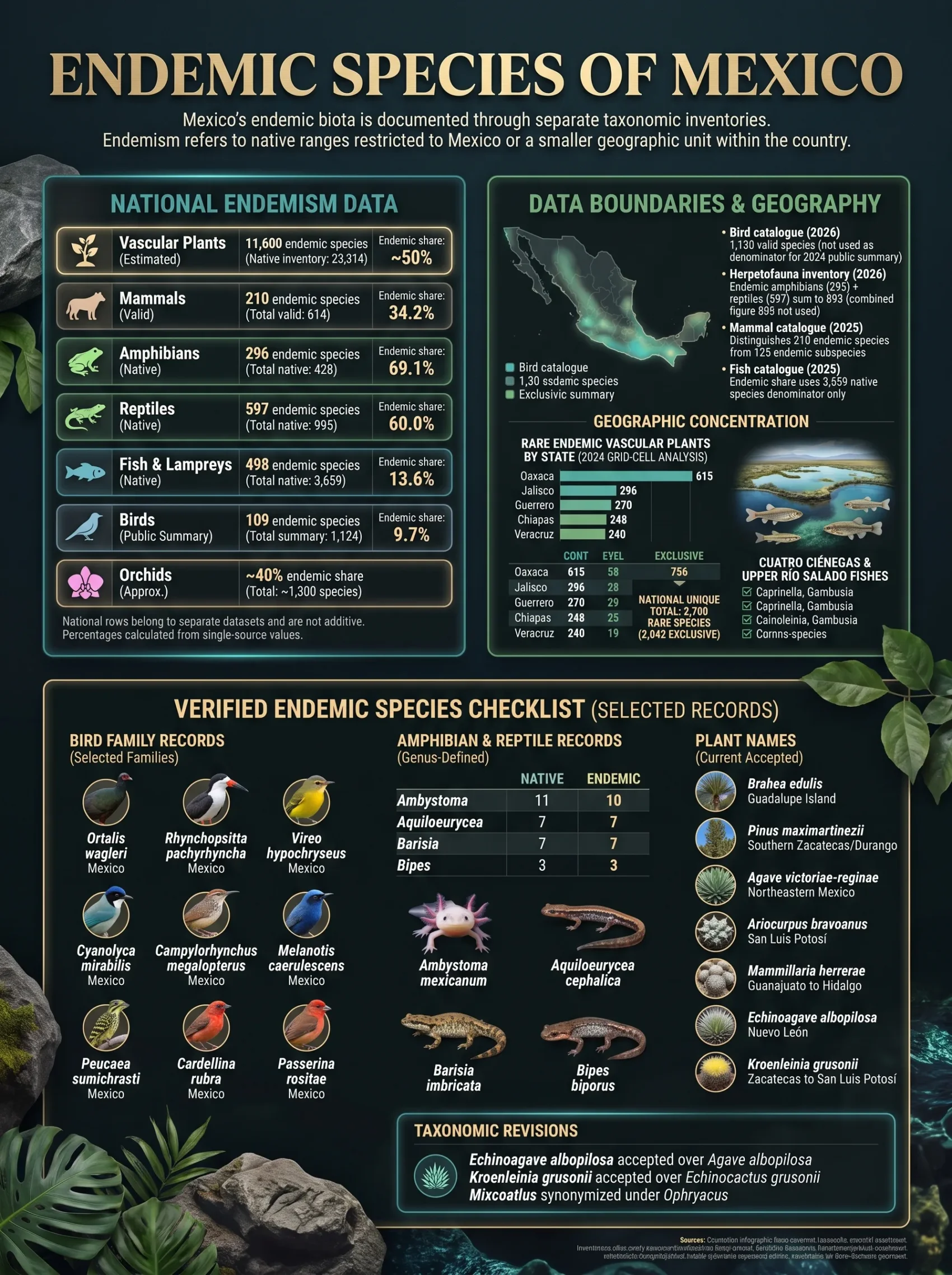
Mexico’s endemic biota is documented through separate taxonomic inventories with different dates, ranks, and coverage. Endemism is treated here as restriction of the natural native range to Mexico or to a smaller geographic unit within Mexico; no synthetic all-taxa total is created from unlike datasets. [S1]
| Measure | Value |
|---|---|
| Estimated endemic vascular plant species | 11,600 species (estimated) [S2] |
| Native vascular plant species in national inventory | 23,314 species [S3] |
| Endemic share of native vascular flora | about 50% [S3] |
| Valid mammal species | 614 species [S4] |
| Endemic mammal species | 210 species [S4] |
| Endemic share of valid mammal species | 34.2% [S4] |
| Native amphibian species | 428 species [S5] |
| Endemic amphibian species | 296 species [S5] |
| Endemic share of native amphibians | 69.1% [S5] |
| Native reptile species | 995 species [S5] |
| Endemic reptile species | 597 species [S5] |
| Endemic share of native reptiles | 60.0% [S5] |
| Native fish and lamprey species | 3,659 species [S6] |
| Endemic fish and lamprey species | 498 species [S6] |
| Endemic share of native fish and lamprey species | 13.6% [S6] |
| Bird species in public national summary | 1,124 species [S7] |
| Endemic bird species in public national summary | 109 species [S7] |
| Endemic share in public national bird summary | 9.7% [S7] |
| Orchid species | about 1,300 species [S8] |
| Endemic share of orchid species | 40% [S8] |
The national rows belong to separate datasets and are not additive. The percentages for mammals, fishes and lampreys, and the 2024 bird summary are calculated only from numerator and denominator values published within the same source. The estimate of 11,600 endemic vascular plant species is not divided by the 23,314-species vascular-plant inventory because those values come from different releases. [S2] [S3] [S4] [S6] [S7]
Data boundaries
- The 2026 CONABIO bird catalogue contains 1,130 valid species and covers records that include hypothetical, extinct, and established introduced birds. Its 1,130 figure is therefore not substituted for the 1,124-species denominator used with the 109 endemic species in the 2024 public summary. [S9] [S7]
- The online 2026 herpetofauna inventory gives 296 endemic amphibians and 597 endemic reptiles. Those subgroup values sum to 893, while the same page separately prints a combined endemic figure of 895. The combined figure is not used here. [S5]
- The 2025 mammal catalogue distinguishes 210 endemic species from 125 endemic subspecies. Only the species-rank figure enters the national species profile. [S4]
- The 2025 fish and lamprey catalogue separates 3,659 native species, 202 introduced species, and 2,807 synonym-status taxa. The endemic share shown above uses the native-species denominator only. [S6]
Geographic concentration
Endemism in Mexico can be national or nested within states, islands, mountain systems, caves, lakes, rivers, and springs. A species restricted to one such unit is also Mexican-endemic when that entire natural range lies inside the country. [S1]
Rare endemic vascular plants by state
A 2024 grid-cell analysis identified 2,705 rare Mexican endemic vascular plant species, defining “rare” as recorded in one grid square. Of these, 2,042 species were exclusive to one state in the study’s distribution matrix. State occurrence counts overlap when the same species occurs in more than one state, so the state rows must not be summed to recreate the national total. [S10]
| State | Rare endemic species recorded | Exclusive to one state |
|---|---|---|
| Aguascalientes | 10 | — |
| Baja California | 68 | 62 |
| Baja California Sur | 86 | 80 |
| Campeche | 11 | 3 |
| Chiapas | 248 | 228 |
| Chihuahua | 47 | 30 |
| Ciudad de México | 3 | 1 |
| Coahuila | 79 | 28 |
| Colima | 42 | 26 |
| Durango | 132 | 47 |
| Guanajuato | 47 | 10 |
| Guerrero | 270 | 204 |
| Hidalgo | 89 | 19 |
| Jalisco | 296 | 200 |
| México | 89 | 34 |
| Michoacán | 142 | 80 |
| Morelos | 30 | 19 |
| Nayarit | 66 | 14 |
| Nuevo León | 108 | 36 |
| Oaxaca | 615 | 534 |
| Puebla | 132 | 58 |
| Querétaro | 107 | 21 |
| Quintana Roo | 12 | 3 |
| San Luis Potosí | 119 | 31 |
| Sinaloa | 99 | 45 |
| Sonora | 33 | 17 |
| Tabasco | 23 | 8 |
| Tamaulipas | 106 | 60 |
| Tlaxcala | 1 | — |
| Veracruz | 240 | 131 |
| Yucatán | 13 | 7 |
| Zacatecas | 52 | 6 |
| National unique total | 2,705 | 2,042 |
{"type":"bar","title":"Rare endemic vascular plants recorded in one grid square","description":"Five states with the largest counts in the 2024 grid-cell analysis.","unit":"species","orientation":"horizontal","data":[{"label":"Oaxaca","value":615},{"label":"Jalisco","value":296},{"label":"Guerrero","value":270},{"label":"Chiapas","value":248},{"label":"Veracruz","value":240}],"source":"[S10] The rarest of rarities in the flora of Mexico"}Cuatro Ciénegas and upper Río Salado fishes
The Cuatro Ciénegas basin in Coahuila contains multiple freshwater fishes identified as endemic by the Desert Fishes Council. The same specialist account also identifies Etheostoma segrex as endemic to the upper Río Salado de los Nadadores just outside the basin. [S11]
| Scientific name | Family | Native endemic range |
|---|---|---|
| Cyprinella xanthicara | Cyprinidae | Cuatro Ciénegas basin, Coahuila |
| Gambusia longispinis | Poeciliidae | Cuatro Ciénegas basin, Coahuila |
| Xiphophorus gordoni | Poeciliidae | Cuatro Ciénegas basin, Coahuila |
| Lucania interioris | Fundulidae | Cuatro Ciénegas basin, Coahuila |
| Cyprinodon atrorus | Cyprinodontidae | Cuatro Ciénegas basin, Coahuila |
| Cyprinodon bifasciatus | Cyprinodontidae | Cuatro Ciénegas basin, Coahuila |
| Etheostoma lugoi | Percidae | Cuatro Ciénegas basin, Coahuila |
| Herichthys minckleyi | Cichlidae | Cuatro Ciénegas basin, Coahuila |
| Etheostoma segrex | Percidae | Upper Río Salado de los Nadadores, Coahuila |
Verified endemic species checklist
Bird family records
The table includes every species marked EN for Mexican endemism in 12 selected families in CONABIO’s AOS 2021 national list. The newer 2026 CONABIO catalogue supplies current catalogue context but is not used to rewrite the source-defined 2021 family subset. [S12] [S9]
| Scientific name | Family | Endemic scope |
|---|---|---|
| Ortalis wagleri | Cracidae | Mexico |
| Ortalis poliocephala | Cracidae | Mexico |
| Dendrortyx macroura | Odontophoridae | Mexico |
| Dendrortyx barbatus | Odontophoridae | Mexico |
| Philortyx fasciatus | Odontophoridae | Mexico |
| Callipepla douglasii | Odontophoridae | Mexico |
| Psittacara brevipes | Psittacidae | Mexico |
| Rhynchopsitta pachyrhyncha | Psittacidae | Mexico |
| Rhynchopsitta terrisi | Psittacidae | Mexico |
| Forpus cyanopygius | Psittacidae | Mexico |
| Amazona viridigenalis | Psittacidae | Mexico |
| Amazona finschi | Psittacidae | Mexico |
| Vireo hypochryseus | Vireonidae | Mexico |
| Vireo brevipennis | Vireonidae | Mexico |
| Vireo nelsoni | Vireonidae | Mexico |
| Vireo bairdi | Vireonidae | Mexico |
| Cyanolyca mirabilis | Corvidae | Mexico |
| Cyanolyca nanus | Corvidae | Mexico |
| Calocitta colliei | Corvidae | Mexico |
| Cyanocorax dickeyi | Corvidae | Mexico |
| Cyanocorax sanblasianus | Corvidae | Mexico |
| Cyanocorax beecheii | Corvidae | Mexico |
| Aphelocoma ultramarina | Corvidae | Mexico |
| Polioptila albiventris | Polioptilidae | Mexico |
| Polioptila nigriceps | Polioptilidae | Mexico |
| Hylorchilus sumichrasti | Troglodytidae | Mexico |
| Hylorchilus navai | Troglodytidae | Mexico |
| Troglodytes sissonii | Troglodytidae | Mexico |
| Troglodytes tanneri | Troglodytidae | Mexico |
| Campylorhynchus megalopterus | Troglodytidae | Mexico |
| Campylorhynchus chiapensis | Troglodytidae | Mexico |
| Campylorhynchus gularis | Troglodytidae | Mexico |
| Campylorhynchus jocosus | Troglodytidae | Mexico |
| Campylorhynchus yucatanicus | Troglodytidae | Mexico |
| Pheugopedius felix | Troglodytidae | Mexico |
| Thryophilus sinaloa | Troglodytidae | Mexico |
| Melanotis caerulescens | Mimidae | Mexico |
| Toxostoma ocellatum | Mimidae | Mexico |
| Toxostoma guttatum | Mimidae | Mexico |
| Toxostoma cinereum | Mimidae | Mexico |
| Mimus graysoni | Mimidae | Mexico |
| Euphonia godmani | Fringillidae | Mexico |
| Peucaea sumichrasti | Passerellidae | Mexico |
| Peucaea humeralis | Passerellidae | Mexico |
| Peucaea mystacalis | Passerellidae | Mexico |
| Spizella wortheni | Passerellidae | Mexico |
| Arremon virenticeps | Passerellidae | Mexico |
| Junco insularis | Passerellidae | Mexico |
| Junco bairdi | Passerellidae | Mexico |
| Oriturus superciliosus | Passerellidae | Mexico |
| Xenospiza baileyi | Passerellidae | Mexico |
| Melozone kieneri | Passerellidae | Mexico |
| Melozone albicollis | Passerellidae | Mexico |
| Aimophila notosticta | Passerellidae | Mexico |
| Pipilo ocai | Passerellidae | Mexico |
| Atlapetes pileatus | Passerellidae | Mexico |
| Geothlypis speciosa | Parulidae | Mexico |
| Geothlypis beldingi | Parulidae | Mexico |
| Geothlypis flavovelata | Parulidae | Mexico |
| Geothlypis nelsoni | Parulidae | Mexico |
| Cardellina rubra | Parulidae | Mexico |
| Piranga erythrocephala | Cardinalidae | Mexico |
| Rhodothraupis celaeno | Cardinalidae | Mexico |
| Granatellus venustus | Cardinalidae | Mexico |
| Passerina rositae | Cardinalidae | Mexico |
| Passerina leclancherii | Cardinalidae | Mexico |
Genus-defined amphibian records
The 2025 published herpetofauna inventory records 10 of 11 native Ambystoma species and all seven native Aquiloeurycea species as endemic to Mexico. The national statistics above use the newer 2026 online inventory, while this checklist section preserves the species identities in the published 2025 genus tables. [S13] [S5]
| Genus | Native species | Endemic species |
|---|---|---|
| Ambystoma | 11 | 10 |
| Aquiloeurycea | 7 | 7 |
| Scientific name | Family | Endemic scope |
|---|---|---|
| Ambystoma altamirani | Ambystomatidae | Mexico |
| Ambystoma amblycephalum | Ambystomatidae | Mexico |
| Ambystoma andersoni | Ambystomatidae | Mexico |
| Ambystoma dumerilii | Ambystomatidae | Mexico |
| Ambystoma lermaense | Ambystomatidae | Mexico |
| Ambystoma mexicanum | Ambystomatidae | Mexico |
| Ambystoma ordinarium | Ambystomatidae | Mexico |
| Ambystoma rosaceum | Ambystomatidae | Mexico |
| Ambystoma silvense | Ambystomatidae | Mexico |
| Ambystoma velasci | Ambystomatidae | Mexico |
| Aquiloeurycea cafetalera | Plethodontidae | Mexico |
| Aquiloeurycea cephalica | Plethodontidae | Mexico |
| Aquiloeurycea galeanae | Plethodontidae | Mexico |
| Aquiloeurycea praecellens | Plethodontidae | Mexico |
| Aquiloeurycea quetzalanensis | Plethodontidae | Mexico |
| Aquiloeurycea rubrimembris | Plethodontidae | Mexico |
| Aquiloeurycea scandens | Plethodontidae | Mexico |
Genus-defined reptile records
Seven genera in the 2025 inventory provide compact species-level sets with explicit native and endemic totals. Only endemic species within those source-defined genera are listed below. [S13]
| Genus | Native species | Endemic species |
|---|---|---|
| Barisia | 7 | 7 |
| Elgaria | 5 | 3 |
| Gerrhonotus | 7 | 5 |
| Bipes | 3 | 3 |
| Crotaphytus | 8 | 4 |
| Anelytropsis | 1 | 1 |
| Siderolamprus | 4 | 3 |
| Scientific name | Family | Endemic scope |
|---|---|---|
| Barisia ciliaris | Anguidae | Mexico |
| Barisia herrerae | Anguidae | Mexico |
| Barisia imbricata | Anguidae | Mexico |
| Barisia jonesi | Anguidae | Mexico |
| Barisia levicollis | Anguidae | Mexico |
| Barisia platifrons | Anguidae | Mexico |
| Barisia rudicollis | Anguidae | Mexico |
| Elgaria cedrosensis | Anguidae | Mexico |
| Elgaria paucicarinata | Anguidae | Mexico |
| Elgaria velazquezi | Anguidae | Mexico |
| Gerrhonotus farri | Anguidae | Mexico |
| Gerrhonotus mccoyi | Anguidae | Mexico |
| Gerrhonotus occidentalis | Anguidae | Mexico |
| Gerrhonotus ophiurus | Anguidae | Mexico |
| Gerrhonotus parvus | Anguidae | Mexico |
| Bipes biporus | Bipedidae | Mexico |
| Bipes canaliculatus | Bipedidae | Mexico |
| Bipes tridactylus | Bipedidae | Mexico |
| Crotaphytus antiquus | Crotaphytidae | Mexico |
| Crotaphytus dickersonae | Crotaphytidae | Mexico |
| Crotaphytus grismeri | Crotaphytidae | Mexico |
| Crotaphytus insularis | Crotaphytidae | Mexico |
| Anelytropsis papillosus | Dibamidae | Mexico |
| Siderolamprus enneagrammus | Diploglossidae | Mexico |
| Siderolamprus ingridae | Diploglossidae | Mexico |
| Siderolamprus legnotus | Diploglossidae | Mexico |
Current accepted plant names
The plant records below use accepted names and native-range statements from Plants of the World Online. Narrow ranges are retained when the source provides them.
| Scientific name | Family | Native endemic range |
|---|---|---|
| Brahea edulis | Arecaceae | Guadalupe Island, Mexican Pacific Islands [S14] |
| Pinus maximartinezii | Pinaceae | Southern Zacatecas and southern Durango [S15] |
| Picea martinezii | Pinaceae | Nuevo León [S16] |
| Picea chihuahuana | Pinaceae | Southwestern Chihuahua and southern Durango [S17] |
| Agave victoriae-reginae | Asparagaceae | Northeastern Mexico [S18] |
| Ariocarpus bravoanus | Cactaceae | San Luis Potosí [S19] |
| Mammillaria herrerae | Cactaceae | Guanajuato to Hidalgo [S20] |
| Agave titanota | Asparagaceae | Southwestern Puebla and northwestern Oaxaca [S21] |
| Echinoagave albopilosa | Asparagaceae | Nuevo León [S22] |
| Kroenleinia grusonii | Cactaceae | Zacatecas to San Luis Potosí [S23] |
| Mammillaria albiflora | Cactaceae | Guanajuato to San Luis Potosí [S24] |
Taxonomic revisions that change checklist names
- Kew accepts Echinoagave albopilosa; Agave albopilosa is listed as a synonym. [S22]
- Kew accepts Kroenleinia grusonii; Echinocactus grusonii is listed as a synonym. [S23]
- The August 2026 herpetofauna update reports the snake genus Mixcoatlus as synonymized under Ophryacus, illustrating why national endemic totals can move when taxonomic treatments change. [S5]
Sources
[S1] ↩ CONABIO — Especies endémicas. National reference for the geographic meaning of endemism in Mexico.
[S2] ↩ CONABIO — Programa Nacional de Restauración Ambiental 2025-2030. Updated 20 June 2025; national biodiversity figures include the estimate of endemic vascular plants.
[S3] ↩ Revista Mexicana de Biodiversidad — Checklist of the native vascular plants of México. Published 5 August 2016; national inventory of native vascular plants and its endemic share.
[S4] ↩ CONABIO/SNIB — Listado taxonómico de mamíferos con distribución en México. Version 1.3, published 14 March 2025; current mammal catalogue used for valid species and endemic-species counts.
[S5] ↩ Herpetología Mexicana — Inventario de la Herpetofauna de México. Online inventory updated 1 August 2026; national amphibian and reptile totals and endemic shares.
[S6] ↩ CONABIO/SNIB — Listado taxonómico de peces y lampreas con distribución en México. Version 1.1, published 2 April 2025; native and endemic fish and lamprey counts.
[S7] ↩ CONABIO — Aves de México. Public national bird summary updated 26 March 2024; total and endemic bird counts used as one compatible data pair.
[S8] ↩ CONABIO — El fantástico mundo de las orquídeas. National orchid summary used for the approximate species total and endemic share.
[S9] ↩ CONABIO/SNIB — Catálogo de autoridades taxonómicas de las aves con distribución en México. Published 20 July 2026; current bird catalogue and coverage definition.
[S10] ↩ Botanical Sciences — The rarest of rarities in the flora of Mexico. 2024 grid-cell analysis of rare Mexican endemic vascular plants and state-level occurrence counts.
[S11] ↩ Desert Fishes Council — Fishes of Cuatrociénegas. Specialist account identifying endemic fishes of Cuatro Ciénegas and the upper Río Salado de los Nadadores.
[S12] ↩ CONABIO — Aves de México: Lista actualizada de especies y nombres comunes. Actualización AOS, 2021. AOS 2021 national list; EN-coded species in the selected families supply the bird records shown.
[S13] ↩ Herpetología Mexicana — Inventario de la Herpetofauna de México 2025. Published 31 December 2025; genus-level endemic counts and species identities used for the amphibian and reptile subsets.
[S14] ↩ Royal Botanic Gardens, Kew — Brahea edulis H.Wendl. ex S.Watson | Plants of the World Online | Kew Science. Accepted-name and native-range record.
[S15] ↩ Royal Botanic Gardens, Kew — Pinus maximartinezii Rzed. | Plants of the World Online | Kew Science. Accepted-name and native-range record.
[S16] ↩ Royal Botanic Gardens, Kew — Picea martinezii T.F.Patt. | Plants of the World Online | Kew Science. Accepted-name and native-range record.
[S17] ↩ Royal Botanic Gardens, Kew — Picea chihuahuana Martínez | Plants of the World Online | Kew Science. Accepted-name and native-range record.
[S18] ↩ Royal Botanic Gardens, Kew — Agave victoriae-reginae T.Moore | Plants of the World Online | Kew Science. Accepted-name and native-range record.
[S19] ↩ Royal Botanic Gardens, Kew — Ariocarpus bravoanus H.M.Hern. & E.F.Anderson | Plants of the World Online | Kew Science. Accepted-name and native-range record.
[S20] ↩ Royal Botanic Gardens, Kew — Mammillaria herrerae Werderm. | Plants of the World Online | Kew Science. Accepted-name and native-range record.
[S21] ↩ Royal Botanic Gardens, Kew — Agave titanota Gentry | Plants of the World Online | Kew Science. Accepted-name and native-range record.
[S22] ↩ Royal Botanic Gardens, Kew — Echinoagave albopilosa (I.Cabral, Villarreal & A.E.Estrada) A.Vázquez, Rosales & García-Mor. | Plants of the World Online | Kew Science. Accepted-name and native-range record; Agave albopilosa is treated as a synonym.
[S23] ↩ Royal Botanic Gardens, Kew — Kroenleinia grusonii (Hildm.) Lodé | Plants of the World Online | Kew Science. Accepted-name and native-range record; Echinocactus grusonii is treated as a synonym.
[S24] ↩ Royal Botanic Gardens, Kew — Mammillaria albiflora (Werderm.) Backeb. | Plants of the World Online | Kew Science. Accepted-name and native-range record.