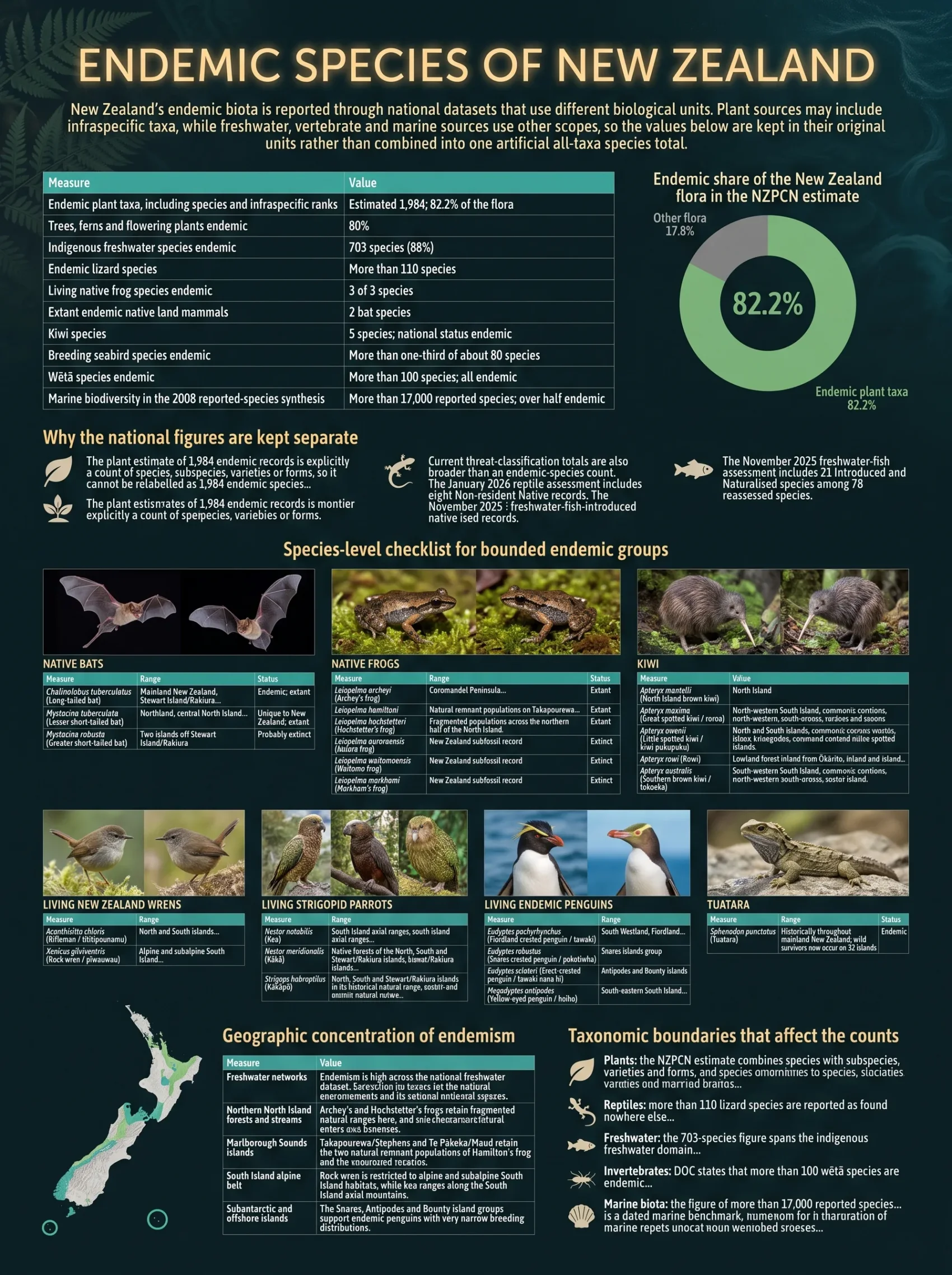
New Zealand’s endemic biota is reported through national datasets that use different biological units. Plant sources may include infraspecific taxa, while freshwater, vertebrate and marine sources use other scopes, so the values below are kept in their original units rather than combined into one artificial all-taxa species total.
| Measure | Value |
|---|---|
| Endemic plant taxa, including species and infraspecific ranks | Estimated 1,984; 82.2% of the flora [S1] |
| Trees, ferns and flowering plants endemic | 80% [S2] |
| Indigenous freshwater species endemic | 703 species (88%) [S3] |
| Endemic lizard species | More than 110 species [S4] |
| Living native frog species endemic | 3 of 3 species [S5] |
| Extant endemic native land mammals | 2 bat species [S6] [S7] [S8] |
| Kiwi species | 5 species; national status endemic [S9] |
| Breeding seabird species endemic | More than one-third of about 80 species [S10] |
| Wētā species endemic | More than 100 species; all endemic [S11] |
| Marine biodiversity in the 2008 reported-species synthesis | More than 17,000 reported species; over half endemic [S12] |
{"type":"donut","title":"Endemic share of the New Zealand flora in the NZPCN estimate","unit":"%","data":[{"label":"Endemic plant taxa","value":82.2},{"label":"Other flora","value":17.8}],"source":"[S1] New Zealand Plant Conservation Network"}Why the national figures are kept separate
The plant estimate of 1,984 endemic records is explicitly a count of species, subspecies, varieties or forms, so it cannot be relabelled as 1,984 endemic species. The 703 freshwater figure is a species count within the indigenous freshwater dataset, while the marine figure is a dated synthesis of reported marine species. These units describe different biological universes and should not be summed. [S1] [S3] [S12]
Current threat-classification totals are also broader than an endemic-species count. The January 2026 reptile assessment includes eight Non-resident Native records and one Introduced and Naturalised record. [S13] The November 2025 freshwater-fish assessment includes 21 Introduced and Naturalised species among 78 reassessed species. [S14] Neither assessment total is an endemic-species total.
Species-level checklist for bounded endemic groups
The tables below cover bounded vertebrate groups for which current specialist sources provide species identities, endemic status or natural-range evidence at species rank. They do not represent the whole endemic biota of New Zealand; the national plant, lizard, freshwater, marine and invertebrate datasets above are much larger than these manageable species groups.
Native bats
New Zealand has two extant native land-mammal species, both bats. A third native bat, the greater short-tailed bat, has not been confirmed since 1967 and is regarded by DOC as probably extinct. [S6] [S8]
| Scientific name | Common name | Natural endemic range | Status in source |
|---|---|---|---|
| Chalinolobus tuberculatus | Long-tailed bat | Mainland New Zealand, Stewart Island/Rakiura, Hauturu-o-Toi, Aotea and Kapiti Island | Endemic; extant [S7] |
| Mystacina tuberculata | Lesser short-tailed bat | Northland, central North Island, Taranaki, East Cape, Whenua Hou and Fiordland across its three subspecies | Unique to New Zealand; extant [S8] |
| Mystacina robusta | Greater short-tailed bat | Two islands off Stewart Island/Rakiura | Probably extinct; last sighted in 1967 [S8] |
Native frogs
NZFrogs recognises three living native Leiopelma species, all endemic, and three named native species that disappeared after human arrival. [S5]
| Scientific name | Common name | Natural endemic range | Status |
|---|---|---|---|
| Leiopelma archeyi | Archey’s frog | Coromandel Peninsula and Whareorino Conservation Area, North Island; Pureora population is translocated | Extant [S15] |
| Leiopelma hamiltoni | Hamilton’s frog | Natural remnant populations on Takapourewa/Stephens Island and Te Pākeka/Maud Island, Marlborough Sounds | Extant [S16] |
| Leiopelma hochstetteri | Hochstetter’s frog | Fragmented populations across the northern half of the North Island | Extant [S17] |
| Leiopelma auroraensis | Aurora frog | New Zealand subfossil record | Extinct [S5] |
| Leiopelma waitomoensis | Waitomo frog | New Zealand subfossil record | Extinct [S5] |
| Leiopelma markhami | Markham’s frog | New Zealand subfossil record | Extinct [S5] |
Kiwi
DOC recognises five living kiwi species and gives the group a national status of endemic. [S9]
| Scientific name | Common name | Natural endemic range |
|---|---|---|
| Apteryx mantelli | North Island brown kiwi | North Island [S18] |
| Apteryx maxima | Great spotted kiwi / roroa | North-western South Island, including north-west Nelson, Paparoa Range and the northern Southern Alps [S19] |
| Apteryx owenii | Little spotted kiwi / kiwi pukupuku | North and South islands in its historical natural range [S20] |
| Apteryx rowi | Rowi | Lowland forest inland from Ōkārito, South Westland, as the native core range [S21] |
| Apteryx australis | Southern brown kiwi / tokoeka | South-western South Island and Stewart Island/Rakiura [S22] |
Living New Zealand wrens
The endemic family Acanthisittidae has two living species. [S23] [S24]
| Scientific name | Common name | Natural endemic range |
|---|---|---|
| Acanthisitta chloris | Rifleman / tītitipounamu | North and South islands, with a sparse presence on Stewart Island/Rakiura [S23] |
| Xenicus gilviventris | Rock wren / pīwauwau | Alpine and subalpine South Island, centred on the Southern Alps and associated ranges [S24] |
Living strigopid parrots
| Scientific name | Common name | Natural endemic range |
|---|---|---|
| Nestor notabilis | Kea | South Island axial ranges from the north-west to Fiordland and the Kaikōura ranges [S25] |
| Nestor meridionalis | Kākā | Native forests of the North, South and Stewart/Rakiura islands and associated offshore islands [S26] |
| Strigops habroptilus | Kākāpō | North, South and Stewart/Rakiura islands in its historical natural range; surviving birds are now managed on predator-free sites [S27] |
Living endemic penguins
| Scientific name | Common name | Native breeding range |
|---|---|---|
| Eudyptes pachyrhynchus | Fiordland crested penguin / tawaki | South Westland, Fiordland, Stewart Island/Rakiura and nearby islands [S28] |
| Eudyptes robustus | Snares crested penguin / pokotiwha | Snares Islands group [S29] |
| Eudyptes sclateri | Erect-crested penguin / tawaki nana hī | Antipodes and Bounty islands [S30] |
| Megadyptes antipodes | Yellow-eyed penguin / hoiho | South-eastern South Island, Stewart Island/Rakiura, Auckland Islands and Campbell Island [S31] |
Tuatara
| Scientific name | Common name | Natural endemic range | Status |
|---|---|---|---|
| Sphenodon punctatus | Tuatara | Historically throughout mainland New Zealand; wild survivors now occur on 32 islands | Endemic [S32] |
Geographic concentration of endemism
| Geographic setting | Endemism pattern |
|---|---|
| Freshwater networks | Endemism is high across the national freshwater dataset, with 703 indigenous freshwater species reported as endemic. [S3] |
| Northern North Island forests and streams | Archey’s and Hochstetter’s frogs retain fragmented natural ranges here, including Coromandel, Whareorino and multiple northern stream systems. [S15] [S17] |
| Marlborough Sounds islands | Takapourewa/Stephens and Te Pākeka/Maud retain the two natural remnant populations of Hamilton’s frog; later translocations do not expand its original native range. [S16] |
| South Island alpine belt | Rock wren is restricted to alpine and subalpine South Island habitats, while kea ranges along the South Island axial mountains. [S24] [S25] |
| Subantarctic and offshore islands | The Snares, Antipodes and Bounty island groups support endemic penguins with very narrow breeding distributions. [S29] [S30] |
Taxonomic boundaries that affect the counts
Plants: the NZPCN estimate combines species with subspecies, varieties and forms. It is a plant-taxon measure, not a species-only count. [S1]
Reptiles: more than 110 lizard species are reported as found nowhere else, but the latest national threat assessment also contains Non-resident Native and Introduced and Naturalised records. Its assessment total should not be treated as an endemic-reptile total. [S4] [S13]
Freshwater: the 703-species figure spans the indigenous freshwater domain. The newer freshwater-fish threat assessment is narrower and includes introduced species, so the two datasets answer different questions. [S3] [S14]
Invertebrates: DOC states that more than 100 wētā species are endemic. That figure describes wētā and is not a proxy for all New Zealand invertebrates. [S11]
Marine biota: the figure of more than 17,000 reported species with over half endemic comes from a 2008 synthesis cited by DOC. It is useful as a dated marine benchmark, not as a current all-taxa national total. [S12]
Sources
[S1] ↩ New Zealand Plant Conservation Network — FAQs: New Zealand plants. National flora estimate and definition of the mixed-rank endemic plant-taxon count.
[S2] ↩ Department of Conservation — Native plants. National plant-endemism percentage.
[S3] ↩ Department of Conservation — Biodiversity factsheet: freshwater domain. Indigenous freshwater species and endemism figures.
[S4] ↩ New Zealand Herpetological Society — Conservation status. Endemic lizard diversity.
[S5] ↩ NZFrogs — Native frogs. Three living endemic species and three named extinct native frogs.
[S6] ↩ Department of Conservation — Bats/pekapeka. Two extant native land-mammal species.
[S7] ↩ Department of Conservation — Long-tailed bat. Endemic status, accepted species name and New Zealand distribution.
[S8] ↩ Department of Conservation — Short-tailed bat. Lesser short-tailed bat range and greater short-tailed bat status.
[S9] ↩ Department of Conservation — Facts and threats to kiwi. Five living kiwi species and national endemic status.
[S10] ↩ Department of Conservation — Sea and shore birds. Endemic share of seabirds breeding in New Zealand.
[S11] ↩ Department of Conservation — Invertebrates. Wētā diversity and endemic status.
[S12] ↩ Department of Conservation — New Zealand’s marine biodiversity. 2008 reported-species synthesis and marine endemism benchmark.
[S13] ↩ Department of Conservation — Conservation status of reptiles in Aotearoa New Zealand, 2025. New Zealand Threat Classification Series 50, January 2026.
[S14] ↩ Department of Conservation — Conservation status of New Zealand freshwater fishes, 2023. New Zealand Threat Classification Series 46, November 2025.
[S15] ↩ NZFrogs — Archey’s frog. Species identity, natural range and 2025 conservation status.
[S16] ↩ NZFrogs — Hamilton’s frog. Species identity and two natural remnant island populations.
[S17] ↩ NZFrogs — Hochstetter’s frog. Species identity and fragmented North Island distribution.
[S18] ↩ New Zealand Birds Online — North Island brown kiwi. Accepted name, endemic status and range.
[S19] ↩ New Zealand Birds Online — Great spotted kiwi. Current name Apteryx maxima, endemic status and range.
[S20] ↩ New Zealand Birds Online — Little spotted kiwi / kiwi pukupuku. Endemic status and historical natural range.
[S21] ↩ New Zealand Birds Online — Rowi / Okarito brown kiwi. Accepted species name, endemic status and native core range.
[S22] ↩ New Zealand Birds Online — Southern brown kiwi / tokoeka. Endemic status and range.
[S23] ↩ New Zealand Birds Online — Rifleman / tītitipounamu. Endemic status and distribution.
[S24] ↩ New Zealand Birds Online — Rock wren / pīwauwau. Endemic status and South Island alpine distribution.
[S25] ↩ New Zealand Birds Online — Kea. Endemic status and South Island range.
[S26] ↩ New Zealand Birds Online — Kākā. Endemic status and distribution.
[S27] ↩ New Zealand Birds Online — Kākāpō. Endemic status, historical natural range and current managed distribution.
[S28] ↩ New Zealand Birds Online — Fiordland crested penguin / tawaki. Endemic status and breeding distribution.
[S29] ↩ New Zealand Birds Online — Snares crested penguin / pokotiwha. Endemic status and Snares Islands breeding range.
[S30] ↩ New Zealand Birds Online — Erect-crested penguin / tawaki nana hī. Endemic status and Antipodes/Bounty breeding range.
[S31] ↩ New Zealand Birds Online — Yellow-eyed penguin / hoiho. Endemic status and breeding distribution.
[S32] ↩ Department of Conservation — Tuatara. Endemic status and present wild distribution.