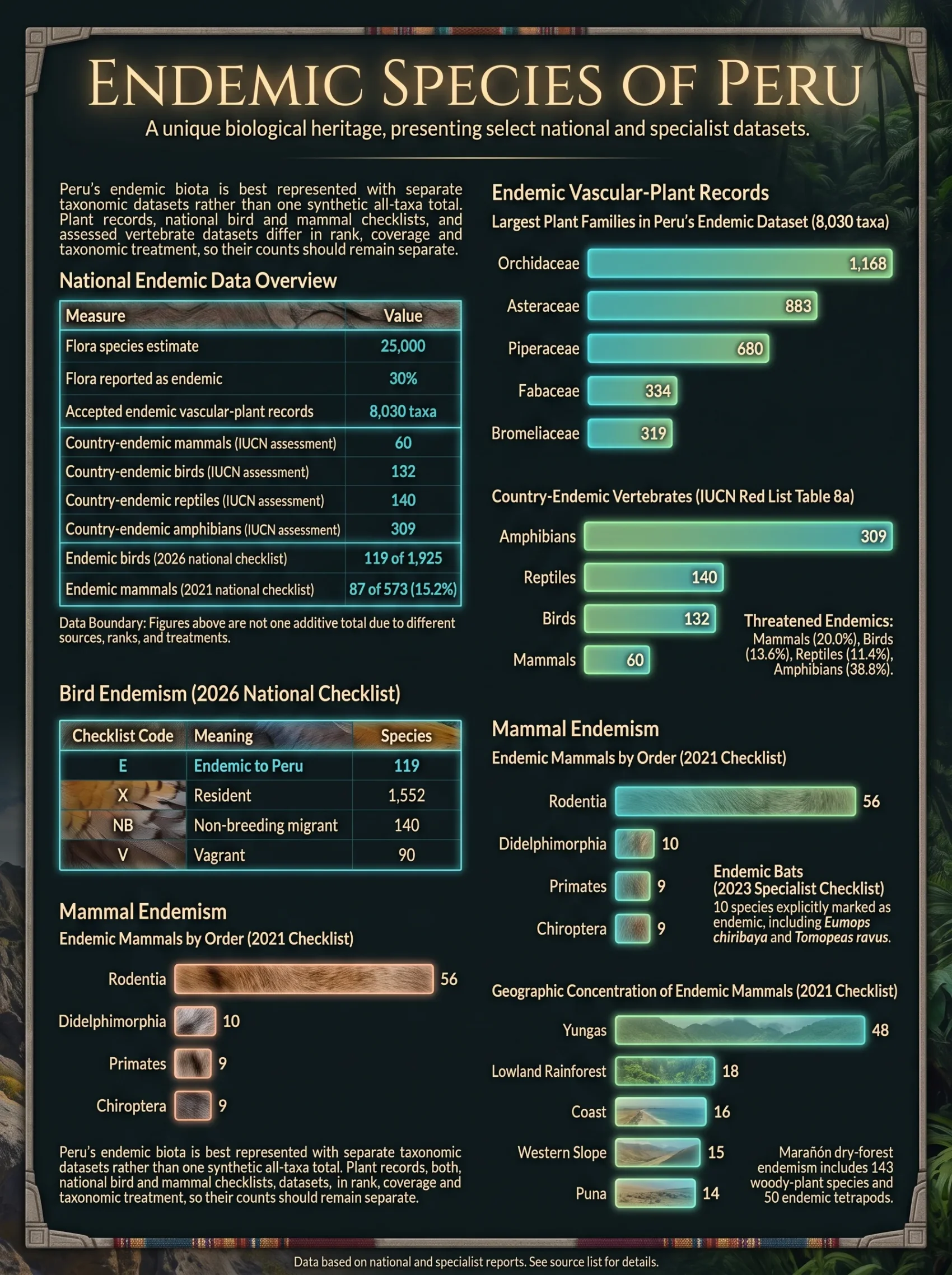
Peru’s endemic biota is best represented with separate taxonomic datasets rather than one synthetic all-taxa total. Plant records, national bird and mammal checklists, and assessed vertebrate datasets differ in rank, coverage and taxonomic treatment, so their counts should remain separate.
| Measure | Value |
|---|---|
| Flora species estimate | 25,000 [S1] |
| Flora reported as endemic | 30% [S1] |
| Accepted endemic vascular-plant taxonomic records | 8,030 taxa [S2] |
| Families represented in endemic vascular-plant records | 165 [S2] |
| Genera represented in endemic vascular-plant records | 1,121 [S2] |
| Country-endemic mammals in the assessed-group treatment | 60 [S3] |
| Threatened endemics among those mammals | 12 [S3] |
| Country-endemic birds in the assessed-group treatment | 132 [S3] |
| Threatened endemics among those birds | 18 [S3] |
| Country-endemic reptiles in the assessed-group treatment | 140 [S3] |
| Threatened endemics among those reptiles | 16 [S3] |
| Country-endemic amphibians in the assessed-group treatment | 309 [S3] |
| Threatened endemics among those amphibians | 120 [S3] |
| Endemic birds in the 2026 national checklist | 119 of 1,925 [S4] |
| Endemic mammals in the 2021 national checklist | 87 of 573 (15.2%) [S5] |
| Living mammals in the current country record | 585 [S6] |
| Endemic bats in the 2023 specialist checklist | 10 of 195 [S7] |
Data boundary: the figures above are not components of one additive total. The 8,030 plant records include species and infraspecific taxa; the IUCN values come from a defined assessed-group treatment; the bird and mammal figures come from separate national checklists. The 87 endemic mammals from the 2021 checklist should not be divided by the current 585-species Mammal Diversity Database total because the two values use different taxonomic versions.
Endemic vascular-plant records under WCVP V16
The WCVP V16-derived ppendemic release, extracted on 4 June 2026, contains 8,030 accepted taxonomic records restricted to Peru across 165 families and 1,121 genera. The dataset includes records at species and infraspecific ranks, so 8,030 is a taxon-record count and must not be presented as 8,030 distinct species. Introduced, cultivated, synonymic, misapplied and unplaced names are excluded from the endemic dataset. [S2]
The national natural-heritage inventory uses a broader flora estimate: about 25,000 flora species, with 30% reported as endemic. [S1] That percentage and the WCVP-derived 8,030-record dataset should not be converted into a single revised species total because their taxonomic ranks and inventory scopes differ.
| Plant family | Accepted endemic taxonomic records |
|---|---|
| Orchidaceae | 1,168 |
| Asteraceae | 883 |
| Piperaceae | 680 |
| Fabaceae | 334 |
| Bromeliaceae | 319 |
| Solanaceae | 314 |
| Melastomataceae | 263 |
| Araceae | 214 |
| Cactaceae | 188 |
| Rubiaceae | 176 |
{
  "type": "bar",
  "title": "Largest families in Peru's WCVP V16-derived endemic-plant dataset",
  "description": "Accepted endemic taxonomic records by family. Counts include species and infraspecific taxa.",
  "unit": "taxonomic records",
  "orientation": "horizontal",
  "data": [
    {"label": "Orchidaceae", "value": 1168},
    {"label": "Asteraceae", "value": 883},
    {"label": "Piperaceae", "value": 680},
    {"label": "Fabaceae", "value": 334},
    {"label": "Bromeliaceae", "value": 319},
    {"label": "Solanaceae", "value": 314},
    {"label": "Melastomataceae", "value": 263},
    {"label": "Araceae", "value": 214},
    {"label": "Cactaceae", "value": 188},
    {"label": "Rubiaceae", "value": 176}
  ],
  "source": "[S2] ppendemic, WCVP V16-derived release, 4 June 2026"
}
Country-endemic vertebrates in the IUCN assessed-group table
IUCN Red List Table 8a version 2025-2 records species known to occur naturally within one country only and reports country endemics for vertebrate groups with more than 80% of species assessed. Under that treatment, Peru has 60 endemic mammals, 132 endemic birds, 140 endemic reptiles and 309 endemic amphibians. [S3]
| Group | Country-endemic species | Threatened endemics | Threatened share | EX/EW endemics |
|---|---|---|---|---|
| Mammals | 60 | 12 | 20.0% | 1 |
| Birds | 132 | 18 | 13.6% | 0 |
| Reptiles | 140 | 16 | 11.4% | 0 |
| Amphibians | 309 | 120 | 38.8% | 0 |
Threatened share is calculated within each IUCN row from the threatened-endemic count divided by the total endemic count. “Threatened” covers CR, EN and VU in this table; EX/EW is reported separately.
{
  "type": "bar",
  "title": "Country-endemic vertebrates in Peru under IUCN Table 8a",
  "description": "Species known to occur naturally only in Peru within the four assessed vertebrate groups shown.",
  "unit": "species",
  "orientation": "horizontal",
  "data": [
    {"label": "Amphibians", "value": 309},
    {"label": "Reptiles", "value": 140},
    {"label": "Birds", "value": 132},
    {"label": "Mammals", "value": 60}
  ],
  "source": "[S3] IUCN Red List Table 8a, version 2025-2"
}
Bird endemism under the 2026 Peru checklist
The Unión de Ornitólogos del Perú checklist updated on 23 March 2026 recognizes 1,925 bird species. Its occurrence codes include 1,552 residents, 119 endemics, 140 non-breeding migrants, 90 vagrants, 3 introduced species, 21 unconfirmed records and no extirpated species. The list follows South American Checklist Committee taxonomy through 27 February 2026. [S4]
| Checklist code | Meaning | Species |
|---|---|---|
| E | Endemic to Peru | 119 |
| X | Resident | 1,552 |
| NB | Non-breeding migrant | 140 |
| V | Vagrant | 90 |
| IN | Introduced | 3 |
| U | Unconfirmed | 21 |
| EX | Extirpated | 0 |
The 2026 national bird checklist gives 119 endemics, while IUCN Table 8a version 2025-2 gives 132 country-endemic birds. These values should not be averaged or treated as interchangeable. The national checklist follows SACC taxonomy and its own inclusion codes, whereas the IUCN table is tied to the Red List’s assessment and taxonomic treatment. A species-by-species reconciliation would be required before attributing the 13-species difference to particular splits, lumps or distribution changes. [S4] [S3]
Marañón dry-forest endemism
The inter-Andean seasonally dry tropical forests of the Marañón valley form a sharply defined regional endemism system across parts of Cajamarca, Amazonas, Piura, La Libertad, Ancash and Huánuco. A 2021 review reported 143 woody-plant species endemic to the Marañón valley and 50 endemic tetrapods in its regional treatment: 4 amphibians, 28 reptiles, 13 birds and 5 mammals. [S8]
| Regional group | Endemic species reported | Scope in the study |
|---|---|---|
| Woody flora | 143 | Endemic to the Marañón valley dry-forest system |
| Amphibians | 4 | Peru endemics recorded in the regional fauna treatment |
| Reptiles | 28 | Peru endemics reported with distribution in the regional system |
| Birds | 13 | Peru endemics recorded in the regional bird assemblage |
| Mammals | 5 | Peru endemics recorded in the regional mammal assemblage |
These are subnational study counts. They describe endemism within or represented in the Marañón dry-forest system and must not be added to Peru’s national taxonomic totals.
Mammal endemism in the 2021 national checklist
The November 2021 national mammal checklist recorded 573 species and 87 Peru endemics, or 15.2% under that checklist’s treatment. Six of the 13 mammal orders contained endemic species. Rodents accounted for 56 of the 87 endemics, followed by didelphimorph marsupials with 10, primates and bats with 9 each, eulipotyphlans with 2 and cingulates with 1. [S5]
| Order | Species in checklist | Endemic species | Endemic share within order |
|---|---|---|---|
| Didelphimorphia | 47 | 10 | 21.3% |
| Paucituberculata | 2 | 0 | 0% |
| Sirenia | 1 | 0 | 0% |
| Cingulata | 5 | 1 | 20.0% |
| Pilosa | 7 | 0 | 0% |
| Primates | 42 | 9 | 21.4% |
| Rodentia | 194 | 56 | 28.9% |
| Lagomorpha | 2 | 0 | 0% |
| Eulipotyphla | 3 | 2 | 66.7% |
| Chiroptera | 189 | 9 | 4.8% |
| Carnivora | 33 | 0 | 0% |
| Perissodactyla | 2 | 0 | 0% |
| Artiodactyla | 46 | 0 | 0% |
| Total | 573 | 87 | 15.2% |
Order-level shares are derived only from the total and endemic counts in the same 2021 checklist.
{
  "type": "bar",
  "title": "Endemic mammals by order in the 2021 Peru checklist",
  "description": "Orders with at least one endemic species in the national mammal checklist.",
  "unit": "species",
  "orientation": "horizontal",
  "data": [
    {"label": "Rodentia", "value": 56},
    {"label": "Didelphimorphia", "value": 10},
    {"label": "Primates", "value": 9},
    {"label": "Chiroptera", "value": 9},
    {"label": "Eulipotyphla", "value": 2},
    {"label": "Cingulata", "value": 1}
  ],
  "source": "[S5] Pacheco et al., Peru mammal checklist, 2021"
}
Three mammal genera were treated as endemic to Peru in the same checklist: Eremoryzomys, Cuscomys and Tomopeas. Tomopeas was associated with the western Andean slope, Cuscomys with the southern Yungas and Eremoryzomys with the Marañón valley. [S5]
Taxonomic version boundary: the 2021 national checklist reports 87 endemic mammals, while IUCN Table 8a version 2025-2 reports 60 country-endemic mammals under its own assessment treatment. [S5] [S3] The difference is a dataset difference, not evidence that 27 endemic mammals disappeared. The Mammal Diversity Database now lists 585 living mammal species for Peru. [S6] A new endemic percentage should not be calculated by pairing the 87 endemic mammals from the 2021 checklist with the later 585-species total.
Geographic concentration of endemic mammals
The 2021 mammal checklist also reports ecoregional occurrence. The Yungas contain records for 48 of the checklist’s endemic mammals, the largest ecoregional count in that treatment. Lowland rainforest follows with 18, the coast with 16, the western slope with 15 and the Puna with 14. [S5]
| Ecoregion | Mammal species | Endemic species recorded |
|---|---|---|
| Oceanic | 30 | 0 |
| Pacific Rainforest | 69 | 0 |
| Equatorial Dry Forest | 81 | 4 |
| Coast | 66 | 16 |
| Western Slope | 71 | 15 |
| Páramo | 26 | 4 |
| Puna | 71 | 14 |
| Yungas | 256 | 48 |
| Lowland Rainforest | 320 | 18 |
| Palm Savanna | 78 | 0 |
{
  "type": "bar",
  "title": "Endemic mammals recorded by ecoregion in the 2021 checklist",
  "description": "Counts of endemic mammals recorded in each ecoregion. A species may occur in more than one ecoregion, so bars are not additive.",
  "unit": "endemic species recorded",
  "orientation": "horizontal",
  "data": [
    {"label": "Yungas", "value": 48},
    {"label": "Lowland Rainforest", "value": 18},
    {"label": "Coast", "value": 16},
    {"label": "Western Slope", "value": 15},
    {"label": "Puna", "value": 14},
    {"label": "Equatorial Dry Forest", "value": 4},
    {"label": "Páramo", "value": 4},
    {"label": "Oceanic", "value": 0},
    {"label": "Pacific Rainforest", "value": 0},
    {"label": "Palm Savanna", "value": 0}
  ],
  "source": "[S5] Pacheco et al., Peru mammal checklist, 2021"
}
Ecoregional values overlap. One endemic mammal can occur in more than one ecoregion, so the rows must not be summed to produce a national endemic-mammal total.
Complete endemic-bat subset in the 2023 specialist checklist
Velazco’s specialist Peru bat checklist, updated on 17 October 2023, lists 195 bat species and explicitly marks 10 species as endemic. All 10 are included below, making this a complete source-defined endemic-bat subset rather than an arbitrary sample of Peru’s endemic fauna. [S7]
| Scientific name | Family | Endemic scope | Source basis |
|---|---|---|---|
| Eumops chiribaya | Molossidae | Peru | [S7] |
| Mormopterus phrudus | Molossidae | Peru | [S7] |
| Tomopeas ravus | Molossidae | Peru | [S7] |
| Anoura javieri | Phyllostomidae | Peru | [S7] |
| Hsunycteris dashe | Phyllostomidae | Peru | [S7] |
| Micronycteris matses | Phyllostomidae | Peru | [S7] |
| Sturnira nana | Phyllostomidae | Peru | [S7] |
| Lasiurus arequipae | Vespertilionidae | Peru | [S7] |
| Myotis bakeri | Vespertilionidae | Peru | [S7] |
| Histiotus mochica | Vespertilionidae | Peru | [S7] |
Names and endemic status in this table follow the cited 2023 specialist bat checklist. The subset is kept separate from the 2021 national mammal checklist because the two datasets use different dates and taxonomic treatments.
Range and rank rules behind Peru endemic counts
- Country endemism is a native-range statement. IUCN Table 8 defines a country endemic as a species known to occur naturally within one country only; the 2026 Peru bird checklist likewise uses its endemic code for species whose entire known range is within Peru. [S3] [S4]
- Introduced or cultivated records do not widen native endemic range. The WCVP-derived endemic-plant dataset filters out introduced and cultivated records, while IUCN’s definition is based on natural occurrence. [S2] [S3]
- Species and infraspecific taxa must remain separate. The 8,030 WCVP-derived plant records include ranks below species, while the IUCN Table 8 figures are species counts. The two cannot be added as if they were the same unit. [S2] [S3]
- Taxonomic revisions can change an endemic count without a biological range expansion. Splits, synonymization and revised distributions change which accepted species are counted. This is why the bird and mammal totals are tied to dated taxonomic treatments rather than presented as timeless constants. [S4] [S5]
Sources
[S1] ↩ Ministerio del Ambiente / SINIA — Primer Reporte del Inventario Nacional del Patrimonio Natural: Análisis al 2021. Published 8 May 2024; national flora and biodiversity inventory figures.
[S2] ↩ Santos Andrade & Vilca Bustamante — ppendemic: Accepted Endemic Plant Taxa from Peru. WCVP V16-derived release extracted 4 June 2026.
[S3] ↩ IUCN Red List — Table 8a: total, threatened, and EX & EW endemic vertebrate species by country, version 2025-2. Country-endemic mammal, bird, reptile and amphibian counts for assessed groups.
[S4] ↩ Plenge & Angulo / Unión de Ornitólogos del Perú — Lista de las aves del Perú / List of the birds of Peru. Version updated 23 March 2026; SACC-based national checklist.
[S5] ↩ Pacheco et al. — Updated list of the diversity of mammals from Peru and a proposal for its updating. Revista Peruana de Biología 28(4), 2021; national mammal checklist and ecoregional counts.
[S6] ↩ Mammal Diversity Database — Peru country mammal diversity. Current country record with 585 living species, 13 orders, 56 families and 229 genera.
[S7] ↩ Velazco — Murciélagos del Perú / Bats of Peru. Specialist checklist updated 17 October 2023; 195 species and a 10-species Peru-endemic subset.
[S8] ↩ Guzman et al. — Endemism of woody flora and tetrapod fauna, and conservation status of the inter-Andean Seasonally Dry Tropical Forests of the Marañón valley. Global Ecology and Conservation 28 (2021), e01639; regional endemism review.