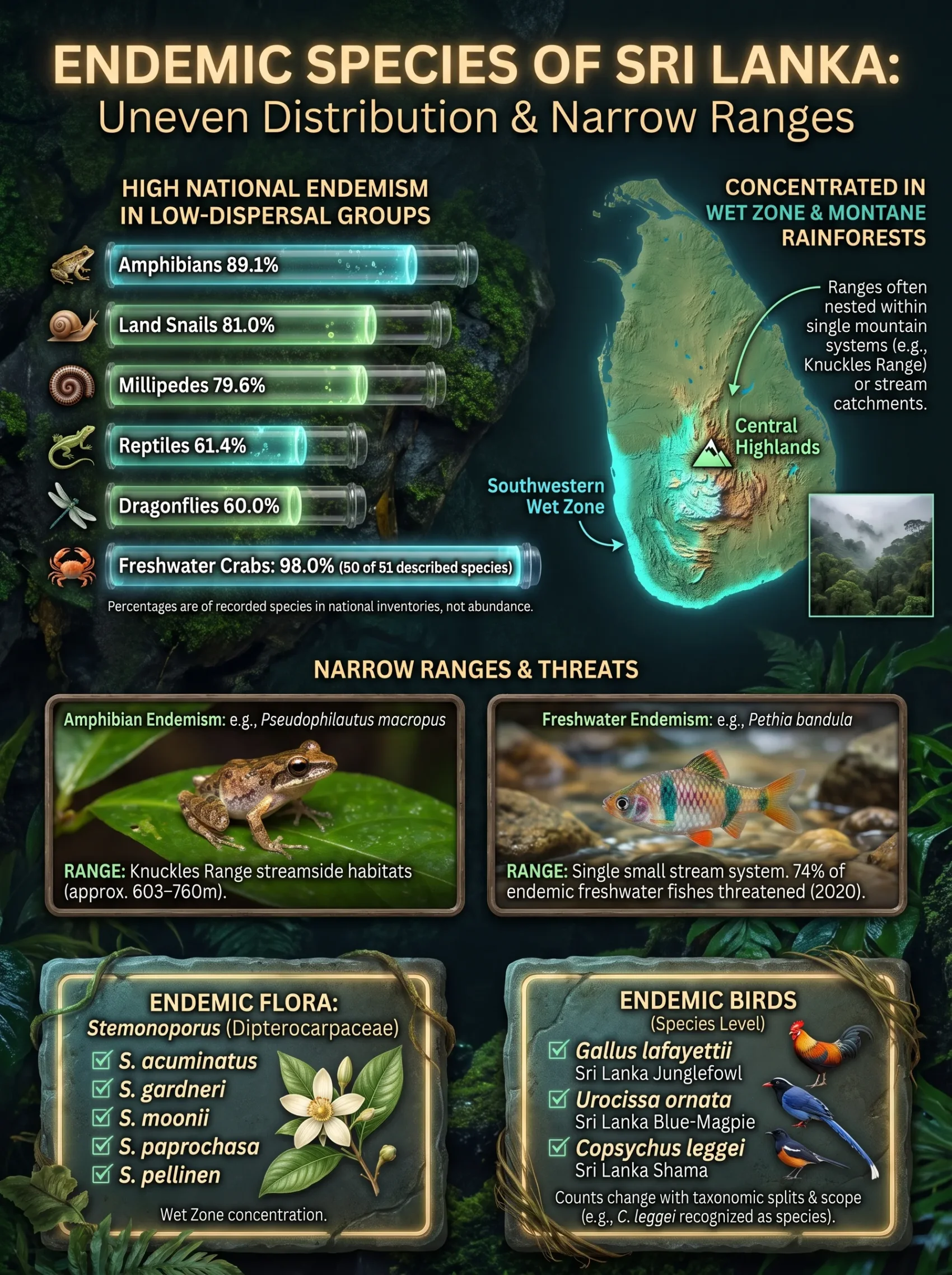
Sri Lanka’s endemic biota is distributed unevenly across taxonomic groups, with especially high national endemism ratios in amphibians, land snails, millipedes, reptiles and several other low-dispersal groups. The national inventories below retain their stated taxonomic scopes instead of being added into a synthetic all-taxa total. [S1]
| Measure | Value |
|---|---|
| Flowering plants | 863 of 3,087 species (28.0%) [S1] |
| Mammals, including marine species | 19 of 140 species (13.6%) [S1] |
| Birds, national-policy treatment | 33 of 510 species (6.5%) [S1] |
| Reptiles, including marine species | 135 of 220 species (61.4%) [S1] |
| Amphibians | 106 of 119 species (89.1%) [S1] |
| Land snails | 205 of 253 species (81.0%) [S1] |
| Butterflies | 31 of 248 species (12.5%) [S1] |
| Dragonflies and damselflies | 78 of 130 species (60.0%) [S1] |
| Scorpions | 14 of 19 species (73.7%) [S1] |
| Spiders | 275 of 563 species (48.8%) [S1] |
| Termites | 18 of 72 species (25.0%) [S1] |
| Ants | 33 of 229 species (14.4%) [S1] |
| Bees | 22 of 159 species (13.8%) [S1] |
| Millipedes | 82 of 103 species (79.6%) [S1] |
| Endemic freshwater fishes assessed | 61 species [S2] |
| Freshwater crabs | 50 of 51 described species (98.0%) [S3] |
{
  "type": "bar",
  "title": "Endemic share of recorded species in selected national groups",
  "description": "Percentages calculated from endemic and recorded-species counts reported within the same national dataset. Freshwater fish and crab figures are excluded because their denominators use different scopes.",
  "unit": "%",
  "orientation": "horizontal",
  "min": 0,
  "max": 100,
  "data": [
    {"label": "Amphibians", "value": 89.1, "display": "89.1%"},
    {"label": "Land snails", "value": 81.0, "display": "81.0%"},
    {"label": "Millipedes", "value": 79.6, "display": "79.6%"},
    {"label": "Scorpions", "value": 73.7, "display": "73.7%"},
    {"label": "Reptiles, including marine species", "value": 61.4, "display": "61.4%"},
    {"label": "Dragonflies and damselflies", "value": 60.0, "display": "60.0%"},
    {"label": "Spiders", "value": 48.8, "display": "48.8%"},
    {"label": "Flowering plants", "value": 28.0, "display": "28.0%"},
    {"label": "Termites", "value": 25.0, "display": "25.0%"},
    {"label": "Ants", "value": 14.4, "display": "14.4%"},
    {"label": "Bees", "value": 13.8, "display": "13.8%"},
    {"label": "Mammals, including marine species", "value": 13.6, "display": "13.6%"},
    {"label": "Butterflies", "value": 12.5, "display": "12.5%"},
    {"label": "Birds, national-policy treatment", "value": 6.5, "display": "6.5%"}
  ],
  "source": "[S1] Ministry of Environment, Sri Lanka"
}
Where endemic ranges concentrate
Sri Lanka’s biodiversity policy places the highest levels of endemism in the southwestern lowland and montane rainforests and in the Central Highlands. The island’s short geographic distances conceal steep changes in rainfall, elevation and forest type, so national endemics can occupy only a fraction of the country even when their entire global range lies inside Sri Lanka. [S1]
The Central Highlands World Heritage property consists of Peak Wilderness Protected Area, Horton Plains National Park and Knuckles Conservation Forest. UNESCO describes these areas as major remnants of Sri Lanka’s submontane and montane rain forests and records a high concentration of endemic vertebrates and plants within the montane forest–grassland system. [S4]
| Geographic unit | Endemism pattern |
|---|---|
| Southwestern Wet Zone | Lowland and montane rainforests hold many of the country’s narrow-range amphibians, reptiles, land snails, plants and freshwater taxa. [S1] |
| Central Highlands | Montane forest and adjoining grassland concentrate endemic vertebrates and flowering plants across Peak Wilderness, Horton Plains and the Knuckles component. [S4] |
| Knuckles Range | Topographic isolation and streamside habitats support species with ranges limited to this mountain system, including endemic shrub frogs documented from the range. [S4] |
Low-dispersal groups carry the highest endemic shares
The national ratios show a clear taxonomic pattern. Amphibians account for 106 endemics among 119 recorded species in the cited national treatment, while land snails account for 205 of 253 and millipedes 82 of 103. Scorpions, reptiles, dragonflies and damselflies also exceed 60% or approach it. These percentages describe the endemic share of each source-defined species inventory; they do not measure abundance or population size. [S1]
For organisms with limited dispersal, forest fragmentation, mountain isolation and drainage boundaries can separate populations across short distances. Sri Lanka’s topographic and climatic variation therefore produces nested ranges: a species may be endemic to Sri Lanka at country scale while its actual native distribution is confined to one mountain block, wet-zone forest complex or stream system.
Amphibian endemism can narrow to individual mountain systems
The 106-of-119 national figure makes amphibians the highest-endemism vertebrate group in the national dataset. Species accounts also show how much smaller the real ranges of individual endemics can be. Pseudophilautus hallidayi is known from only two Sri Lankan wet-forest localities: the Hanthana Range near Kandy at 510–800 m and Tonacombe Estate at Namunukula at about 1,240 m. [S5]
Pseudophilautus macropus has an even more clearly mountain-bound distribution in the current Amphibian Species of the World account: streamside habitats in the Knuckles Range at roughly 603–760 m elevation. [S6]
| Species | Supported native range |
|---|---|
| Pseudophilautus hallidayi | Hanthana Range, Kandy; and Tonacombe Estate, Namunukula [S5] |
| Pseudophilautus macropus | Streamside habitats in the Knuckles Range [S6] |
A country-endemic label gives the outer boundary of a species’ natural range. It does not mean the species occurs throughout Sri Lanka. For narrow-range frogs, the useful geographic record may be a named mountain range or a small set of wet-forest localities.
Freshwater endemism follows drainage boundaries
Sri Lanka’s 2020 national freshwater-fish assessment evaluated 61 endemic species. Twelve point-endemic species were listed as Critically Endangered, 24 range-restricted species as Endangered and nine as Vulnerable; five were Near Threatened, two Data Deficient and the remaining nine Least Concern. The assessment reports 74% of the endemic freshwater fishes as threatened. [S2]
| 2020 freshwater-fish category | Endemic species |
|---|---|
| Critically Endangered point endemics | 12 [S2] |
| Endangered range-restricted species | 24 [S2] |
| Vulnerable | 9 [S2] |
| Near Threatened | 5 [S2] |
| Data Deficient | 2 [S2] |
| Least Concern | 9 [S2] |
{
  "type": "bar",
  "title": "National Red List categories for 61 endemic freshwater fishes",
  "description": "Species counts in the 2020 national assessment. The first three categories are the threatened categories used in the reported 74% threatened share.",
  "unit": "species",
  "orientation": "horizontal",
  "data": [
    {"label": "Endangered", "value": 24},
    {"label": "Critically Endangered", "value": 12},
    {"label": "Vulnerable", "value": 9},
    {"label": "Least Concern", "value": 9},
    {"label": "Near Threatened", "value": 5},
    {"label": "Data Deficient", "value": 2}
  ],
  "source": "[S2] National Red List of Sri Lanka: Freshwater Fishes 2020"
}
Drainage-scale restriction is visible in individual records. The Bandula barb, Pethia bandula, is recorded by FishBase only from a small unnamed stream through Minimaru Coloniya in Pallegama Estate near Galapitamada. Its global range is therefore far narrower than the outline of Sri Lanka itself. [S7]
Freshwater crabs show an even higher species-level endemic proportion in a 2025 specialist treatment: 50 of 51 described species are endemic. The same study found freshwater-crab hotspots concentrated in the Central Highlands and the southwestern and western lowlands of the Wet Zone. [S3]
Flowering-plant endemism and the Wet Zone
The National Red List of Flora 2020 evaluated 3,087 flowering plant species and recognized 863 as endemic. The revision also removed 131 entries that had appeared in the 2012 list because they were naturalized exotics, misidentifications or species whose natural distributions were reassessed as lying outside Sri Lanka. [S8] This is a direct example of how native-range correction can change an endemic inventory without any biological range expansion or contraction occurring.
A Ministry of Environment workshop reporting the National Red List findings stated that 48.4% of Sri Lanka’s endemic flora species were under threat and highlighted the concentration of threatened endemic flora in the Wet Zone. [S9]
An endemic plant genus: Stemonoporus
Kew’s Plants of the World Online accepts Stemonoporus in Dipterocarpaceae, gives the genus a native range restricted to Sri Lanka and lists 26 accepted species in its WCVP-backed 2026 taxonomic backbone. [S10]
Accepted species shown: 26
This is the accepted species set for Stemonoporus in the cited Kew treatment; it is not a substitute for Sri Lanka’s much larger national endemic-flora inventory.
| Scientific name |
|---|
| Stemonoporus acuminatus |
| Stemonoporus affinis |
| Stemonoporus angustisepalus |
| Stemonoporus bullatus |
| Stemonoporus canaliculatus |
| Stemonoporus ceylanicus |
| Stemonoporus cordifolius |
| Stemonoporus elegans |
| Stemonoporus gardneri |
| Stemonoporus gilimalensis |
| Stemonoporus gracilis |
| Stemonoporus kanneliyensis |
| Stemonoporus laevifolius |
| Stemonoporus lanceolatus |
| Stemonoporus lancifolius |
| Stemonoporus latisepalus |
| Stemonoporus marginalis |
| Stemonoporus moonii |
| Stemonoporus nitidus |
| Stemonoporus oblongifolius |
| Stemonoporus petiolaris |
| Stemonoporus reticulatus |
| Stemonoporus revolutus |
| Stemonoporus rigidus |
| Stemonoporus scalarinervis |
| Stemonoporus scaphifolius |
Bird endemics change with taxonomic treatment
The national biodiversity policy reports 33 endemic bird species in its source treatment. [S1] A current species-level treatment differs because avian taxonomy has continued to split formerly broader species. The checklist below follows eBird/Clements v2025 nomenclature [S11] and the Clements-based Sri Lanka country checklist in Avibase, which identifies the country-endemic species records. [S12]
Two documented revisions illustrate the change. Clements split the monotypic Red-backed Flameback Dinopium psarodes from Black-rumped Flameback in 2019. [S13] In 2024 it split White-rumped Shama into four species, recognizing the monotypic Sri Lanka Shama Copsychus leggei; the 2025 edition changed its English name from “Sri Lankan Shama” to “Sri Lanka Shama.” [S14] [S11]
Species-level endemic bird records shown: 35
The count belongs to the stated Clements v2025 treatment. It should not be substituted into older national datasets without also changing their taxonomic basis.
| Common name | Scientific name |
|---|---|
| Sri Lanka Spurfowl | Galloperdix bicalcarata |
| Sri Lanka Junglefowl | Gallus lafayettii |
| Sri Lanka Wood-Pigeon | Columba torringtoniae |
| Sri Lanka Green-Pigeon | Treron pompadora |
| Green-billed Coucal | Centropus chlororhynchos |
| Red-faced Malkoha | Phaenicophaeus pyrrhocephalus |
| Serendib Scops-Owl | Otus thilohoffmanni |
| Chestnut-backed Owlet | Glaucidium castanotum |
| Sri Lanka Gray Hornbill | Ocyceros gingalensis |
| Crimson-fronted Barbet | Psilopogon rubricapillus |
| Yellow-fronted Barbet | Psilopogon flavifrons |
| Crimson-backed Flameback | Chrysocolaptes stricklandi |
| Red-backed Flameback | Dinopium psarodes |
| Layard's Parakeet | Psittacula calthrapae |
| Sri Lanka Hanging-Parrot | Loriculus beryllinus |
| Sri Lanka Woodshrike | Tephrodornis affinis |
| Sri Lanka Drongo | Dicrurus lophorinus |
| Sri Lanka Blue-Magpie | Urocissa ornata |
| Sri Lanka Bush Warbler | Elaphrornis palliseri |
| Sri Lanka Swallow | Cecropis hyperythra |
| Black-capped Bulbul | Rubigula melanictera |
| Yellow-eared Bulbul | Pycnonotus penicillatus |
| Sri Lanka White-eye | Zosterops ceylonensis |
| Sri Lanka Scimitar-Babbler | Pomatorhinus melanurus |
| Brown-capped Babbler | Pellorneum fuscocapillus |
| Ashy-headed Laughingthrush | Argya cinereifrons |
| Orange-billed Babbler | Argya rufescens |
| Sri Lanka Myna | Gracula ptilogenys |
| White-faced Starling | Sturnornis albofrontatus |
| Sri Lanka Thrush | Zoothera imbricata |
| Spot-winged Thrush | Geokichla spiloptera |
| Sri Lanka Shama | Copsychus leggei |
| Dull-blue Flycatcher | Eumyias sordidus |
| Sri Lanka Whistling-Thrush | Myophonus blighi |
| White-throated Flowerpecker | Pachyglossa vincens |
Species and subspecies are separate endemism records
Species-level endemic counts cannot absorb endemic subspecies as additional species. UNESCO treats the Sri Lankan leopard, Panthera pardus kotiya, as a subspecies endemic to Sri Lanka. [S4] Its rank is therefore different from the species-level records in the bird and plant checklists.
| Taxon | Rank used here | Species-level endemic checklist |
|---|---|---|
| Panthera pardus kotiya | Subspecies | Excluded from species count |
| Gallus lafayettii | Species | Included where the source treats its natural range as Sri Lanka only |
The same rank control applies to varieties, forms and named populations. A Sri Lankan vernacular label also does not establish species-level endemism; the accepted rank and natural native range must both support the classification.
Why Sri Lankan endemic counts change
- Species splits and lumps: bird totals can rise or fall when a population is recognized as a full species or merged back into a broader species concept. [S13] [S14]
- Species versus infraspecific ranks: endemic subspecies remain biologically useful records, but they are not species and are not added to species totals.
- Native-status correction: the 2020 flora revision removed naturalized exotics and misidentified or wrongly ranged species from the earlier list. [S8]
- Dataset scope: the national mammal and reptile totals explicitly include marine species, while the freshwater-fish endemic figure comes from an inland-water assessment. [S1] [S2]
- Assessment edition: Red List categories and taxonomic backbones are versioned datasets. A later release may change accepted names, ranks or assessment status without making an older figure invalid in its original treatment.
These differences are the reason a single synthetic “total endemic species of Sri Lanka” is not derived by adding the rows in the opening table. The rows do not all use the same biological universe, date, taxonomic coverage or denominator.
Small ranges shape exposure to change
A 2025 species-distribution study modeled 233 vertebrate species endemic to Sri Lanka under three general circulation models and three socioeconomic pathways. The southwestern Wet Zone and montane areas remained the main modeled areas of suitability, while projected losses were especially severe for higher-elevation species. Under the high-emissions SSP5 pathway, modeled amphibian and reptile extinctions ranged from 1.4% to 22.5% across the study’s scenarios and models. These are projections from species-distribution models, not observed future extinctions. [S15]
| Range constraint | Documented example | Exposure indicated by the source |
|---|---|---|
| High-elevation and montane distribution | Modeled endemic vertebrates across Sri Lanka | Projected area-of-habitat declines were more severe at higher elevations. [S15] |
| Single small stream | Pethia bandula | The recorded native range is confined to one small stream system, leaving little geographic redundancy. [S7] |
| Wet-zone concentration | Endemic flora | The Ministry’s Red List workshop placed many threatened endemic flora species in the Wet Zone. [S9] |
Endemic-species management beyond protected-area cores
Current work in the Central Highlands also covers forest remnants inside production landscapes. In June 2026, IUCN reported work with government, plantation companies, smallholders and local communities to identify and manage conservation areas, including remnant forests within tea estates that support endemic species. Red List data are being used to identify priority species and habitats for land-use planning, restoration and protected-area management. [S16]
Sri Lanka’s endemic-species record is therefore best represented as a set of taxonomically bounded inventories tied to real native ranges. Country endemism describes the outer limit; the biologically useful range may be a wet-zone forest, a montane block, the Knuckles Range or a single freshwater system. Keeping those scales separate preserves the information that a national total alone cannot show.
Sources
[S1] ↩ Ministry of Environment, Sri Lanka — National Policy on Biodiversity, final draft. National species-richness, endemic-species and geographic-context data.
[S2] ↩ Sri Lanka Biodiversity — The National Red List of Sri Lanka: Assessment of the Threat Status of the Freshwater Fishes of Sri Lanka 2020. Endemic freshwater-fish count and Red List category totals.
[S3] ↩ Gabadage et al. — A geospatial approach to the distribution, density, and hotspots of freshwater crabs in Sri Lanka. 2025 species total, endemic count and hotspot analysis.
[S4] ↩ UNESCO World Heritage Centre — Central Highlands of Sri Lanka. Montane geography, endemic concentration and Sri Lankan leopard rank treatment.
[S5] ↩ American Museum of Natural History — Pseudophilautus hallidayi. Accepted taxon and documented endemic distribution.
[S6] ↩ American Museum of Natural History — Pseudophilautus macropus. Accepted taxon and Knuckles Range distribution.
[S7] ↩ FishBase — Pethia bandula. Species account and restricted native distribution.
[S8] ↩ Sri Lanka Biodiversity — Launch of the National Red List of Flora 2020 and Conservation Status of the Flora of Sri Lanka. Flowering-plant totals and 2012-to-2020 inventory corrections.
[S9] ↩ Ministry of Environment, Sri Lanka — Awareness Workshop on the National Red List 2020: Conservation Status of the Flora of Sri Lanka. Reported threatened share and Wet Zone concentration of endemic flora.
[S10] ↩ Kew Science, Plants of the World Online — Stemonoporus. Accepted genus, Sri Lanka native range and 26 accepted species in the 2026 backbone.
[S11] ↩ Cornell Lab of Ornithology — eBird/Clements Checklist v2025. Bird nomenclature, taxonomic rank and range backbone.
[S12] ↩ Avibase — Sri Lanka bird checklist, Clements treatment. Country checklist used to identify species-level endemic bird records.
[S13] ↩ Cornell Lab of Ornithology — Clements Checklist updates and corrections, August 2019. Red-backed Flameback species split.
[S14] ↩ Cornell Lab of Ornithology — Clements Checklist updates and corrections, October 2024. Recognition of Copsychus leggei as a species.
[S15] ↩ Global Ecology and Conservation — The vulnerability of endemic vertebrates in Sri Lanka to climate change. 2025 species-distribution modeling of 233 endemic vertebrates.
[S16] ↩ IUCN — Safeguarding Sri Lanka’s natural heritage: IUCN, GEF and partners working for nature and people. 2026 Central Highlands work on endemic species, Red List data and remnant forests in tea estates.