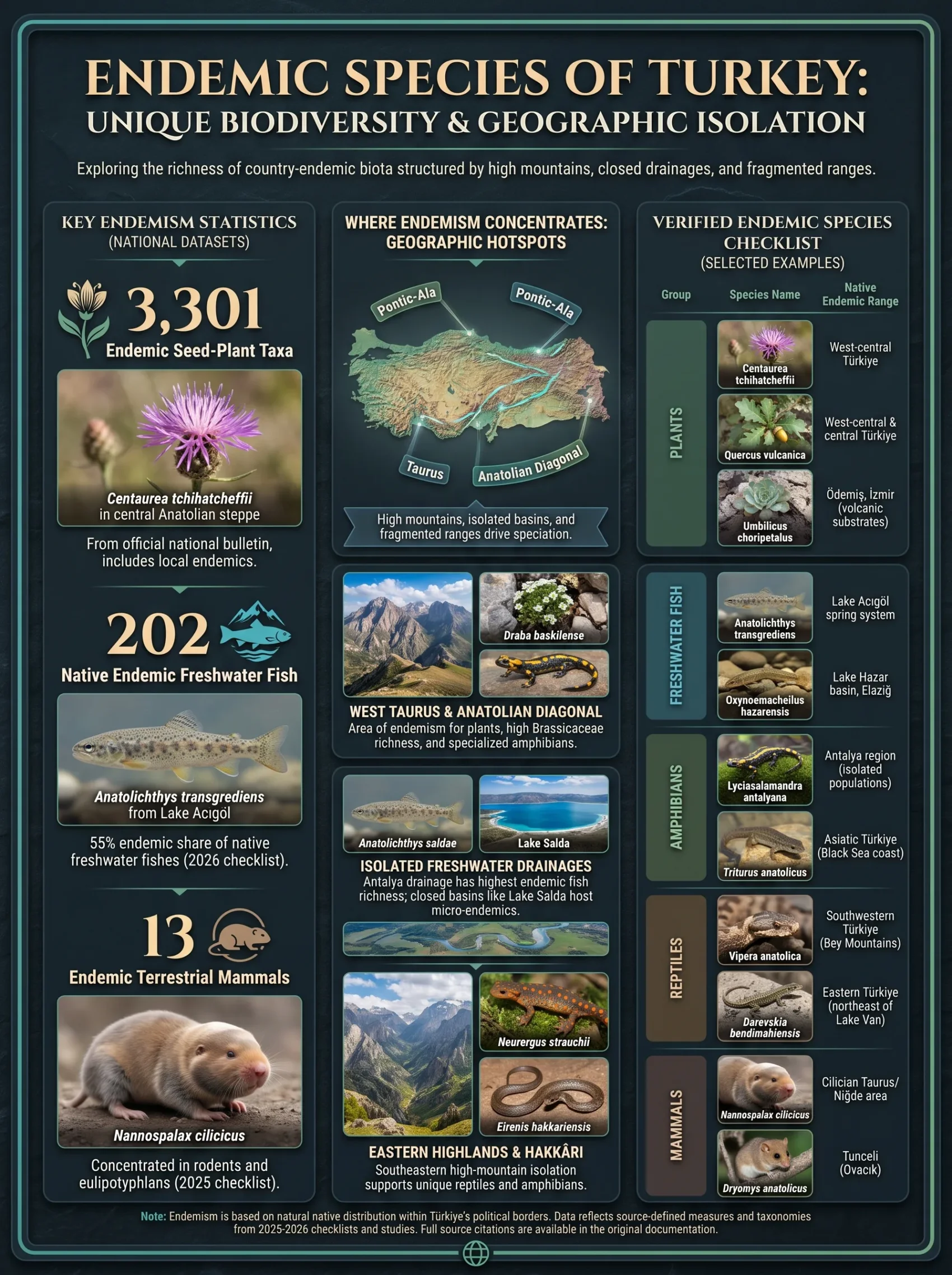
Türkiye’s country-endemic biota is structured by several different isolation systems: high mountains, the Taurus–Anatolian Diagonal belt, closed inland drainages, narrow southwestern amphibian ranges and small-mammal lineages. National datasets measure these groups with different taxonomic units, so plant taxa, vertebrate species and group-specific checklist totals are kept separate.
| Measure | Value |
|---|---|
| Endemic seed-plant taxa | 3,301 [S1] |
| Local-endemic seed-plant taxa | 391 [S1] |
| Freshwater fish species recognized | 390 species [S2] |
| Native freshwater fish species | 367 species [S2] |
| Native freshwater fish species endemic to Türkiye | 202 species [S2] |
| Endemic share of native freshwater fishes | 55% [S2] |
| Freshwater fish families | 37 families [S2] |
| Wild mammal species in the 2025 checklist | 177 species [S3] |
| Terrestrial mammal species in the 2025 checklist | 165 species [S3] |
| Endemic terrestrial mammal species in the 2025 checklist | 13 species [S3] |
| Endemic share of terrestrial mammals in the 2025 checklist | 7.88% [S3] |
| IUCN country-endemic amphibian species | 12 species [S4] |
| Native Brassicaceae species in the 2026 checklist | 663 species [S5] |
| Endemic Brassicaceae species | 273 species [S5] |
| Endemic share of Brassicaceae species | ~41.2% [S5] |
The values above are separate source-defined measures and are not additive. The national plant bulletin labels its endemism table as taxon counts while the surrounding prose uses species terminology; the same table prints a total of 13,341 although its three listed categories sum to 13,343. No endemic percentage is derived from that inconsistent denominator. [S1]
Where endemism concentrates in Türkiye
Plant endemism is spatially clustered rather than evenly spread across the country. A quantitative analysis of 1,102 endemic taxa from Asteraceae, Lamiaceae and Boraginaceae identified areas of endemism in the West Taurus, the Anatolian Diagonal, the Pontic–Ala region and Hakkâri. Fourteen grid cells qualified as centers of endemism under at least one index. The identified centers covered about 16% of Türkiye’s surface yet contained 59% of the endemic taxa in that three-family dataset. [S6]
A separate 2026 analysis of Brassicaceae, based on 663 native species and more than 15,000 georeferenced herbarium records, again found richness peaks along the Western and Central Taurus and through the Anatolian Diagonal. Endemic richness was associated with high elevation and topographic roughness. [S5]
| Endemism zone | Evidence in national datasets | Biogeographic signal |
|---|---|---|
| West Taurus | Area of endemism in the three-family plant analysis; high Brassicaceae richness in the 2026 grid analysis [S6] [S5] | High-elevation mountain isolation and strong topographic relief |
| Anatolian Diagonal | Area of endemism in the three-family analysis; Brassicaceae richness extends through this belt [S6] [S5] | A long mountain-linked floristic discontinuity across central and eastern Anatolia |
| Pontic–Ala | Area of endemism in the three-family plant analysis [S6] | Northeastern high-mountain concentration |
| Hakkâri | Area of endemism in the three-family plant analysis [S6] | Southeastern high-mountain isolation |
| Antalya freshwater drainage | Highest endemic freshwater-fish richness among catchments in the 2026 fish checklist: 28 species [S2] | Drainage isolation and short Mediterranean river systems |
The 16% surface-area and 59% endemic-taxon figures apply only to the 1,102-taxon dataset drawn from three vascular-plant families. They are not national percentages for all endemic plants.
Plant endemism: taxa, species and narrow ranges
The official national bulletin and the 2026 Brassicaceae study measure different biological units. The bulletin separates “endemic” and “local endemic” seed-plant taxa, while the Brassicaceae analysis reports accepted species, subspecies and varieties separately. Keeping those ranks apart prevents a plant-taxon total from being mistaken for a species count. [S1] [S5]
High mountains repeatedly appear as plant-endemism centers
All hotspot grid cells in the three-family analysis occurred in high mountains. The newer Brassicaceae dataset independently places its strongest species-richness signal in southern Anatolia, especially the Western and Central Taurus, with the pattern continuing through the Anatolian Diagonal. These studies use different families and methods, but both point to elevation and topographic fragmentation as recurring features of Turkish plant endemism. [S6] [S5]
Volcanic rock and isolated outcrops can hold micro-endemics
Umbilicus choripetalus, described from the Ödemiş district of İzmir in 2025, is ecologically confined to volcanic substrates; the related species discussed in its description are associated with limestone. Its range and substrate association provide a direct example of edaphic isolation within western Anatolia. [S7]
Draba baskilense, described in May 2026, is known only from rocks 7–8 km north of Baskil in Elazığ. The species is chasmophytic, living in rock crevices, and its known distribution is much narrower than a province-level range. [S8]
The Brassicaceae checklist was published in March 2026, while Draba baskilense was described in May 2026. Family-level endemic counts therefore remain versioned snapshots as new species are named and taxonomic treatments change. [S5] [S8]
Freshwater fish endemism follows drainage boundaries
The 2026 freshwater-fish checklist defines strict endemism as a native species whose entire known natural distribution lies within Türkiye. Unestablished introductions and strictly marine visitors were excluded from its national total. The same dataset records the highest endemic richness in the Antalya drainage, with 28 endemic species, while total fish richness ranges from 11 species in the Van Basin to 65 in the Sakarya drainage. [S2]
| Freshwater-fish component | Species |
|---|---|
| Native endemic | 202 [S2] |
| Native non-endemic | 165 [S2] |
| Established non-native | 23 [S2] |
| Total recognized | 390 |
The native non-endemic value is the remainder within the same checklist: 367 native species minus 202 native endemics. The three categories therefore form the complete 390-species dataset without mixing taxonomic ranks or geographic scopes.
{
  "type": "donut",
  "title": "Composition of Türkiye’s 2026 freshwater-fish checklist",
  "description": "Native endemic, native non-endemic and established non-native species within one national checklist.",
  "unit": "species",
  "data": [
    {
      "label": "Native endemic",
      "value": 202
    },
    {
      "label": "Native non-endemic",
      "value": 165
    },
    {
      "label": "Established non-native",
      "value": 23
    }
  ],
  "source": "[S2] Kaya et al. 2026"
}
The range descriptions in the same checklist show several different forms of micro-endemism. Anatolichthys transgrediens is restricted to the freshwater spring system of Lake Acıgöl, A. saldae to Lake Salda, A. irregularis to Kaklık Spring in the Büyük Menderes drainage, and Oxynoemacheilus hazarensis to the Lake Hazar basin. These distributions are much narrower than the national border that defines their country-endemic status. [S2]
The checklist also treats Anatolichthys splendens, formerly endemic to Lake Gölcük in Isparta, as extinct. It is kept outside the extant reference tables below so extinct and living records are not silently mixed. [S2]
Amphibian endemism is concentrated in narrow Anatolian lineages
IUCN’s 2025 country table records 12 amphibian species whose natural distribution is restricted to Türkiye. [S4] A large share of the species-level pattern is carried by southwestern salamanders in Lyciasalamandra, where neighboring lineages occupy short, fragmented ranges in Muğla and Antalya.
Current Amphibian Species of the World accounts also support Turkey-only native ranges for Lissotriton kosswigi, Ommatotriton nesterovi, Triturus anatolicus, Rana tavasensis and Neurergus strauchii. [S9] [S10] [S11] [S12] [S13]
Taxonomic rank can change the country count. Lyciasalamandra finikensis, centered in the Finike region, was elevated from subspecies to species rank in a recent treatment incorporated by Amphibian Species of the World. [S14] The IUCN country total and the species identities in the current taxonomic accounts are therefore kept as separate source-bounded datasets rather than forced into one reconstructed list.
Mammal endemism is concentrated in small terrestrial mammals
The 2025 mammal checklist reports 13 endemic terrestrial species. Ten are rodents and three are eulipotyphlans; no bats, carnivorans, artiodactyls or lagomorphs are counted as Turkish endemics in that checklist. [S3] The pattern is therefore dominated by blind mole-rats, voles, dormice, ground squirrels, shrews and moles rather than large mammals.
The count is a dated checklist value, not a timeless national total. Dryomys anatolicus was described in 2025 from the Eşekçayırı plateau near Ovacık in Tunceli and is treated by the Mammal Diversity Database as a Turkey-only species. [S15] A later revision of the Nannospalax ehrenbergi complex described three Anatolian species—N. colaki, N. garzanensis and N. karyominor—illustrating how species splits can alter the set of country endemics without any change in geography. [S16]
The 13-species figure is retained with its 2025 checklist label. It is not recalculated by adding later taxonomic splits from a different source treatment.
Reptile endemics follow fragmented mountain and steppe ranges
Current species accounts show Turkey-only reptiles in several separate geographic settings: southeastern steppe around Harran, the Taurus and Amanos mountains, eastern Anatolia around Lake Van, and small southwestern mountain ranges. This makes a single old national reptile count less informative than current species-level range treatments when the taxonomic list is changing.
Examples in the checklist include Acanthodactylus harranensis from southeastern Türkiye, Darevskia bendimahiensis and D. sapphirina in eastern Anatolia, Eirenis hakkariensis in the eastern Taurus, and Vipera anatolica in southwestern Türkiye. [S17] [S18] [S19] [S20] [S21]
Bird diversity does not produce a strict country endemic
Türkiye supports a large resident and migratory bird fauna, but the national environmental indicator reports no bird species whose natural range is confined to the country. [S22] A species can be characteristic of Anatolia, rare within Europe, or have a large share of its global population in Türkiye without meeting the stricter country-endemic definition.
Native to Türkiye is not the same as endemic to Türkiye
Several species closely associated with Anatolia occur naturally beyond Türkiye’s political border. Their presence in neighboring islands or countries prevents them from being strict Turkey endemics even when Türkiye holds a large part of the range.
Endemism is based on natural native distribution. Introduced, cultivated, naturalized or conservation-translocated occurrences do not expand the native range used for this classification.
| Species | Native range evidence | Endemism result |
|---|---|---|
| Fritillaria imperialis | Native from eastern-central and southeastern Türkiye eastward through parts of Iran, Iraq, Afghanistan, Pakistan and the western Himalaya [S23] | Native to Türkiye, not Turkey-endemic |
| Liquidambar orientalis | Native in southwestern Türkiye and the East Aegean Islands, including Rhodes [S24] | Native to Türkiye, not Turkey-endemic |
| Anatololacerta anatolica | Native in western Anatolia and on the Greek islands of Samos and Ikaria [S25] | Native to Türkiye, not Turkey-endemic |
Verified endemic species checklist
Verified species-level records shown: 61
The tables below are a source-bounded cross-taxon reference set, not a claim of a full national all-taxa checklist. Subspecies, varieties and synonym duplicates are excluded as rows.
Plants with Turkey-only native ranges
| Scientific name | Native endemic range | Evidence |
|---|---|---|
| Centaurea tchihatcheffii | West-central Türkiye | [S26] |
| Quercus vulcanica | West-central and central Türkiye | [S27] |
| Astragalus beypazaricus | Türkiye; Ankara area in the accepted-range account | [S28] |
| Polygonum istanbulicum | Northwestern Türkiye | [S29] |
| Bornmuellera cappadocica | Eastern Türkiye | [S30] |
| Plantago anatolica | Eastern Türkiye | [S31] |
| Scrophularia erzincanica | Eastern Türkiye | [S32] |
| Lepidium caespitosum | Eastern Türkiye | [S33] |
| Umbilicus choripetalus | Ödemiş district, İzmir; volcanic substrates | [S7] |
| Draba baskilense | Rocks 7–8 km north of Baskil, Elazığ | [S8] |
Freshwater fishes with Turkey-only native ranges
All fish records in this table use the accepted names, endemic treatment and within-Türkiye distributions of the 2026 national checklist. [S2]
| Scientific name | Native endemic range |
|---|---|
| Oxynoemacheilus evreni | Upper Ceyhan River |
| Oxynoemacheilus fatmae | Güzelhisar drainage, northeastern Aegean basin |
| Oxynoemacheilus fatsaensis | Yeşilırmak drainage and adjacent Elekçi coastal stream |
| Oxynoemacheilus germencicus | Büyük Menderes and Gediz drainages |
| Oxynoemacheilus hazarensis | Lake Hazar basin, Elazığ |
| Oxynoemacheilus isauricus | Lake Beyşehir and Suğla basin |
| Oxynoemacheilus eregliensis | Lake Tuz drainages, Ereğli–Karaman area and Manavgat drainage |
| Oxynoemacheilus kaynaki | Upper Göksu, Kaynarca, Gül, Peri Suyu, Sultan Suyu and Kangal systems of the Euphrates drainage |
| Anatolichthys transgrediens | Freshwater spring system of Lake Acıgöl, Afyon–Denizli |
| Anatolichthys maeandricus | Lake Işıklı, Denizli, and Düden Spring, Afyonkarahisar |
| Anatolichthys marassantensis | Kızılırmak drainage, lower and middle Yeşilırmak, and adjacent coastal wetlands west of Sinop |
| Anatolichthys meridionalis | Upper Eşen and the Söğüt, Avlan and Gölhisar lake basins |
| Anatolichthys saldae | Lake Salda, Burdur |
| Anatolichthys sureyanus | Lake Burdur |
| Anatolichthys irregularis | Kaklık Spring, Büyük Menderes drainage |
| Anatolichthys iconii | Lakes Eğirdir and Kovada drainages |
| Anatolichthys villwocki | Lake Ilgın, a spring east of Emirdağ, and upper Sakarya drainages |
Amphibians with Turkey-only native ranges
| Scientific name | Native endemic range | Evidence |
|---|---|---|
| Lyciasalamandra antalyana | Antalya region; isolated populations around Termessos and Yağca | [S34] |
| Lyciasalamandra atifi | Southwestern Taurus from Akyaka, Muğla, toward Gazipaşa, Antalya | [S35] |
| Lyciasalamandra billae | Antalya Province | [S36] |
| Lyciasalamandra fazilae | Between Cöymen and Domuz Island–Darboğaz, south to the Tersabe and Domuz coastal islands | [S37] |
| Lyciasalamandra flavimembris | Marmaris–Ula–Kötekli area, Muğla | [S38] |
| Lyciasalamandra finikensis | Başkoz River Valley in the Finike region, below 800 m | [S14] |
| Lissotriton kosswigi | Northwestern Türkiye from the Bosporus toward the western Black Sea coast | [S9] |
| Ommatotriton nesterovi | From the Kızılırmak Delta in Samsun west to the Sea of Marmara near Subaşı | [S10] |
| Triturus anatolicus | Asiatic Türkiye south of the Black Sea, from the Bosporus east to Yomra near Trabzon | [S11] |
| Rana tavasensis | Isolated southwestern Türkiye range | [S12] |
| Neurergus strauchii | Eastern Türkiye around the south and west of Lake Van, with Tunceli and Malatya records | [S13] |
Mammals treated as Turkey-only species in current accounts
| Scientific name | Supported range context | Evidence |
|---|---|---|
| Nannospalax cilicicus | Türkiye; type locality in the Cilician Taurus/Niğde area | [S39] |
| Nannospalax tuncelicus | Türkiye; type locality near Tunceli | [S40] |
| Chionomys stekolnikovi | Türkiye; type locality in Aladağlar, Central Taurus | [S41] |
| Microtus fingeri | Türkiye; type locality north of Bolu | [S42] |
| Microtus anatolicus | Türkiye; type locality near Cihanbeyli, Konya | [S43] |
| Spermophilus taurensis | Türkiye; Taurus range with type locality near Akseki, Antalya | [S44] |
| Dryomys laniger | Türkiye; Bey Mountains and related southwestern highlands in the current treatment | [S45] |
| Dryomys anatolicus | Türkiye; type locality on Eşekçayırı plateau, Ovacık, Tunceli | [S15] |
| Talpa hakkariensis | Türkiye; Hakkâri highlands | [S46] |
| Talpa levantis | Türkiye in the current MDD treatment; type locality south of Trabzon | [S47] |
| Nannospalax colaki | Türkiye; type locality near Nizip, Gaziantep | [S48] |
| Nannospalax garzanensis | Türkiye; type locality near Kurtalan, Siirt | [S49] |
| Nannospalax karyominor | Türkiye; type locality near Yayladağı, Hatay | [S50] |
For several mammals, the source supports country restriction more confidently than a complete fine-scale range polygon. Type localities are therefore labeled as type localities and are not presented as the entire native range.
Reptiles with Turkey-only native ranges
| Scientific name | Native endemic range | Evidence |
|---|---|---|
| Acanthodactylus ilgazi | Türkiye; Malatya region | [S51] |
| Lacerta pamphylica | Southern Türkiye around the central Mediterranean coast and inland Antalya | [S52] |
| Acanthodactylus harranensis | Southeastern Türkiye; Harran, Şanlıurfa region | [S17] |
| Darevskia bendimahiensis | Eastern Türkiye northeast of Lake Van | [S18] |
| Darevskia sapphirina | Eastern Türkiye north of Lake Van | [S19] |
| Eirenis hakkariensis | Eastern Taurus south of Lake Van; Hakkâri region | [S20] |
| Eirenis aurolineatus | Türkiye; Bolkar Mountains/Taurus range | [S53] |
| Asaccus barani | Southeastern Anatolia; Harran, Şanlıurfa region | [S54] |
| Muhtarophis barani | Amanos Mountains, Hatay Province | [S55] |
| Vipera anatolica | Southwestern Türkiye; Bey Mountains/Elmalı sector | [S21] |
Sources
[S1] ↩ T.C. Ministry of Agriculture and Forestry — Biyolojik Çeşitlilik İstatistikleri, 2025. Official biodiversity statistics bulletin published 12 June 2026.
[S2] ↩ Kaya et al. — A Critical Checklist of Turkish Freshwater Fishes (2026). National freshwater-fish checklist, taxonomic treatment, endemic status and drainage distributions.
[S3] ↩ Sözen & Çolak — An updated checklist of the mammals of Türkiye. Peer-reviewed 2025 national mammal checklist.
[S4] ↩ IUCN Red List / Our World in Data — Endemic amphibian species, 2025. Country-endemic amphibian count from IUCN country summary statistics.
[S5] ↩ Dumlupınar et al. — A Plant-Diversity Dark Spot at the Intersection of Three Biodiversity Hotspots: Environmental Drivers of Brassicaceae Richness in Türkiye. 2026 national Brassicaceae checklist and spatial richness analysis.
[S6] ↩ Noroozi et al. — Patterns of Endemism in Turkey, the Meeting Point of Three Global Biodiversity Hotspots, Based on Three Diverse Families of Vascular Plants. Quantitative analysis of 1,102 endemic taxa in Asteraceae, Lamiaceae and Boraginaceae.
[S7] ↩ Yıldırım et al. — An extraordinary new species from western Anatolia (Türkiye): Umbilicus choripetalus (Crassulaceae). Original 2025 species description from Ödemiş, İzmir.
[S8] ↩ Behçet — Draba baskilense (Brassicaceae), a new chasmophytic species from eastern Anatolia, Türkiye. Original 2026 species description from Baskil, Elazığ.
[S9] ↩ Amphibian Species of the World — Lissotriton kosswigi. Current taxonomy and native distribution.
[S10] ↩ Amphibian Species of the World — Ommatotriton nesterovi. Current taxonomy and native distribution.
[S11] ↩ Amphibian Species of the World — Triturus anatolicus. Current taxonomy and native distribution.
[S12] ↩ Amphibian Species of the World — Rana tavasensis. Current taxonomy and native distribution.
[S13] ↩ Amphibian Species of the World — Neurergus strauchii. Current taxonomy and native distribution.
[S14] ↩ Amphibian Species of the World — Lyciasalamandra finikensis. Current taxonomy; elevated to species rank in the recent treatment cited by ASW.
[S15] ↩ Mammal Diversity Database — Dryomys anatolicus. Current taxonomic and country-distribution account.
[S16] ↩ Kankılıç et al. — Taxonomic revision of the Nannospalax ehrenbergi species complex in the Anatolian Peninsula, with description of three new species. Blind mole-rat taxonomic revision published in Zoologischer Anzeiger.
[S17] ↩ The Reptile Database — Acanthodactylus harranensis. Current species account and distribution.
[S18] ↩ The Reptile Database — Darevskia bendimahiensis. Current species account and distribution.
[S19] ↩ The Reptile Database — Darevskia sapphirina. Current species account and distribution.
[S20] ↩ The Reptile Database — Eirenis hakkariensis. Current species account and distribution.
[S21] ↩ The Reptile Database — Vipera anatolica. Current species account and distribution.
[S22] ↩ Republic of Türkiye Ministry of Environment, Urbanization and Climate Change — Total Number of Species, Endangered Species, Endemism Rate. National environmental indicator stating that Türkiye has no country-endemic bird species.
[S23] ↩ Plants of the World Online — Fritillaria imperialis. Accepted name and native distribution.
[S24] ↩ Plants of the World Online — Liquidambar orientalis. Accepted name and native distribution.
[S25] ↩ The Reptile Database — Anatololacerta anatolica. Current species account and native distribution in Türkiye and Greece.
[S26] ↩ Plants of the World Online — Centaurea tchihatcheffii. Accepted name and native range.
[S27] ↩ Plants of the World Online — Quercus vulcanica. Accepted name and native range.
[S28] ↩ Plants of the World Online — Astragalus beypazaricus. Accepted name and native range.
[S29] ↩ Plants of the World Online — Polygonum istanbulicum. Accepted name and native range.
[S30] ↩ Plants of the World Online — Bornmuellera cappadocica. Accepted name and native range.
[S31] ↩ Plants of the World Online — Plantago anatolica. Accepted name and native range.
[S32] ↩ Plants of the World Online — Scrophularia erzincanica. Accepted name and native range.
[S33] ↩ Plants of the World Online — Lepidium caespitosum. Accepted name and native range.
[S34] ↩ Amphibian Species of the World — Lyciasalamandra antalyana. Current taxonomy and native distribution.
[S35] ↩ Amphibian Species of the World — Lyciasalamandra atifi. Current taxonomy and native distribution.
[S36] ↩ Amphibian Species of the World — Lyciasalamandra billae. Current taxonomy and native distribution.
[S37] ↩ Amphibian Species of the World — Lyciasalamandra fazilae. Current taxonomy and native distribution.
[S38] ↩ Amphibian Species of the World — Lyciasalamandra flavimembris. Current taxonomy and native distribution.
[S39] ↩ Mammal Diversity Database — Nannospalax cilicicus. Current taxonomy and country distribution.
[S40] ↩ Mammal Diversity Database — Nannospalax tuncelicus. Current taxonomy and country distribution.
[S41] ↩ Mammal Diversity Database — Chionomys stekolnikovi. Current taxonomy and country distribution.
[S42] ↩ Mammal Diversity Database — Microtus fingeri. Current taxonomy and country distribution.
[S43] ↩ Mammal Diversity Database — Microtus anatolicus. Current taxonomy and country distribution.
[S44] ↩ Mammal Diversity Database — Spermophilus taurensis. Current taxonomy and country distribution.
[S45] ↩ Mammal Diversity Database — Dryomys laniger. Current taxonomy and country distribution.
[S46] ↩ Mammal Diversity Database — Talpa hakkariensis. Current taxonomy and country distribution.
[S47] ↩ Mammal Diversity Database — Talpa levantis. Current taxonomy and country distribution.
[S48] ↩ Mammal Diversity Database — Nannospalax colaki. Current taxonomy and country distribution.
[S49] ↩ Mammal Diversity Database — Nannospalax garzanensis. Current taxonomy and country distribution.
[S50] ↩ Mammal Diversity Database — Nannospalax karyominor. Current taxonomy and country distribution.
[S51] ↩ The Reptile Database — Acanthodactylus ilgazi. Current species account and distribution.
[S52] ↩ The Reptile Database — Lacerta pamphylica. Current species account and distribution.
[S53] ↩ The Reptile Database — Eirenis aurolineatus. Current species account and distribution.
[S54] ↩ The Reptile Database — Asaccus barani. Current species account and distribution.
[S55] ↩ The Reptile Database — Muhtarophis barani. Current species account and distribution.