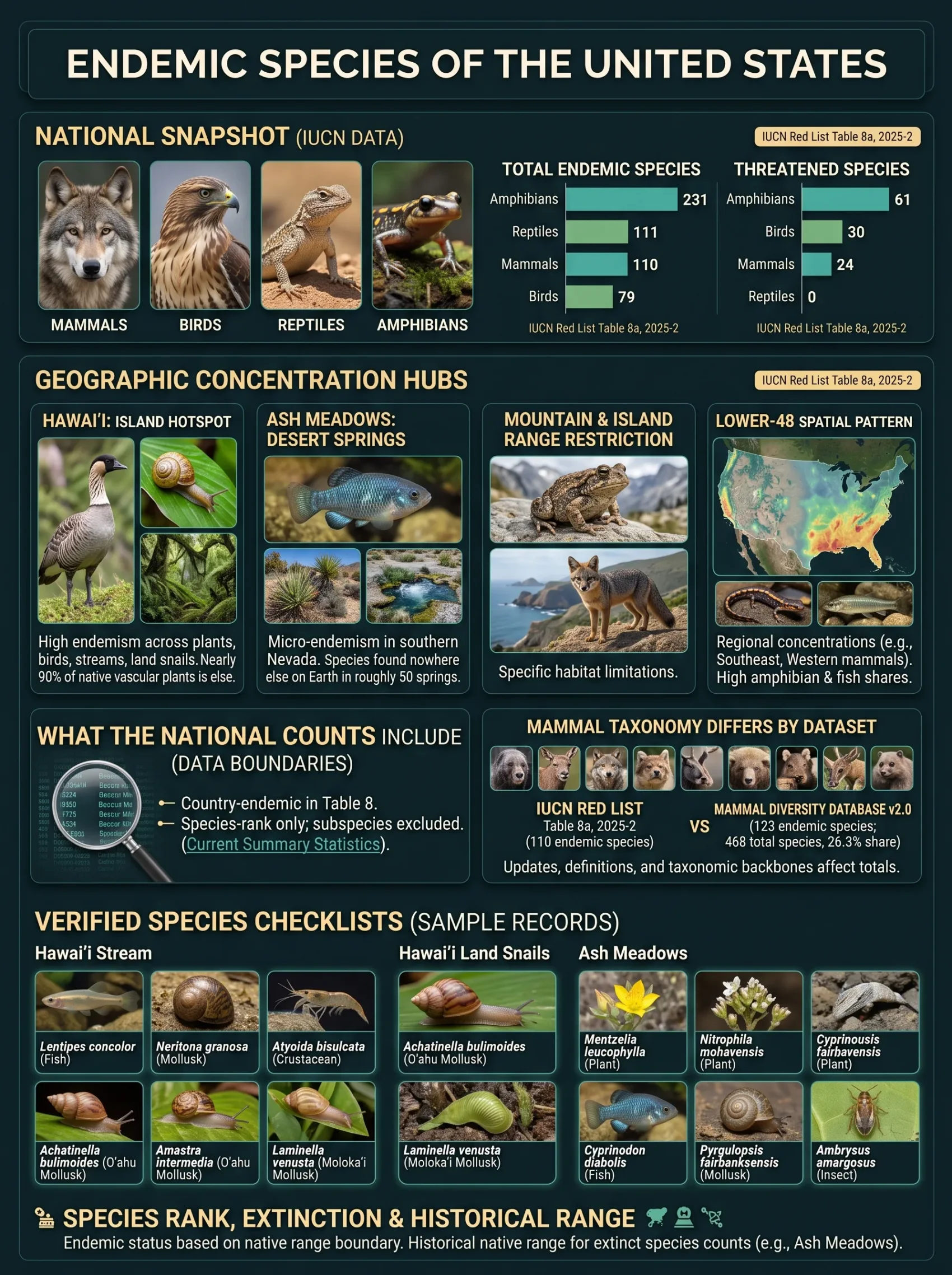
U.S. endemism is concentrated in several very different systems: island biotas in Hawaiʻi and the Channel Islands, desert springs, western mountain ranges, and species-rich southeastern watersheds. The national table uses one IUCN country dataset for four vertebrate groups and does not combine those groups with plant, fish, or invertebrate datasets into a synthetic all-taxa total.[S1]
| Measure | Value |
|---|---|
| Endemic mammal species | 110 species [S1] |
| Threatened endemic mammal species | 24 species [S1] |
| EX/EW endemic mammal species | 0 species [S1] |
| Endemic bird species | 79 species [S1] |
| Threatened endemic bird species | 30 species [S1] |
| EX/EW endemic bird species | 32 species [S1] |
| Endemic reptile species | 111 species [S1] |
| Threatened endemic reptile species | 0 species [S1] |
| EX/EW endemic reptile species | 0 species [S1] |
| Endemic amphibian species | 231 species [S1] |
| Threatened endemic amphibian species | 61 species [S1] |
| EX/EW endemic amphibian species | 0 species [S1] |
{"type": "bar", "title": "U.S.-endemic species in four IUCN vertebrate groups", "description": "Country-endemic species reported for the United States in IUCN Red List Table 8a, version 2025-2. The groups are shown separately and are not summed.", "unit": "species", "orientation": "horizontal", "data": [{"label": "Amphibians", "value": 231}, {"label": "Reptiles", "value": 111}, {"label": "Mammals", "value": 110}, {"label": "Birds", "value": 79}], "source": "[S1] IUCN Red List Table 8a, 2025-2"}
{"type": "bar", "title": "Threatened U.S.-endemic species in the same IUCN groups", "description": "Threatened endemic species are those in CR, EN or VU in IUCN Red List Table 8a, version 2025-2.", "unit": "species", "orientation": "horizontal", "data": [{"label": "Amphibians", "value": 61}, {"label": "Birds", "value": 30}, {"label": "Mammals", "value": 24}, {"label": "Reptiles", "value": 0}], "source": "[S1] IUCN Red List Table 8a, 2025-2"}
What the national counts include
IUCN defines a country endemic in Table 8 as a species known to occur naturally within one country only. The current Summary Statistics page is for Red List version 2026-1 and states that Table 8 is limited to groups in which more than 80% of species have been assessed. The statistics are species-rank only; subspecies, varieties and isolated subpopulations are excluded.[S2]
The opening values come from the directly verified 2025-2 Table 8a file, dated 10 October 2025. They should be read as dataset-version counts. IUCN notes that country statistics can change when species are newly assessed, reassessed or taxonomically revised.[S2]
No single all-taxa U.S. endemic-species total is asserted here. Plant statistics from Hawaiʻi include infraspecific taxa, the IUCN vertebrate table is species-rank only, and specialist databases can apply different taxonomic and geographic treatments. Adding those values would create a biologically mixed total.
Why mammal totals differ by dataset
The Mammal Diversity Database 2.0 analysis recognized 468 mammal species for the United States and classified 123 of them as country endemics, an endemic share of 26.3%.[S3] That result is higher than the 110 endemic mammals in IUCN Table 8a. The values should remain separate because the two systems use different taxonomic backbones, update schedules and geographic coding.
| Dataset | U.S. mammal species | U.S.-endemic mammals | Endemic share |
|---|---|---|---|
| MDD2, taxonomic cutoff 15 August 2024 | 468 | 123 | 26.3% [S3] |
| IUCN Red List Table 8a, 2025-2 | Not a total-mammal inventory table | 110 | Not calculated [S1] |
Mammal taxonomy continues to move. MDD v2.5 was released on 28 July 2026 and recorded 79 taxonomy changes from v2.4, including new species, splits, lumps, genus changes and name changes.[S4] A national endemic count tied to one mammal backbone therefore should not be silently substituted for a count produced under another.
Where U.S. endemism is concentrated
Hawaiʻi: high endemism across plants, birds, streams and land snails
Hawaiʻi contains several datasets that measure different biological units. State forestry estimates approximately 1,400 native vascular plant taxa—explicitly including species, subspecies and varieties—and says nearly 90% are found nowhere else.[S5] Those plant taxa cannot be added to species-only vertebrate counts.
The state bird inventory reports at least 113 endemic bird species before human arrival and 71 confirmed bird losses since human settlement, including 48 losses before European arrival and 23 afterward. It also identifies 26 forest-bird species still in existence today.[S6] These historical and extant inventories answer different questions and should not be treated as interchangeable with the current IUCN country-endemic bird total.
| Hawaiʻi measure | Value | Unit or boundary |
|---|---|---|
| Native vascular plant taxa | approximately 1,400 [S5] | Species, subspecies and varieties |
| Share of native vascular plant taxa found nowhere else | nearly 90% [S5] | Taxa, not species-only |
| Endemic bird species before human arrival | at least 113 [S6] | Historical species inventory |
| Confirmed bird losses since human arrival | 71 [S6] | 48 pre-European; 23 after 1778 |
| Forest-bird species still in existence | 26 [S6] | Current state forest-bird inventory |
| Endemic native stream fishes | 4 of 5 [S7] | Species |
| Endemic native stream crustaceans | 2 of 2 [S7] | Species |
| Endemic native stream mollusks | 3 of 3 [S7] | Species |
| Amastridae described species | 325 [S8] | Entire family endemic to Hawaiʻi |
| Achatinellidae described Hawaiian species | 209 [S8] | All endemic to Hawaiʻi |
| Succineidae endemic species | 42 [S8] | Species |
| Pupillidae endemic species | 56 [S8] | Species |
| Helicinidae endemic species | 14 [S8] | Species |
| Zonitidae Hawaiian endemic species | 14 [S8] | Species |
| Hydrocenidae endemic species | 2 [S8] | Species |
{"type": "bar", "title": "Endemic Hawaiian land-snail species in source-defined families", "description": "Species counts are shown only for families where the state source explicitly provides a Hawaiian endemic count or states that all described Hawaiian species in the family are endemic.", "unit": "species", "orientation": "horizontal", "data": [{"label": "Amastridae", "value": 325}, {"label": "Achatinellidae", "value": 209}, {"label": "Pupillidae", "value": 56}, {"label": "Succineidae", "value": 42}, {"label": "Helicinidae", "value": 14}, {"label": "Zonitidae", "value": 14}, {"label": "Hydrocenidae", "value": 2}], "source": "[S8] Hawaiʻi DLNR Snail Extinction Prevention Program — Meet the Snails"}
Ash Meadows: spring and seep micro-endemism
Ash Meadows National Wildlife Refuge in southern Nevada is a compact desert-spring system. The U.S. Fish & Wildlife Service reports 26 species found nowhere else on Earth, with nearly all of them living in or around roughly 50 springs and seeps.[S9]
The refuge species page mixes species with subspecies, varieties and unresolved sp./spp. entries.[S10] The species-level checklist below excludes those infraspecific and unresolved records. It also updates several legacy spellings against current taxonomic sources: Pyrgulopsis isolata is the accepted name for the elongate-gland springsnail,[S11] while current U.S. Fish & Wildlife Service nomenclature uses Pyrgulopsis fairbanksensis, Tryonia ericae and Tryonia angulata.[S12]
The refuge page also lists Tecopa birdsbeak under the synonym Cordylanthus tecopensis. Plants of the World Online accepts Chloropyron tecopense and gives its native range as eastern California to western Nevada, so it is not carried into the Ash Meadows-only species checklist here.[S13]
Mountain and California island endemics
The Yosemite toad, Anaxyrus canorus, is endemic to the Sierra Nevada; Yosemite National Park contains more than one-third of its total range.[S14] The island fox, Urocyon littoralis, occurs naturally only on six of the eight Channel Islands off southern California.[S15] These species show two different forms of range restriction: a mountain-system endemic and an island-archipelago endemic.
Lower-48 endemism is strongly regional
A 2015 range-map analysis of the lower 48 states, excluding Hawaiʻi and U.S. territories, found that endemism across the mapped taxa was centered strongly in the Southeast, with additional western concentrations for mammals. In that study, amphibians and freshwater fishes had the highest endemic shares among the analyzed groups, and the southern Appalachians contained many small-ranged salamanders.[S16] The analysis is a historical spatial benchmark rather than a current national species count.
Native range is the boundary used for endemism. Introduced, naturalized, cultivated or conservation-translocated populations do not expand a species’ original native range.
Verified species-level checklists
There is no single compatible national source that yields every U.S.-endemic species across animals, plants, fungi and other groups under one current taxonomy. The tables below therefore use source-bounded datasets whose inclusion rules are explicit: all nine endemic native Hawaiian stream shellfish and fishes named by the state stream inventory; all 42 named species-rank records on the state land-snail priority list; and the species-rank Ash Meadows records that remain defensible after removing infraspecific, unresolved and broader-range entries. This avoids an arbitrary fixed-row sample while keeping unlike datasets separate.
Hawaiian stream endemics
The state stream inventory states that four of Hawaiʻi’s five native stream fishes are endemic and that its two native stream crustaceans and three native stream mollusks are all endemic.[S7] Current MolluscaBase treatment accepts Neritona granosa for the state-listed Neritina granosa,[S17] and places the state-listed Neritina vespertina and Theodoxus cariosus in Neripteron as Neripteron vespertinum and Neripteron cariosum.[S18]
| Scientific name | Group | Native endemic range |
|---|---|---|
| Lentipes concolor | Fish | Hawaiian Islands; native streams |
| Sicyopterus stimpsoni | Fish | Hawaiian Islands; native streams |
| Stenogobius hawaiiensis | Fish | Hawaiian Islands; estuaries and lower streams |
| Eleotris sandwicensis | Fish | Hawaiian Islands; estuaries and lower streams |
| Atyoida bisulcata | Crustacean | Hawaiian Islands; native streams |
| Macrobrachium grandimanus | Crustacean | Hawaiian Islands; estuaries and lower streams |
| Neritona granosa | Mollusk | Hawaiian Islands; lower and middle streams |
| Neripteron vespertinum | Mollusk | Hawaiian Islands; estuaries and lower streams |
| Neripteron cariosum | Mollusk | Hawaiian Islands; brackish estuaries and coastal pools |
Hawaiian land-snail priority species
The Hawaiʻi Snail Extinction Prevention Program lists its priority terrestrial snails by island. The table carries every named species-rank record in that island list and excludes the genus-only Leptachatina sp., Lyropupa sp., Pleuropoma sp. and Pleuropoma spp. entries.[S8] The state source identifies Amastridae as entirely endemic to the Hawaiian Islands and all 209 described Hawaiian Achatinellidae as endemic; the remaining listed Cookeconcha hystricella is independently documented as endemic to Oʻahu by Bishop Museum.[S19]
| Scientific name | Group | Island |
|---|---|---|
| Achatinella bulimoides | Mollusk | Oʻahu |
| Achatinella concavospira | Mollusk | Oʻahu |
| Achatinella byrnoii | Mollusk | Oʻahu |
| Achatinella decipiens | Mollusk | Oʻahu |
| Achatinella fulgens | Mollusk | Oʻahu |
| Achatinella fuscobasis | Mollusk | Oʻahu |
| Achatinella lila | Mollusk | Oʻahu |
| Achatinella livida | Mollusk | Oʻahu |
| Achatinella mustelina | Mollusk | Oʻahu |
| Achatinella sowerbyana | Mollusk | Oʻahu |
| Amastra intermedia | Mollusk | Oʻahu |
| Amastra micans | Mollusk | Oʻahu |
| Amastra rubens | Mollusk | Oʻahu |
| Amastra spirizona | Mollusk | Oʻahu |
| Amastra variegata | Mollusk | Oʻahu |
| Auriculella gagneorum | Mollusk | Oʻahu |
| Auriculella perpusilla | Mollusk | Oʻahu |
| Cookeconcha hystricella | Mollusk | Oʻahu |
| Laminella sanguinea | Mollusk | Oʻahu |
| Laminella venusta | Mollusk | Molokaʻi |
| Newcombia canaliculata | Mollusk | Molokaʻi |
| Partulina mighelsiana | Mollusk | Molokaʻi |
| Partulina proxima | Mollusk | Molokaʻi |
| Partulina redfieldi | Mollusk | Molokaʻi |
| Partulina virgulata | Mollusk | Molokaʻi |
| Perdicella helena | Mollusk | Molokaʻi |
| Partulina variabilis | Mollusk | Lānaʻi |
| Partulina semicarinata | Mollusk | Lānaʻi |
| Amastra goniops | Mollusk | Maui |
| Laminella aspera | Mollusk | Maui |
| Leptachatina vitreola | Mollusk | Maui |
| Newcombia cumingi | Mollusk | Maui |
| Partulina crocea | Mollusk | Maui |
| Partulina fusoidea | Mollusk | Maui |
| Partulina marmorata | Mollusk | Maui |
| Partulina perdix | Mollusk | Maui |
| Partulina porcellana | Mollusk | Maui |
| Partulina splendida | Mollusk | Maui |
| Partulina tappaniana | Mollusk | Maui |
| Perdicella ornata | Mollusk | Maui |
| Perdicella zebra | Mollusk | Maui |
| Partulina physa | Mollusk | Hawaiʻi Island |
Ash Meadows species-level records
The refuge inventory is filtered here to accepted species rank. Subspecies, varieties, unresolved records and the broader-ranging Tecopa birdsbeak are not counted as Ash Meadows-only species.[S10][S13]
| Scientific name | Group | Native endemic range |
|---|---|---|
| Mentzelia leucophylla | Plant | Ash Meadows area, Nevada |
| Nitrophila mohavensis | Plant | Ash Meadows area, Nevada |
| Astragalus phoenix | Plant | Ash Meadows area, Nevada |
| Grindelia fraxinipratensis | Plant | Ash Meadows area, Nevada |
| Spiranthes infernalis | Plant | Ash Meadows area, Nevada |
| Zeltnera namophila | Plant | Ash Meadows area, Nevada |
| Ambrysus amargosus | Insect | Ash Meadows spring systems, Nevada |
| Ambrysus relictus | Insect | Ash Meadows spring systems, Nevada |
| Pyrgulopsis erythropoma | Mollusk | Ash Meadows spring systems, Nevada |
| Pyrgulopsis crystalis | Mollusk | Ash Meadows spring systems, Nevada |
| Pyrgulopsis nanus | Mollusk | Ash Meadows spring systems, Nevada |
| Pyrgulopsis isolata [S11] | Mollusk | Historical Ash Meadows locality, Nevada |
| Pyrgulopsis fairbanksensis [S12] | Mollusk | Fairbanks Spring, Ash Meadows, Nevada |
| Pyrgulopsis pisteri | Mollusk | Ash Meadows spring systems, Nevada |
| Tryonia variegata | Mollusk | Ash Meadows spring systems, Nevada |
| Tryonia ericae [S12] | Mollusk | Ash Meadows spring systems, Nevada |
| Tryonia elata | Mollusk | Point of Rocks Springs, Ash Meadows, Nevada |
| Tryonia angulata [S12] | Mollusk | Big Spring, Ash Meadows, Nevada |
| Cyprinodon diabolis | Fish | Devils Hole, Ash Meadows, Nevada |
| Empetrichthys merriami | Fish | Historical Ash Meadows waters, Nevada |
Rank, extinction and historical range
Endemic status is based on natural native distribution, including historical native range where a species is extinct. That is why an extinct Ash Meadows species can still be an Ash Meadows—and therefore U.S.—endemic. Local extirpation is different from global extinction, and a species moved for conservation outside its original range does not stop being endemic to its natural range.
Species rank is kept separate from subspecies and varieties throughout these checklists. This matters in places such as Ash Meadows, where the official refuge list includes Cyprinodon nevadensis pectoralis, Cyprinodon nevadensis mionectes, Rhinichthys osculus nevadensis, Stenelmis calida calida and plant varieties. Those records may be locally endemic at an infraspecific rank, but they are not counted as endemic species here.[S10]
The same rule prevents synonym duplication. A legacy name is not treated as a second species when a current authority accepts it as a synonym, and a common name is not used as evidence of taxonomic identity.
Sources
[S1] ↩ International Union for Conservation of Nature (IUCN) — IUCN Red List version 2025-2 — Table 8a: Total, threatened, and EX & EW endemic species in each country (totals by taxonomic group): VERTEBRATES. Country-endemic vertebrate counts; last updated 10 October 2025.
[S2] ↩ International Union for Conservation of Nature (IUCN) — Summary Statistics. Current Red List summary-statistics scope and Table 8 methodology; version 2026-1.
[S3] ↩ Journal of Mammalogy / Mammal Diversity Database — How many mammal species are there now? Updates and trends in taxonomic, nomenclatural, and geographic knowledge. MDD2 country and state mammal totals, endemism and geographic coding.
[S4] ↩ American Society of Mammalogists — Mammal Diversity Database — MDD Release Notes. MDD v2.5 release dated 28 July 2026 and tracked taxonomy changes.
[S5] ↩ Hawaiʻi Department of Land and Natural Resources — Plants in Hawaiʻi. Native vascular-plant taxa and state endemism estimate.
[S6] ↩ Hawaiʻi Department of Land and Natural Resources — Native Birds of Hawaiʻi. Historical endemic-bird totals, confirmed losses and current forest-bird inventory.
[S7] ↩ Hawaiʻi Department of Land and Natural Resources — Division of Aquatic Resources — Native Animals. Native Hawaiian stream fishes, crustaceans and mollusks with distribution status.
[S8] ↩ Hawaiʻi Department of Land and Natural Resources — Snail Extinction Prevention Program — Meet the Snails. Land-snail family endemism and the program's island-by-island priority-species list.
[S9] ↩ U.S. Fish & Wildlife Service — Ash Meadows is the Galapagos of the Mojave Desert. Ash Meadows endemic-species concentration and spring-system context.
[S10] ↩ U.S. Fish & Wildlife Service — Ash Meadows National Wildlife Refuge — Species. Refuge endemic-species inventory and rank information.
[S11] ↩ NatureServe Explorer — Pyrgulopsis isolata. Accepted name and current global status for the elongate-gland springsnail.
[S12] ↩ U.S. Fish & Wildlife Service — Endangered and Threatened Wildlife and Plants; 17 Species Not Warranted for Listing as Endangered or Threatened Species. Current names used for several Ash Meadows springsnails and tryonias.
[S13] ↩ Royal Botanic Gardens, Kew — Plants of the World Online — Chloropyron tecopense (Munz & J.C.Roos) Tank & J.M.Egger. Accepted plant name and native range; Cordylanthus tecopensis is treated as a synonym.
[S14] ↩ U.S. National Park Service — Species in the Spotlight: Yosemite Toad. Species-level Sierra Nevada endemic range for Anaxyrus canorus.
[S15] ↩ U.S. National Park Service — Island Fox. Species-level range restricted to six California Channel Islands.
[S16] ↩ Proceedings of the National Academy of Sciences — US protected lands mismatch biodiversity priorities. 2015 lower-48 spatial analysis of endemism across terrestrial vertebrates, freshwater fishes and trees.
[S17] ↩ MolluscaBase / World Register of Marine Species — Neritona granosa (G. B. Sowerby I, 1825). Accepted 2026 species name; Neritina granosa is listed as an unaccepted superseded combination.
[S18] ↩ MolluscaBase / World Register of Marine Species — Neripteron taxon list. Current treatment places Neritina vespertina as Neripteron vespertinum and Theodoxus cariosus as Neripteron cariosum.
[S19] ↩ Bernice Pauahi Bishop Museum — BIORETS. Museum malacology page identifies Cookeconcha hystricella as endemic to Oʻahu.