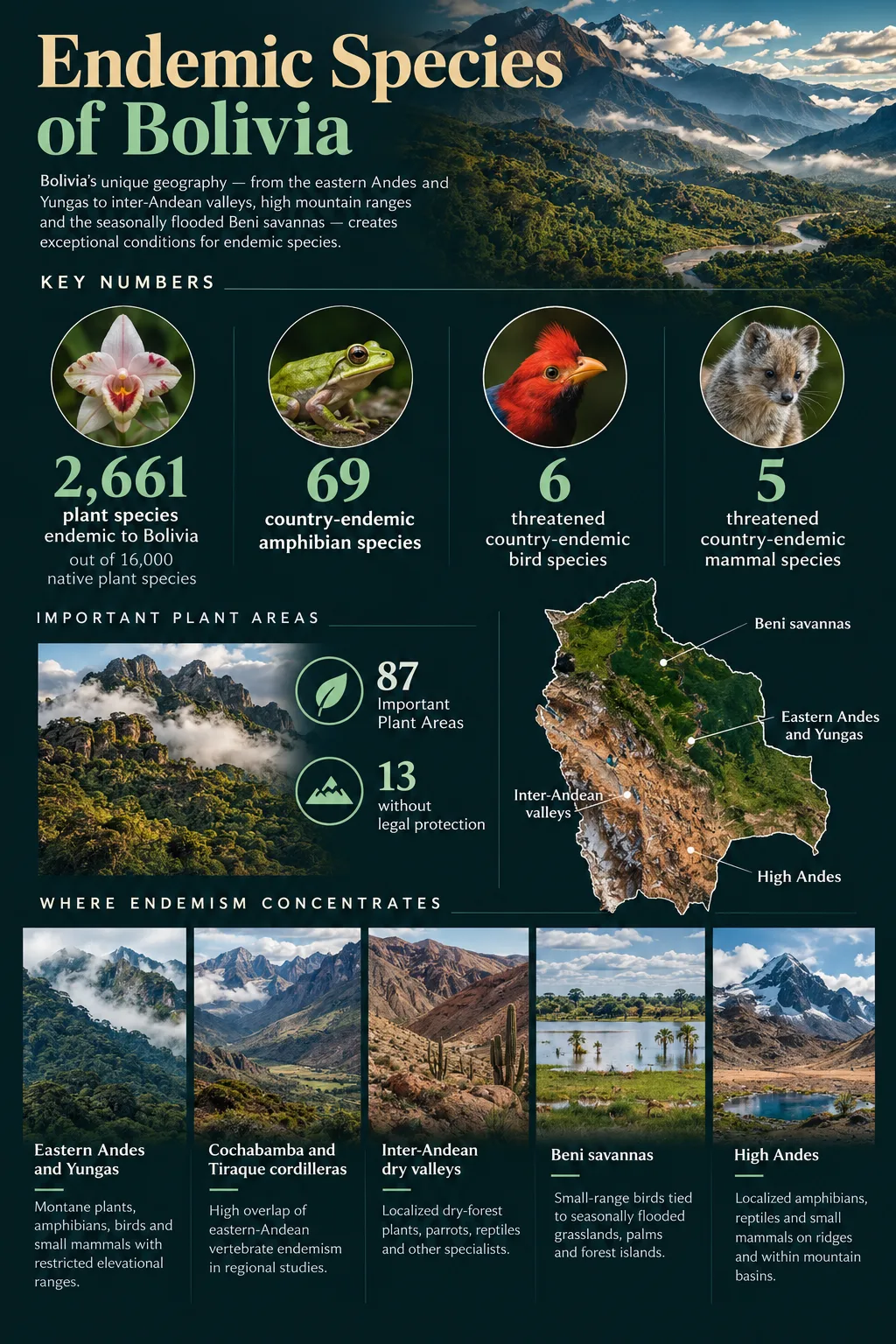
Bolivia’s country endemics are concentrated in several different geographic systems: the humid eastern Andes and Yungas, isolated inter-Andean valleys, high Andean ridges and basins, and the seasonally flooded Beni savannas. Plant, vertebrate and specialist taxonomic datasets use different scopes, so their values are kept separate instead of being combined into an artificial all-taxa total.
| Measure | Value |
|---|---|
| Native wild plant species | 16,000 species [S1] |
| Plant species endemic to Bolivia | 2,661 species [S1] |
| Endemic plant species with IUCN Red List status | 899 species (33%) [S1] |
| Endemic plant extinction-risk assessments produced by the IPA project | 732 species [S1] |
| Important Plant Areas | 87 sites [S1] |
| Important Plant Areas without legal protection | 13 sites [S1] |
| Country-endemic amphibian species | 69 species [S2] |
| Threatened country-endemic bird species | 6 species [S2] |
| Threatened country-endemic mammal species | 5 species [S2] |
The rows above come from independently defined datasets. The plant totals, IUCN vertebrate totals and threatened subsets are not additive, and they do not establish a national all-taxa endemic-species total.
Where Bolivian endemism concentrates
Bolivia spans low Amazonian plains, the eastern Andean slope, enclosed valleys, high plateaus and seasonally flooded savannas. The sharpest concentrations of narrow-range terrestrial species are associated with geographic barriers inside that larger landscape.
A regional analysis of the eastern Andes of Peru and Bolivia found different elevational patterns among vertebrate groups. Endemic amphibian richness peaked mainly around 1,000–1,500 m, while the combined vertebrate pattern was strongest around 2,000–3,000 m. The highest modeled overlap in that study, 75–78 endemic vertebrate species in individual grid cells, occurred in Bolivia’s Cochabamba and Tiraque cordilleras. These are regional eastern-Andean results, not a count of species endemic to Bolivia as a country. [S3]
| Geographic system | Endemism pattern | Main isolation mechanism |
|---|---|---|
| Eastern Andes and Yungas | Montane plants, amphibians, birds and small mammals with restricted elevational ranges | Steep elevation changes, cloud-forest belts and separated mountain slopes |
| Cochabamba and Tiraque cordilleras | High overlap of eastern-Andean vertebrate endemism in regional modeling | Mountain ridges, valleys and narrow climate bands |
| Inter-Andean dry valleys | Localized dry-forest plants, parrots, reptiles and other xeric specialists | Dry valleys separated by higher, cooler or wetter terrain |
| Beni savannas | Small-range birds tied to seasonally flooded grasslands, palms and forest islands | Seasonal flooding and patchy elevated woody habitat |
| High Andes | Localized amphibians, reptiles and small mammals on ridges and within mountain basins | Elevation, cold-climate specialization and separation among valleys and watersheds |
Plant endemism and the Important Plant Area network
Kew’s Bolivia project reports 2,661 endemic plant species among 16,000 native wild plant species. It has identified 87 Important Plant Areas covering 406,071 km². Seventy-four of the sites match or overlap protected areas, Key Biodiversity Areas or Ramsar sites to varying degrees, while 13 are reported as lacking any form of legal protection. [S1]
Red List coverage is still incomplete. Kew reports an IUCN Red List status for 899 of the 2,661 endemic plants. Using those two values from the same dataset leaves 1,762 endemic plant species outside that published-status subset.
| IUCN status coverage | Endemic plant species |
|---|---|
| Species with an IUCN Red List status | 899 |
| Remaining endemic species outside that status subset | 1,762 |
{
  "type": "donut",
  "title": "IUCN status coverage among Bolivia's endemic plants",
  "description": "Kew reports IUCN Red List status for 899 of 2,661 endemic plant species; 1,762 remain outside that published-status subset.",
  "unit": "species",
  "data": [
    {"label": "With IUCN status", "value": 899},
    {"label": "Outside the status subset", "value": 1762}
  ],
  "source": "[S1] Royal Botanic Gardens, Kew"
}
The national plant figure should remain separate from vertebrate figures. It is a species-level botanical estimate from the Bolivia IPA project and cannot be added to IUCN vertebrate tables to manufacture a single total.
Amphibian microendemism in the eastern Andes
IUCN’s country table records 69 amphibian species whose natural distributions are confined to Bolivia. The pattern includes many very small montane ranges, especially in La Paz and Cochabamba.
Microkayla shows this concentration at genus level. Amphibian Species of the World recognizes 25 species in the genus; its current species accounts classify 22 of them as endemic to Bolivia. Many are known from one cordillera, valley system or small set of high-elevation localities. [S4]
| Microkayla treatment | Species |
|---|---|
| Recognized species in the genus | 25 |
| Species classified as endemic to Bolivia | 22 |
| Other recognized Microkayla | 3 |
{
  "type": "donut",
  "title": "Country-endemic status of recognized Microkayla species",
  "description": "Amphibian Species of the World recognizes 25 species in the genus; 22 are classified by their species accounts as endemic to Bolivia.",
  "unit": "species",
  "data": [
    {"label": "Endemic to Bolivia", "value": 22},
    {"label": "Other Microkayla", "value": 3}
  ],
  "source": "[S4] Amphibian Species of the World 6.2"
}
The narrow ranges are biologically different from a single nationwide endemic distribution. Microkayla chacaltaya, for example, is associated with high-elevation localities in the La Paz region, while M. iatamasi is tied to the Carrasco area of Cochabamba. Country endemism can therefore contain another layer of much finer mountain-scale endemism.
Endemic birds in the Beni savannas and dry valleys
Blue-throated Macaw in the Beni savannas
The Blue-throated Macaw (Ara glaucogularis) is native only to Bolivia’s Beni savannas. BirdLife treats it as Critically Endangered and describes three small subpopulations in a landscape that can remain flooded for much of the year. Its range depends on the relationship between open savanna, palms and elevated forest islands. [S5]
BirdLife’s 2023 account cited an official wild-population estimate of 455 birds. The same account reports that a nest-box programme begun in 2005 had expanded to more than 100 boxes installed or maintained annually and had helped 113 young macaws fledge over a 15-year period. Those figures describe the conservation programme reported in that account rather than a new population estimate.
Red-fronted Macaw in the inter-Andean valleys
The Red-fronted Macaw (Ara rubrogenys) occupies a small section of south-central Bolivia’s eastern Andean valleys, including parts of the Río Grande, Mizque, Caine and Pilcomayo systems. BirdLife classifies it as Critically Endangered and gives an estimated 134–272 mature individuals with a declining trend. [S6]
| Species | Core endemic landscape | Assessment | Population evidence |
|---|---|---|---|
| Ara glaucogularis | Beni seasonally flooded savannas | Critically Endangered | 455 wild birds in the BirdLife 2023 account |
| Ara rubrogenys | South-central inter-Andean dry valleys | Critically Endangered | 134–272 mature individuals in the BirdLife assessment |
The two macaws illustrate separate routes to country endemism. One is tied to a lowland flooded savanna system; the other follows dry Andean valleys isolated by mountain terrain.
Mammal endemism under changing inventories
A national mammal checklist published in 2019 recognized 406 native mammal species and treated 25 as endemic to Bolivia. Twenty of those 25 were rodents, including two then-undescribed species; six endemic species in that treatment belonged to Ctenomys. [S7]
That figure is a historical checklist treatment, not a current fixed total. The Mammal Diversity Database now lists 420 living mammal species for Bolivia and 13 resident Ctenomys species. [S8] Changes in accepted species, newly described taxa and revised distributions prevent the 2019 endemic count from being transferred unchanged into the current inventory.
The older checklist nevertheless reveals a persistent pattern: much of Bolivia’s documented mammal endemism is concentrated among small mammals, especially rodents with limited Andean or valley distributions, rather than among the country’s better-known large mammals.
Recent taxonomy can change the endemic list
Leopardus tilcayo in the Bolivian Yungas
Leopardus tilcayo was described as a distinct tiger-cat species in 2026 during a phylogenomic revision of South American tiger cats. The type material and confirmed records used in the description come from the Bolivian Yungas. [S9]
Range treatment: Leopardus tilcayo is currently confirmed from Bolivia in the published taxonomic treatment, but a newly described species can acquire additional verified localities as field and museum material is reassessed. It is therefore kept separate from the country-endemic checklist below until its natural range is better resolved.
Cliff Parakeet became a country endemic after a species split
The 2025 Clements update elevated Myiopsitta luchsi from the Monk Parakeet complex to species rank as the Cliff Parakeet and explicitly recorded the result as a new endemic species for Bolivia. The split was supported by breeding behavior, plumage, vocal and genetic evidence and was accepted by SACC and AviList. [S10]
This is a direct example of a country-endemic count changing because taxonomic rank changed. The birds did not acquire a new geographic range; the scientific treatment of that range changed.
Reptile endemism in mountains and dry valleys
The Reptile Database’s current Bolivia search returns 327 reptile species recorded from the country. That value is a country inventory, not an endemic-species total. [S11]
Country-only distributions occur in several unrelated reptile lineages. Examples include the amphisbaenian Amphisbaena cegei, high-Andean and montane Liolaemus, the dry-country snake Clelia langeri, and localized pit vipers. Their ranges are better represented individually than by treating all Bolivian reptiles as one biogeographic unit.
Country-endemic, near-endemic and lake-endemic are different
| Range term | Meaning in a Bolivia dataset |
|---|---|
| Bolivia endemic | The species’ natural native range lies entirely within Bolivia. |
| Near-endemic | Most of the range may lie in Bolivia, but a natural native population also occurs in another country. |
| Range-restricted | The species has a small distribution, but that range does not have to stop at Bolivia’s national border. |
| Lake or basin endemic | The species is restricted to a water body or drainage. If that system crosses a national border, the species is not automatically country-endemic. |
Lake Titicaca is a useful boundary case because the lake is shared by Bolivia and Peru. A species naturally confined to Lake Titicaca can be endemic to the lake while failing the definition of a Bolivia-endemic species if its native distribution occurs on both sides of the international border.
Introduced, naturalized, captive, cultivated or conservation-translocated records do not expand a species’ original native range for endemic-status purposes.
Verified endemic species checklist
Verified species-level records shown: 45
Amphibians: Bolivia-endemic Microkayla
Amphibian Species of the World recognizes 25 species of Microkayla. Its species accounts classify the 22 records below as endemic to Bolivia; the other three recognized members of the genus are excluded because their accepted natural distributions are not Bolivia-only. [S4]
| Scientific name | Supported native range within Bolivia |
|---|---|
| Microkayla adenopleura | Carrasco area, Cochabamba |
| Microkayla ankohuma | Larecaja, La Paz |
| Microkayla chacaltaya | Cotapata and Zongo region, La Paz |
| Microkayla chaupi | Franz Tamayo and Madidi region, La Paz |
| Microkayla colla | Palcabamba and Madidi region, La Paz |
| Microkayla condoriri | Amaguaya, Larecaja, La Paz |
| Microkayla guillei | Cordillera de Apolobamba, La Paz |
| Microkayla harveyi | Ayopaya, Cochabamba |
| Microkayla huayna | Zongo Valley, La Paz |
| Microkayla iani | Tacacoma region, Larecaja, La Paz |
| Microkayla iatamasi | Carrasco area, Cochabamba |
| Microkayla illampu | Larecaja, La Paz |
| Microkayla illimani | Nevado Illimani and Sud Yungas, La Paz |
| Microkayla kallawaya | Cordillera de Apolobamba, La Paz |
| Microkayla katantika | Upper cloud-forest zone, La Paz |
| Microkayla kempffi | Serranía Siberia, Cochabamba and Santa Cruz |
| Microkayla melanocheira | Cargatero Valley, Franz Tamayo, La Paz |
| Microkayla pinguis | Inquisivi, La Paz |
| Microkayla quimsacruzis | Cordillera de Quimsa Cruz, Inquisivi, La Paz |
| Microkayla saltator | Cordillera de Apolobamba, La Paz |
| Microkayla teqta | Pablo Amaya, Larecaja, La Paz |
| Microkayla wettsteini | Bolivia |
Mammals with current Bolivia-only distributions
| Scientific name | Supported native range |
|---|---|
| Abrocoma boliviensis | Bolivia; restricted central-eastern Andean range [S12] |
| Thomasomys andersoni | Bolivia; montane central Bolivian range [S13] |
| Ctenomys lessai | Bolivia; Cochabamba region [S14] |
| Ctenomys yatesi | Bolivia; Santa Cruz region [S15] |
| Oxymycterus hucucha | Bolivia; central Andean and adjacent montane region [S16] |
| Plecturocebus modestus | Bolivia; restricted Río Beni region [S17] |
| Plecturocebus olallae | Bolivia; restricted Río Beni region [S18] |
Birds with Bolivia-only native ranges
BirdLife’s Bolivia dataset and species accounts support the native-range treatment of the bird records below; the Cliff Parakeet follows the Clements 2025 species split. [S19]
| Scientific name | Common name | Supported native range |
|---|---|---|
| Ara glaucogularis | Blue-throated Macaw | Beni savannas [S5] |
| Ara rubrogenys | Red-fronted Macaw | South-central eastern-Andean valleys [S6] |
| Aglaeactis pamela | Black-hooded Sunbeam | Bolivian Andes [S19] |
| Poospiza garleppi | Cochabamba Mountain Finch | Cochabamba highlands [S19] |
| Cranioleuca henricae | Bolivian Spinetail | Central Bolivian Andes [S19] |
| Grallaria erythrotis | Rufous-faced Antpitta | Bolivian Andes [S19] |
| Oreopsar bolivianus | Bolivian Blackbird | Bolivian Andes [S19] |
| Myiopsitta luchsi | Cliff Parakeet | Central Bolivia under the Clements 2025 species treatment [S10] |
Reptiles with current Bolivia-only distributions
| Scientific name | Supported native range |
|---|---|
| Amphisbaena cegei | Santa Cruz, Bolivia [S20] |
| Liolaemus aparicioi | La Paz, Bolivia; high-elevation Andean range [S21] |
| Liolaemus fittkaui | Cochabamba, Bolivia [S22] |
| Tropidurus azurduyae | Chuquisaca, Cochabamba, Potosí and Santa Cruz [S23] |
| Epictia undecimstriata | Bolivia [S24] |
| Bothrops sanctaecrucis | Beni and Santa Cruz, Bolivia [S25] |
| Clelia langeri | Santa Cruz, including inter-Andean dry-valley habitat [S26] |
| Bothrops monsignifer | Santa Cruz, Bolivia [S27] |
Data boundaries that change Bolivia’s counts
- Native range controls country endemism. Introduced or naturalized populations do not alter the original endemic range.
- Species rank is kept separate from subspecies and other infraspecific taxa. A newly elevated species such as Myiopsitta luchsi can change a species-level national count.
- Taxonomic revisions can alter totals without a geographic change. Newly described or split species may expose country-level endemism that was previously hidden within a wider taxon.
- Different datasets are not summed. Kew’s plant dataset, IUCN’s assessed vertebrate tables and specialist taxonomic databases have different coverage and update cycles.
- A restricted range is not automatically a national endemic range. Transboundary Andean systems and Lake Titicaca require the natural distribution to be checked on both sides of Bolivia’s borders.
- Occurrence records alone are insufficient. A lack of records outside Bolivia does not prove absence; country-endemic classification requires an accepted distribution treatment.
Sources
[S1] ↩ Royal Botanic Gardens, Kew — Important plants for the world in the centre of South America. Bolivia plant-endemism totals, Important Plant Area network and Red List assessment coverage.
[S2] ↩ IUCN Red List — Table 8a, 2025-2. Country totals for endemic, threatened endemic and extinct species in assessed vertebrate groups excluding fishes.
[S3] ↩ BMC Ecology — Plant and animal endemism in the eastern Andean slope: challenges to conservation. Regional eastern-Andean elevational and geographic endemism patterns.
[S4] ↩ American Museum of Natural History — Microkayla, Amphibian Species of the World 6.2. Accepted species and linked distribution accounts for the genus.
[S5] ↩ BirdLife International — Success in the Savannah: Saving the Critically Endangered Blue-throated Macaw. Beni range, population census and nest-box programme figures.
[S6] ↩ BirdLife DataZone — Red-fronted Macaw Ara rubrogenys Species Factsheet. Distribution, population and Red List treatment.
[S7] ↩ SciELO Bolivia — Lista actualizada y comentada de los mamíferos de Bolivia. 2019 national mammal checklist and endemic-species treatment.
[S8] ↩ Mammal Diversity Database — Bolivia (Plurinational State of) Mammal Diversity Statistics. Current country inventory and taxonomic structure.
[S9] ↩ Lescroart et al. — Leopardus tilcayo taxonomic treatment. Species description associated with the 2026 phylogenomic revision of South American tiger cats.
[S10] ↩ Clements Checklist — Updates and Corrections, October 2025. Species split recognizing the Cliff Parakeet Myiopsitta luchsi as a Bolivia endemic.
[S11] ↩ The Reptile Database — Bolivia country search. Current reptile inventory for Bolivia.
[S12] ↩ Mammal Diversity Database — Abrocoma boliviensis. Current taxon and country distribution.
[S13] ↩ Mammal Diversity Database — Thomasomys andersoni. Current taxon and country distribution.
[S14] ↩ Mammal Diversity Database — Ctenomys lessai. Current taxon and country distribution.
[S15] ↩ Mammal Diversity Database — Ctenomys yatesi. Current taxon and country distribution.
[S16] ↩ Mammal Diversity Database — Oxymycterus hucucha. Current taxon and country distribution.
[S17] ↩ Mammal Diversity Database — Plecturocebus modestus. Current taxon and country distribution.
[S18] ↩ Mammal Diversity Database — Plecturocebus olallae. Current taxon and country distribution.
[S19] ↩ BirdLife DataZone — Bolivia Factsheet. Country bird dataset and endemic-range records.
[S20] ↩ The Reptile Database — Amphisbaena cegei. Current distribution treatment.
[S21] ↩ The Reptile Database — Liolaemus aparicioi. Current distribution treatment.
[S22] ↩ The Reptile Database — Liolaemus fittkaui. Current distribution treatment.
[S23] ↩ The Reptile Database — Tropidurus azurduyae. Current distribution treatment.
[S24] ↩ The Reptile Database — Epictia undecimstriata. Current distribution treatment.
[S25] ↩ The Reptile Database — Bothrops sanctaecrucis. Current distribution treatment.
[S26] ↩ The Reptile Database — Clelia langeri. Current distribution treatment.
[S27] ↩ The Reptile Database — Bothrops monsignifer. Current distribution treatment.