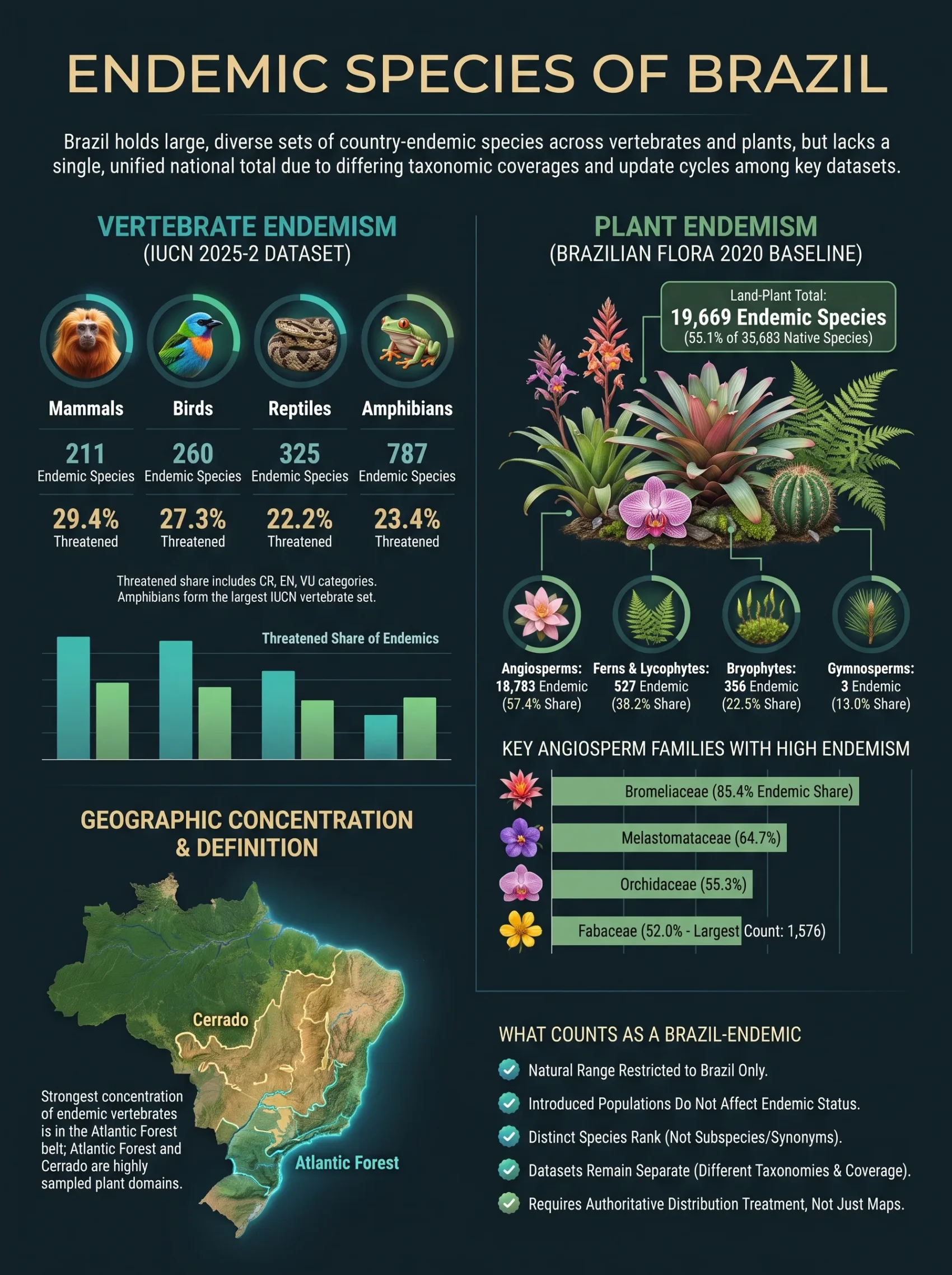
Brazil has large country-endemic species sets across vertebrates and plants, but no single defensible all-taxa endemic total. The strongest national datasets use different taxonomic coverage and update cycles, so their counts are kept separate rather than added together.
| Measure | Value |
|---|---|
| Endemic mammals | 211 species [S1] |
| Endemic birds | 260 species [S1] |
| Endemic reptiles | 325 species [S1] |
| Endemic amphibians | 787 species [S1] |
| Endemic cacti | 201 species [S2] |
| Endemic conifers | 3 species [S2] |
| Endemic Proteaceae | 24 species [S2] |
| Endemic trees | 3,620 species [S2] |
| Native endemic land plants | 19,669 species [S3] |
| Endemic angiosperms | 18,783 species [S3] |
| Endemic ferns and lycophytes | 527 species [S3] |
| Endemic bryophytes | 356 species [S3] |
Data boundary: the IUCN figures above come from its 2025-2 country-endemic tables and cover defined assessed groups. The land-plant figures are the published Brazilian Flora 2020 baseline. Tree, cactus, conifer and Proteaceae categories overlap taxonomically and must not be added together. The plant and vertebrate datasets also must not be combined into an artificial national total.
Vertebrate endemism in the IUCN country dataset
IUCN Table 8 defines an endemic species as one known to occur naturally within one country only. Its country totals are restricted to taxonomic groups for which more than 80% of species have been assessed. Introduced populations, vagrant records and other non-native occurrences do not make a species non-endemic under this definition. [S1]
| Group | Endemic species | Threatened endemic species | EX or EW endemics | Threatened share of endemics |
|---|---|---|---|---|
| Mammals | 211 | 62 | 2 | 29.4% |
| Birds | 260 | 71 | 4 | 27.3% |
| Reptiles | 325 | 72 | 0 | 22.2% |
| Amphibians | 787 | 184 | 2 | 23.4% |
The threatened percentages are calculated directly from the endemic and threatened-endemic values in the same IUCN table. “Threatened” covers Critically Endangered, Endangered and Vulnerable species. EX and EW refer to Extinct and Extinct in the Wild.
Amphibians form the largest of these four national endemic sets, with 787 species in the IUCN table. Mammals have the highest calculated threatened share among the four groups at 29.4%, followed by birds at 27.3%.
Plant groups assessed by IUCN
IUCN’s plant country table provides another national dataset, but its categories are not mutually exclusive. A tree can also belong to one of the named plant lineages, so these rows describe separate assessment sets rather than pieces of one total. [S2]
| Assessed plant group | Endemic species | Threatened endemics | EX or EW endemics | Threatened share |
|---|---|---|---|---|
| Cacti | 201 | 108 | 0 | 53.7% |
| Conifers | 3 | 2 | 0 | 66.7% |
| Proteaceae | 24 | 10 | 0 | 41.7% |
| Trees | 3,620 | 1,237 | 4 | 34.2% |
The tree dataset contains 3,620 Brazil-endemic species, of which 1,237 are classified in threatened categories in the IUCN table. Cacti have 201 country-endemic species, with 108 listed as threatened.
Plant endemism in the Brazilian Flora 2020 baseline
The Brazilian Flora 2020 project recorded 46,975 native species of algae, fungi and plants. Its published Table 1 reports endemic counts for the four land-plant groups below. Those groups contain 35,683 native species, including 19,669 endemic species. [S3]
| Land-plant group | Native species | Endemic species | Endemic share |
|---|---|---|---|
| Bryophytes | 1,584 | 356 | 22.5% |
| Ferns and lycophytes | 1,380 | 527 | 38.2% |
| Gymnosperms | 23 | 3 | 13.0% |
| Angiosperms | 32,696 | 18,783 | 57.4% |
| Land-plant total | 35,683 | 19,669 | 55.1% |
Angiosperms account for most of the endemic land-plant records in this dataset. The 18,783 endemic angiosperms represent 57.4% of the 32,696 native angiosperm species documented in the 2020 treatment. The published table did not provide equivalent endemic totals for algae or fungi, so those groups are not assigned an endemic count here.
Angiosperm families with many endemic species
The same Flora 2020 dataset identified ten species-rich angiosperm families that together contained 9,579 species endemic to Brazil. The percentages below use the native and endemic counts reported for each family in the same dataset. [S3]
| Family | Native species | Endemic species | Endemic share |
|---|---|---|---|
| Fabaceae | 3,033 | 1,576 | 52.0% |
| Orchidaceae | 2,692 | 1,490 | 55.3% |
| Asteraceae | 2,205 | 1,361 | 61.7% |
| Bromeliaceae | 1,379 | 1,177 | 85.4% |
| Melastomataceae | 1,436 | 929 | 64.7% |
| Myrtaceae | 1,193 | 783 | 65.6% |
| Rubiaceae | 1,415 | 707 | 50.0% |
| Euphorbiaceae | 973 | 602 | 61.9% |
| Poaceae | 1,551 | 510 | 32.9% |
| Malvaceae | 840 | 444 | 52.9% |
Bromeliaceae has the highest endemic proportion among these ten families in the 2020 dataset, with 1,177 of 1,379 native species restricted to Brazil. Fabaceae has the largest absolute endemic count in the table, at 1,576 species.
Living taxonomy and dataset versions
Plant counts should be read as dated dataset values rather than permanent totals. The official Flora e Funga do Brasil checklist maintained by the Rio de Janeiro Botanical Garden continues to change as names, synonymies, distributions and newly described taxa are incorporated. Its official IPT release published on 1 August 2026 is version 393.429, is marked for weekly updates and contains 165,176 checklist records. Records are not equivalent to unique accepted species, so that figure is not an endemic-species total. [S4]
Why the 2020 plant count remains labelled as a baseline: the published 2020 treatment provides a clearly defined native-species denominator and endemic numerator for each major land-plant group. The living Flora e Funga dataset is the better resource for checking current accepted names and distributions, but a current record count cannot simply replace those published species totals.
Amphibian taxonomy has also moved
The Brazilian Society of Herpetology’s national list based on peer-reviewed evidence through March 2026 recognizes 1,251 valid amphibian species: 1,206 anurans, 40 caecilians and five salamanders. [S5]
That 1,251-species national checklist should not be used as the denominator for a new percentage based on the IUCN figure of 787 endemic amphibians. The two values come from different versions, taxonomic treatments and data purposes. A percentage created by dividing them would imply compatibility that has not been established.
Endemic bats of Brazil
A 2024 national bat checklist recognizes 186 bat species in Brazil and identifies exactly 13 as endemic to the country. Because that publication supplies both the full order-level checklist and an explicit endemic subset, the 13 species below form a complete source-defined checklist rather than a fixed-size sample. They represent about 7.0% of the bat fauna in that treatment. [S6]
| Scientific name | Family |
|---|---|
| Dryadonycteris capixaba | Phyllostomidae |
| Glyphonycteris behnii | Phyllostomidae |
| Histiotus alienus | Vespertilionidae |
| Lasiurus ebenus | Vespertilionidae |
| Lonchophylla bokermanni | Phyllostomidae |
| Lonchophylla inexpectata | Phyllostomidae |
| Lonchophylla mordax | Phyllostomidae |
| Lonchophylla peracchii | Phyllostomidae |
| Neoeptesicus taddeii | Vespertilionidae |
| Neonycteris pusilla | Phyllostomidae |
| Platyrrhinus recifinus | Phyllostomidae |
| Trachops ehrhardti | Phyllostomidae |
| Xeronycteris vieirai | Phyllostomidae |
Taxonomic boundaries in the bat checklist
The checklist treats Glyphonycteris behnii as endemic to Brazil after a specimen previously attributed to the species in Bolivia was reidentified as Micronycteris hirsuta. [S6]
Trachops ehrhardti is also a useful example of taxonomy affecting endemic totals. The checklist accepts it at species rank and cites morphological and molecular evidence supporting a distribution in southern and southeastern Brazil, while noting that some other taxonomic resources had treated it within Trachops cirrhosus. [S6]
These cases show why national endemic counts can change without any biological expansion or contraction of a species’ natural range. Reidentification, synonymization and species-level splits can alter which names qualify as Brazil-endemic.
Geographic concentration of endemism
Brazilian endemism is geographically uneven. A national spatial analysis of birds, mammals and amphibians found the strongest concentration of species endemic to Brazil in the Atlantic Forest, particularly along the belt from southern Bahia through southeastern Brazil to São Paulo. The same analysis found relatively few Brazil-endemic species in the Pampa and Pantanal for the vertebrate groups studied. [S7]
The botanical pattern is related but should not be treated as the same dataset. Brazilian Flora 2020 identified the Atlantic Rainforest as the most species-rich phytogeographic domain for the plant groups it examined except gymnosperms, for which the Amazon had the highest richness. It also reported that the Atlantic Rainforest and Cerrado had been more intensively sampled and studied than other Brazilian domains. [S3]
Richness and endemism are different measures. A biome can contain many species without all of them being restricted to Brazil, and a species endemic to a particular Brazilian mountain, island, river basin or forest system is also nationally endemic if its entire natural range remains inside Brazil.
What counts as a Brazil-endemic species
- Natural range controls endemic status. A species qualifies as nationally endemic when its natural native distribution is restricted to Brazil.
- Introduced populations do not extend the native range. A Brazil-endemic species does not cease to be endemic merely because people establish it outside the country.
- Species rank matters. Subspecies, varieties, forms and populations should not be silently counted as species.
- Synonyms are not separate records. A taxonomic name placed in synonymy must not create a duplicate endemic species.
- Different datasets should remain separate. Counts based on different taxonomic backbones, assessment coverage or biological groups cannot be added unless their definitions and coverage are demonstrably compatible.
- An occurrence map alone is insufficient. A lack of records outside Brazil does not by itself establish endemism; the classification needs an authoritative distribution treatment.
For Brazil, this distinction matters because the documented endemic biota spans thousands of species and several independently maintained taxonomic systems. The national IUCN tables provide comparable country-endemic statistics for defined assessment groups; Flora e Funga do Brasil supplies the principal living taxonomic and distribution backbone for Brazilian plants and fungi; specialist national checklists remain necessary for groups such as amphibians and bats.
Sources
[S1] ↩ IUCN — Red List version 2025-2, Table 8a: endemic mammals, birds, reptiles and amphibians by country. Country-endemic totals, threatened-endemic totals and EX/EW endemic totals for assessed vertebrate groups; last updated 10 October 2025.
[S2] ↩ IUCN — Red List version 2025-2, Table 8d: endemic plants by country. Country totals for endemic, threatened-endemic and EX/EW species in defined assessed plant groups; last updated 10 October 2025.
[S3] ↩ Brazil Flora Group — Brazilian Flora 2020: Leveraging the power of a collaborative scientific network. Published national baseline for native and endemic algae, fungi and plant diversity, including major land-plant groups and angiosperm families.
[S4] ↩ Jardim Botânico do Rio de Janeiro — Flora e Funga do Brasil, official checklist dataset. Living taxonomic checklist maintained by JBRJ; version 393.429 was published 1 August 2026 with weekly update frequency.
[S5] ↩ Sociedade Brasileira de Herpetologia — Lista de Anfíbios. National amphibian checklist based on peer-reviewed evidence through March 2026, recognizing 1,251 valid species.
[S6] ↩ Garbino et al. — Updated checklist of bats (Mammalia: Chiroptera) from Brazil. Zoologia, 2024. National checklist of 186 bat species identifying 13 species as exclusive to Brazil and discussing recent taxonomic changes.
[S7] ↩ Patterns of Vertebrate Diversity and Protection in Brazil. National spatial analysis of bird, mammal and amphibian richness, restricted ranges and Brazil-endemic distributions.