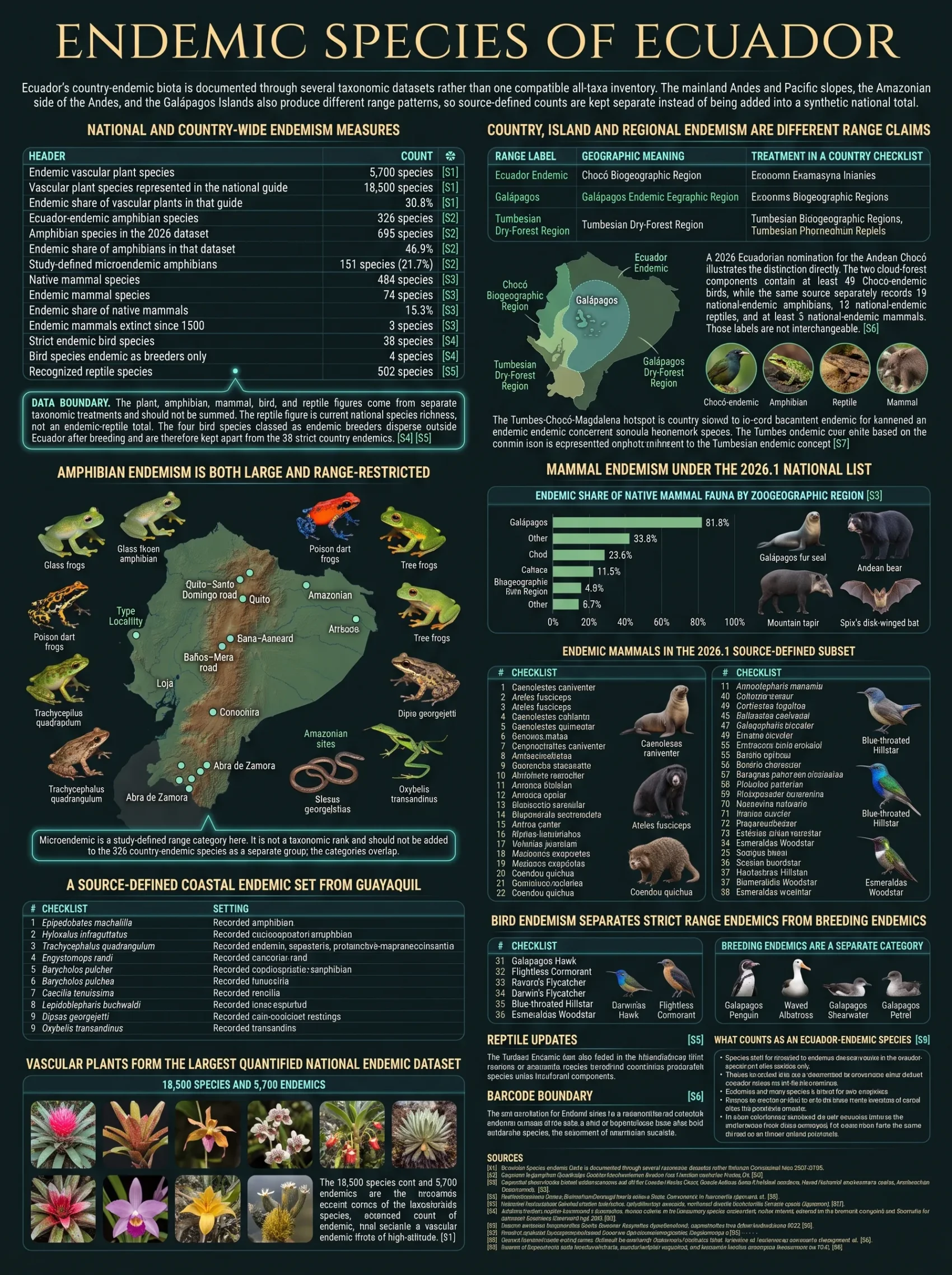
Ecuador’s country-endemic biota is documented through several taxonomic datasets rather than one compatible all-taxa inventory. The mainland Andes and Pacific slopes, the Amazonian side of the Andes, and the Galápagos Islands also produce different range patterns, so source-defined counts are kept separate instead of being added into a synthetic national total.
| Measure | Value |
|---|---|
| Endemic vascular plant species | 5,700 species [S1] |
| Vascular plant species represented in the national guide | 18,500 species [S1] |
| Endemic share of vascular plants in that guide | 30.8% [S1] |
| Ecuador-endemic amphibian species | 326 species [S2] |
| Amphibian species in the 2026 dataset | 695 species [S2] |
| Endemic share of amphibians in that dataset | 46.9% [S2] |
| Study-defined microendemic amphibians | 151 species (21.7%) [S2] |
| Native mammal species | 484 species [S3] |
| Endemic mammal species | 74 species [S3] |
| Endemic share of native mammals | 15.3% [S3] |
| Endemic mammals extinct since 1500 | 3 species [S3] |
| Strict endemic bird species | 38 species [S4] |
| Bird species endemic as breeders only | 4 species [S4] |
| Recognized reptile species | 502 species [S5] |
Data boundary. The plant, amphibian, mammal, bird, and reptile figures come from separate taxonomic treatments and should not be summed. The reptile figure is current national species richness, not an endemic-reptile total. The four bird species classed as endemic breeders disperse outside Ecuador after breeding and are therefore kept apart from the 38 strict country endemics. [S4] [S5]
Country, island and regional endemism are different range claims
An Ecuador-endemic species has its natural global range within Ecuador. A species restricted to the Galápagos Islands can therefore also be Ecuador-endemic because the archipelago is part of Ecuador. A Chocó endemic or Tumbesian endemic carries a different geographic claim: those biogeographic regions cross national borders.
| Range label | Geographic meaning | Treatment in a country checklist |
|---|---|---|
| Ecuador endemic | Natural global range confined to Ecuador | Included at species rank |
| Galápagos endemic | Natural range confined to all or part of the Galápagos archipelago | Also Ecuador-endemic if no native range occurs outside Ecuador |
| Chocó endemic | Restricted to the Chocó biogeographic region | Included only when the species’ entire natural range also lies within Ecuador |
| Tumbesian endemic | Restricted to the Tumbesian dry-forest region | Included only when the species does not naturally extend into Peru |
A 2026 Ecuadorian nomination for the Andean Chocó illustrates the distinction directly. The two cloud-forest components contain at least 49 Chocó-endemic birds, while the same source separately records 19 national-endemic amphibians, 12 national-endemic reptiles, and at least 3 national-endemic mammals. Those labels are not interchangeable. [S6]
The Tumbes-Chocó-Magdalena hotspot likewise crosses borders. Its dry forests extend through southwestern Ecuador into northern Peru, so a Tumbesian species cannot be treated as Ecuador-endemic without species-level range evidence. [S7]
Amphibian endemism is both large and range-restricted
A 2026 Scientific Reports dataset recognized 695 amphibian species reported from Ecuador, of which 326 were endemic to the country. The same analysis classified 151 species, or 21.7% of the dataset, as microendemic under its study definition; 69 of those were known only from their type locality and nearby areas. Another 79 names with Ecuadorian type localities had been synonymized and were excluded from the recognized-species dataset. [S2]
Type localities were concentrated unevenly across continental Ecuador. Among the 505 species whose type localities could be positioned with adequate precision, clusters occurred around Abra de Zamora and Loja, the Baños–Mera road, the old Quito–Santo Domingo road, and several Amazonian localities. Eastern and western montane forests contained more type localities than the dry habitats in the study’s ecosystem classification. [S2]
Microendemic is a study-defined range category here. It is not a taxonomic rank and should not be added to the 326 country-endemic species as a separate group; the categories overlap.
A source-defined coastal endemic set from Guayaquil
A 17-year inventory of Guayaquil recorded 63 amphibian and reptile species: 19 amphibians and 44 reptiles. Within that defined study area, six amphibians and three reptiles were explicitly marked as endemic to Ecuador. The nine species below are the complete endemic subset identified in the study, rather than a hand-picked example list. [S8]
| Scientific name | Group | Recorded setting |
|---|---|---|
| Epipedobates machalilla | Amphibian | Conservation areas; remnant native vegetation |
| Hyloxalus infraguttatus | Amphibian | Conservation areas; remnant native vegetation |
| Trachycephalus quadrangulum | Amphibian | Conservation areas; remnant native vegetation |
| Engystomops randi | Amphibian | Conservation areas; remnant native vegetation |
| Barycholos pulcher | Amphibian | Conservation areas; remnant native vegetation |
| Caecilia tenuissima | Amphibian | Conservation areas |
| Lepidoblepharis buchwaldi | Reptile | Conservation areas; remnant native vegetation |
| Dipsas georgejetti | Reptile | Conservation areas |
| Oxybelis transandinus | Reptile | Conservation areas; remnant native vegetation |
Mammal endemism under the 2026.1 national list
The official mammal checklist version 2026.1 recognizes 484 native species and 74 Ecuador endemics. It also lists 43 undescribed or pending forms separately, 140 subspecies, 17 introduced species with wild populations, and three species extinct since 1500. The 74-species endemic list is therefore a species-rank subset rather than a count of every named or pending mammalian taxon. [S3]
The update changed the national treatment of several taxa. It added the newly described Oreoryzomys jumandi and Coendou sangay, recognized Oreoryzomys hesperus as valid, and treated Ateles fusciceps as a monotypic species endemic to Ecuador. [S3]
Endemics are concentrated in a few mammal orders
Rodents account for 53 of the 74 endemic mammals in the national list. All five recognized Paucituberculata species are endemic, while bats have the largest native species count but only seven country endemics. Percentages in the last column are calculated from the native and endemic counts in the same 2026.1 table. [S3]
| Order | Native species | Endemic species | Endemic/native ratio |
|---|---|---|---|
| Didelphimorphia | 26 | 0 | 0.0% |
| Paucituberculata | 5 | 5 | 100.0% |
| Sirenia | 1 | 0 | 0.0% |
| Cingulata | 6 | 0 | 0.0% |
| Pilosa | 8 | 0 | 0.0% |
| Primates | 22 | 1 | 4.5% |
| Rodentia | 143 | 53 | 37.1% |
| Lagomorpha | 4 | 2 | 50.0% |
| Eulipotyphla | 5 | 3 | 60.0% |
| Chiroptera | 183 | 7 | 3.8% |
| Carnivora | 37 | 2 | 5.4% |
| Perissodactyla | 2 | 0 | 0.0% |
| Artiodactyla | 42 | 1 | 2.4% |
Galápagos and the Andes separate richness from endemism
The national mammal dataset also assigns species to zoogeographic regions. These regional occurrence categories overlap, so they cannot be added to produce national totals. The derived endemic/native ratio shows a different pattern from raw richness: the Amazonian lowlands contain 220 native mammals but no country-endemic mammal in this regional treatment, whereas Galápagos contains 11 native mammals and nine Ecuador endemics. [S3]
| Zoogeographic region | Native species | Endemic species | Endemic/native ratio |
|---|---|---|---|
| Galápagos | 11 | 9 | 81.8% |
| Coastal lowlands | 187 | 12 | 6.4% |
| Humid forest (northwest) | 152 | 10 | 6.6% |
| Dry forest (southwest) | 137 | 8 | 5.8% |
| Western subtropics (foothills) | 174 | 16 | 9.2% |
| Western temperate zone | 94 | 17 | 18.1% |
| High-Andean | 78 | 23 | 29.5% |
| Western Andes | 60 | 17 | 28.3% |
| Eastern Andes | 67 | 18 | 26.9% |
| Inter-Andean valleys | 58 | 9 | 15.5% |
| Eastern temperate zone | 90 | 22 | 24.4% |
| Eastern subtropics (foothills) | 184 | 13 | 7.1% |
| Amazonian lowlands | 220 | 0 | 0.0% |
{
  "type": "bar",
  "title": "Endemic share of native mammal fauna by zoogeographic region",
  "description": "Percentages are calculated from native and Ecuador-endemic species counts in the same 2026.1 mammal dataset. Regional occurrence categories overlap.",
  "unit": "%",
  "orientation": "horizontal",
  "min": 0,
  "max": 100,
  "data": [
    {"label": "Galápagos", "value": 81.8},
    {"label": "Coastal lowlands", "value": 6.4},
    {"label": "Humid forest (northwest)", "value": 6.6},
    {"label": "Dry forest (southwest)", "value": 5.8},
    {"label": "Western subtropics (foothills)", "value": 9.2},
    {"label": "Western temperate zone", "value": 18.1},
    {"label": "High-Andean", "value": 29.5},
    {"label": "Western Andes", "value": 28.3},
    {"label": "Eastern Andes", "value": 26.9},
    {"label": "Inter-Andean valleys", "value": 15.5},
    {"label": "Eastern temperate zone", "value": 24.4},
    {"label": "Eastern subtropics (foothills)", "value": 7.1},
    {"label": "Amazonian lowlands", "value": 0.0}
  ],
  "source": "AEM Mammals of Ecuador, version 2026.1"
}
Endemic mammals in the 2026.1 source-defined subset
The national checklist supplies a discrete 74-species endemic section. The three mammals that the same publication lists as extinct since 1500 are retained and marked rather than mixed silently with living records. [S3]
| Scientific name | Order |
|---|---|
| Caenolestes caniventer | Paucituberculata |
| Caenolestes condorensis | Paucituberculata |
| Caenolestes convelatus | Paucituberculata |
| Caenolestes fuliginosus | Paucituberculata |
| Caenolestes sangay | Paucituberculata |
| Ateles fusciceps | Primates |
| Microsciurus simonsi | Rodentia |
| Simosciurus stramineus | Rodentia |
| Heteromys teleus | Rodentia |
| Reithrodontomys soederstroemi | Rodentia |
| Aegialomys galapagoensis | Rodentia |
| Chilomys carapazi | Rodentia |
| Chilomys georgeledecii | Rodentia |
| Chilomys neisi | Rodentia |
| Chilomys percequilloi | Rodentia |
| Chilomys weksleri | Rodentia |
| Hylaeamys tatei | Rodentia |
| Ichthyomys orientalis | Rodentia |
| Ichthyomys pinei | Rodentia |
| Megaoryzomys curioi — extinct since 1500 | Rodentia |
| Mindomys hammondi | Rodentia |
| Mindomys kutuku | Rodentia |
| Neacomys auriventer | Rodentia |
| Nectomys saturatus | Rodentia |
| Neomicroxus latebricola | Rodentia |
| Nephelomys moerex | Rodentia |
| Nesoryzomys darwini — extinct since 1500 | Rodentia |
| Nesoryzomys fernandinae | Rodentia |
| Nesoryzomys indefessus — extinct since 1500 | Rodentia |
| Nesoryzomys narboroughi | Rodentia |
| Nesoryzomys swarthi | Rodentia |
| Neusticomys orcesi | Rodentia |
| Oreoryzomys balneator | Rodentia |
| Oreoryzomys hesperus | Rodentia |
| Oreoryzomys jumandi | Rodentia |
| Pattonimus ecominga | Rodentia |
| Pattonimus musseri | Rodentia |
| Phyllotis haggardi | Rodentia |
| Rhagomys septentrionalis | Rodentia |
| Rhipidomys albujai | Rodentia |
| Sigmodon inopinatus | Rodentia |
| Tanyuromys thomasleei | Rodentia |
| Thomasomys aureus | Rodentia |
| Thomasomys auricularis | Rodentia |
| Thomasomys burneoi | Rodentia |
| Thomasomys erro | Rodentia |
| Thomasomys fumeus | Rodentia |
| Thomasomys hudsoni | Rodentia |
| Thomasomys igor | Rodentia |
| Thomasomys otavalo | Rodentia |
| Thomasomys pardignasi | Rodentia |
| Thomasomys salazari | Rodentia |
| Thomasomys silvestris | Rodentia |
| Thomasomys ucucha | Rodentia |
| Thomasomys vulcani | Rodentia |
| Coendou quichua | Rodentia |
| Coendou sangay | Rodentia |
| Lagidium ahuacaense | Rodentia |
| Cavia patzelti | Rodentia |
| Sylvilagus daulensis | Lagomorpha |
| Sylvilagus surdaster | Lagomorpha |
| Cryptotis albujai | Eulipotyphla |
| Cryptotis equatoris | Eulipotyphla |
| Cryptotis osgoodi | Eulipotyphla |
| Lonchophylla orcesi | Chiroptera |
| Micronycteris giovanniae | Chiroptera |
| Micronycteris simmonsae | Chiroptera |
| Sturnira boadai | Chiroptera |
| Sturnira perla | Chiroptera |
| Cabreramops aequatorianus | Chiroptera |
| Myotis moratellii | Chiroptera |
| Arctocephalus galapagoensis | Carnivora |
| Zalophus wollebaeki | Carnivora |
| Mazama gualea | Artiodactyla |
Bird endemism separates strict range endemics from breeding endemics
The Ecuadorian Ornithological Records Committee’s 2025 list follows AviList 2025 and recognizes 38 bird species whose known global distributions are confined to Ecuador. Its distribution field places 30 of those 38 in Galápagos and eight on the mainland. The same source keeps four endemic breeders in a separate category because they leave Ecuador during the non-breeding period. [S4]
Strict endemic bird checklist
| Scientific name | English name | Source distribution |
|---|---|---|
| Zenaida galapagoensis | Galapagos Dove | Galápagos |
| Laterallus spilonota | Galapagos Crake | Galápagos |
| Leucophaeus fuliginosus | Lava Gull | Galápagos |
| Nannopterum harrisi | Flightless Cormorant | Galápagos |
| Butorides sundevalli | Lava Heron | Galápagos |
| Eriocnemis nigrivestis | Black-breasted Puffleg | Northern Andes |
| Oreotrochilus cyanolaemus | Blue-throated Hillstar | Southern Andes |
| Metallura baroni | Violet-throated Metaltail | Southern Andes |
| Chaetocercus berlepschi | Esmeraldas Woodstar | Southern Pacific |
| Buteo galapagoensis | Galapagos Hawk | Galápagos |
| Amazona lilacina | Lilacine Amazon | Central–southern Pacific |
| Pyrrhura orcesi | El Oro Parakeet | Southern Andes |
| Myiarchus magnirostris | Galapagos Flycatcher | Galápagos |
| Pyrocephalus nanus | Darwin's Flycatcher | Galápagos |
| Scytalopus robbinsi | El Oro Tapaculo | Southern Andes |
| Progne modesta | Galapagos Martin | Galápagos |
| Mimus parvulus | Galapagos Mockingbird | Galápagos |
| Mimus trifasciatus | Floreana Mockingbird | Galápagos — Floreana |
| Mimus macdonaldi | Española Mockingbird | Galápagos — Española |
| Mimus melanotis | San Cristobal Mockingbird | Galápagos — San Cristóbal |
| Atlapetes pallidiceps | Pale-headed Brushfinch | Southern Andes |
| Certhidea olivacea | Green Warbler-Finch | Galápagos |
| Certhidea fusca | Grey Warbler-Finch | Galápagos |
| Platyspiza crassirostris | Vegetarian Finch | Galápagos |
| Camarhynchus pallidus | Woodpecker Finch | Galápagos |
| Camarhynchus psittacula | Large Tree Finch | Galápagos |
| Camarhynchus pauper | Medium Tree Finch | Galápagos — Floreana |
| Camarhynchus parvulus | Small Tree Finch | Galápagos |
| Camarhynchus heliobates | Mangrove Finch | Galápagos — Isabela and Fernandina |
| Geospiza fuliginosa | Small Ground Finch | Galápagos |
| Geospiza magnirostris | Large Ground Finch | Galápagos |
| Geospiza septentrionalis | Vampire Ground Finch | Galápagos — Darwin and Wolf |
| Geospiza acutirostris | Genovesa Ground Finch | Galápagos — Genovesa |
| Geospiza difficilis | Sharp-beaked Ground Finch | Northern Galápagos |
| Geospiza scandens | Common Cactus Finch | Galápagos |
| Geospiza fortis | Medium Ground Finch | Galápagos |
| Geospiza conirostris | Española Cactus Finch | Galápagos — Española |
| Geospiza propinqua | Genovesa Cactus Finch | Galápagos — Genovesa |
Breeding endemics are a separate category
These four species reproduce only in Ecuador under the CERO treatment but disperse to other countries or territories afterward. They are therefore not included in the 38-species strict endemic checklist. [S4]
| Scientific name | English name | Post-breeding dispersal |
|---|---|---|
| Spheniscus mendiculus | Galapagos Penguin | Eastern Pacific |
| Phoebastria irrorata | Waved Albatross | Eastern Pacific |
| Puffinus subalaris | Galapagos Shearwater | Eastern Pacific and Central America |
| Pterodroma phaeopygia | Galapagos Petrel | Eastern Pacific and Central America |
Vascular plants form the largest quantified national endemic dataset
Ecuador’s national biodiversity portal presents an interactive vascular-plant guide containing 18,500 species, including 5,700 endemic species across the country’s four regions. Within that guide, the endemic count is about 30.8% of the represented vascular-plant species. [S1]
The plant figure remains separate from vertebrate totals because its taxonomic coverage and source treatment differ.
Reptile richness has a current taxonomy but no synchronized endemic total on the public index
The second edition of Reptiles of Ecuador recognizes 502 species: 3 worm lizards, 5 crocodilians, 216 lizards, 244 snakes, and 34 turtles and tortoises. The 2026 edition reports 15 additions and two synonymies, and its PDF edition 2.1 was updated on 11 September 2026. [S5]
The public index supplies a current national richness denominator but does not present a synchronized country-endemic reptile total beside it. An older endemic count should therefore not be divided by 502 to create a current percentage. The Guayaquil dataset above provides a smaller, explicitly defined source-level set of three Ecuador-endemic reptiles without implying that it is the national total.
DNA barcode uniqueness is not an endemic-species count
Standardized arthropod sampling in Mashpi–Tayra recorded 8,057 Barcode Index Numbers (BINs), about 7,848 of them unique in a comparison of ten Neotropical sites. The source describes BINs as genetic clusters or putative undescribed species. They are not equivalent to 7,848 formally described Ecuador-endemic species and are not added to the national endemic totals. [S6]
What counts as an Ecuador-endemic species
The IUCN country-statistics system defines an endemic species as one occurring naturally within one country only, and its country-endemic tables are limited to species groups with more than 80% assessment coverage. [S9]
- Natural range controls the classification. Introduced, naturalized, cultivated, captive, or conservation-translocated occurrences do not expand a species’ original native range.
- Galápagos can be nested within Ecuador. A species naturally restricted to one Galápagos island is also Ecuador-endemic when it has no native population outside Ecuador.
- Regional endemism is tested separately. Chocó and Tumbesian endemics enter an Ecuador country checklist only when their natural global ranges stop at Ecuador’s borders.
- Species rank stays separate from lower ranks. Endemic subspecies and plant varieties are useful records but do not increase a species-level endemic count.
- Synonyms are not extra species. Current accepted treatments prevent the same lineage from being counted twice under old and new names.
- Occurrence gaps are not proof of endemism. A map showing records only inside Ecuador is insufficient without a distribution source that supports the native-range restriction.
Sources
[S1] ↩ Instituto Nacional de Biodiversidad — Guías de plantas de Ecuador. National vascular-plant guide figures.
[S2] ↩ Scientific Reports — Patterns in the distribution of Ecuadorian amphibian type localities. 2026 country-level amphibian dataset and microendemism analysis.
[S3] ↩ Asociación Ecuatoriana de Mastozoología — Mamíferos del Ecuador: lista oficial actualizada de especies / Mammals of Ecuador: official updated species checklist, version 2026.1. Official national mammal list and endemic subset.
[S4] ↩ Comité Ecuatoriano de Registros Ornitológicos — Aves endémicas de Ecuador a nivel de especies y subespecies, con listados adicionales de taxones cuya distribución se restringe principalmente a los límites territoriales del Ecuador, versión 2025. Strict endemic species, endemic breeders, and taxonomic notes following AviList 2025.
[S5] ↩ Reptiles of Ecuador — Reptiles of Ecuador, second edition. 2026 national reptile taxonomy and species richness.
[S6] ↩ UNESCO World Heritage Centre — The Andean Chocó Cloud Forest – Soundscape. 2026 site-level national-endemic, Chocó-endemic, and arthropod BIN figures.
[S7] ↩ Critical Ecosystem Partnership Fund — Tumbes-Chocó-Magdalena – Species. Geographic context for the transboundary hotspot and its southwestern Ecuador–northern Peru dry forests.
[S8] ↩ Ecology and Evolution — Urban–Wild Interface Diversity: A Comprehensive Checklist of Herpetofauna of Guayaquil, Ecuador. 2026 study and its source-defined Ecuador-endemic amphibian and reptile subset.
[S9] ↩ IUCN Red List of Threatened Species — Summary Statistics. Country-endemic definition and Table 8 assessment-coverage rule.