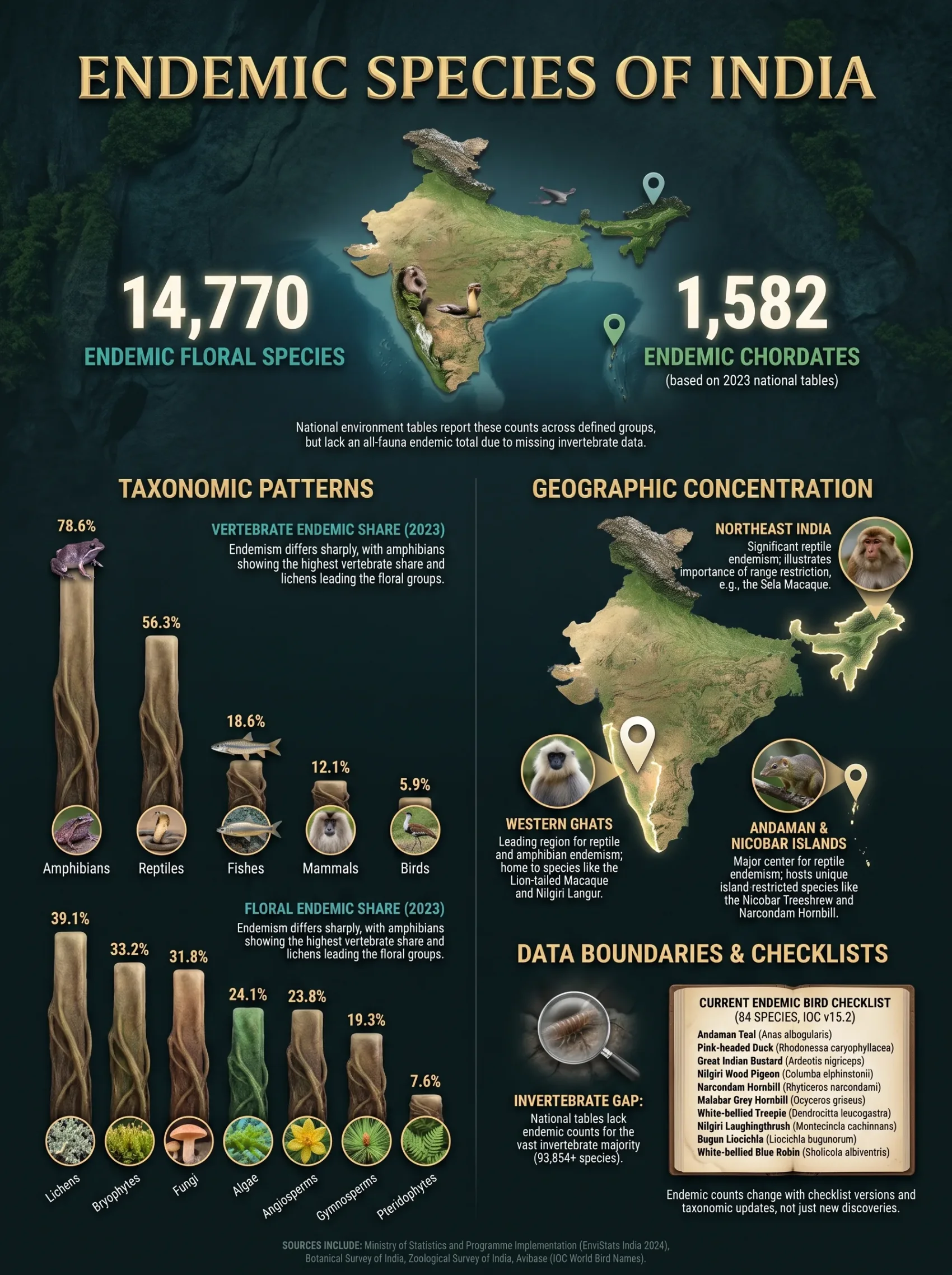
India’s 2023 national environment tables report 14,770 endemic species across the source-defined floral groups and 1,582 endemic chordates. The same fauna table leaves endemic totals blank for protozoans and invertebrates, so it does not support a single all-fauna endemic total.[S1]
| Measure | Value |
|---|---|
| Documented floristic elements | 56,177 taxa [S2] |
| Documented faunal diversity after 2025 additions | 105,953 species [S3] |
| Species in the 2023 national floral table | 55,726 [S1] |
| Endemic species reported in the 2023 floral table | 14,770 [S1] |
| Endemic share of the 2023 floral table | 26.5% [S1] |
| Endemic angiosperms | 5,286 of 22,214 species (23.8%) [S1] |
| Endemic bryophytes | 941 of 2,835 species (33.2%) [S1] |
| Endemic lichens | 1,207 of 3,088 species (39.1%) [S1] |
| Endemic chordates | 1,582 of 7,119 species (22.2%) [S1] |
| Endemic fishes | 664 of 3,579 species (18.6%) [S1] |
| Endemic amphibians | 359 of 457 species (78.6%) [S1] |
| Endemic reptiles in the 2023 national table | 427 of 758 species (56.3%) [S1] |
| Country-endemic reptiles in the later specialist checklist | 472 species [S4] |
| Endemic birds in the 2023 national table | 79 of 1,347 species (5.9%) [S1] |
| India-endemic birds in the current IOC-based checklist | 84 species [S5] |
| Endemic mammals | 53 of 438 species (12.1%) [S1] |
Scope of the opening data: the 2023 ratios use paired numerator and denominator values from the same national tables. The later 56,177-floristic-element inventory, 105,953-fauna inventory, 472-reptile checklist and 84-bird checklist are shown as separate updates and are not substituted into the older denominators.
{
  "type": "bar",
  "title": "Endemic share within 2023 vertebrate group totals",
  "description": "Percentages are calculated only from the paired total and endemic counts in the same 2023 national fauna table.",
  "unit": "percent",
  "orientation": "horizontal",
  "data": [
    {"label": "Amphibians", "value": 78.6},
    {"label": "Reptiles", "value": 56.3},
    {"label": "Fishes", "value": 18.6},
    {"label": "Mammals", "value": 12.1},
    {"label": "Birds", "value": 5.9}
  ],
  "source": "[S1] EnviStats India 2024, Table 5.2"
}
Endemism differs sharply among major taxonomic groups
The 2023 vertebrate data show the strongest endemic share among amphibians: 359 of 457 recorded species, or 78.6%. Reptiles follow at 427 of 758 species, or 56.3%. The corresponding shares are 18.6% for fishes, 12.1% for mammals and 5.9% for birds.[S1] These percentages describe the taxonomic treatment and inventory represented in that national dataset; later specialist checklists can contain different totals.
The floral table shows a different pattern. Lichens have the highest endemic proportion among groups with paired counts, with 1,207 endemic species among 3,088 recorded species. Bryophytes reach 33.2% and fungi 31.8%. Angiosperms have a lower proportional value of 23.8%, but their 5,286 endemic species form the largest absolute endemic count in the table.[S1]
{
  "type": "bar",
  "title": "Endemic share within 2023 floral-group totals",
  "description": "Percentages use paired species and endemic-species values from the same national floral table.",
  "unit": "percent",
  "orientation": "horizontal",
  "data": [
    {"label": "Lichens", "value": 39.1},
    {"label": "Bryophytes", "value": 33.2},
    {"label": "Fungi", "value": 31.8},
    {"label": "Algae", "value": 24.1},
    {"label": "Angiosperms", "value": 23.8},
    {"label": "Gymnosperms", "value": 19.3},
    {"label": "Pteridophytes", "value": 7.6}
  ],
  "source": "[S1] EnviStats India 2024, Table 5.1"
}
Why India does not have one interchangeable endemic-species total
The figure of 55,726 in the 2023 floral table is tied to that table’s biological coverage. It combines angiosperms, gymnosperms, pteridophytes, bryophytes, algae, fungi, lichens, and a virus-and-bacteria category. Its 14,770 endemic-species figure belongs to the same treatment.[S1]
A later Botanical Survey of India inventory reports 56,177 documented floristic elements, including 22,368 angiosperms, 83 gymnosperms, 1,325 pteridophytes, 2,850 bryophytes, 9,117 algae, 15,986 fungi, 3,151 lichens and 1,297 microbes.[S2] That later total should not be used as the denominator for the earlier 14,770 endemic count because the inventory version and category totals have changed.
The 2023 fauna table reports 93,854 invertebrate species and 7,119 chordate species. Endemic counts are supplied for chordates and their principal vertebrate groups, but the endemic field for invertebrates is blank.[S1] A blank endemic field is not evidence of zero endemic invertebrates. It means the table cannot be used to calculate an all-fauna endemic count.
No synthetic all-taxa endemic total: flora, fauna and specialist checklists use different ranks, coverage and release cycles. Their endemic counts are retained within the biological universe defined by each source.
Where Indian endemism is concentrated
Western Ghats
The Western Ghats are the leading region for reptile endemism in the Zoological Survey of India’s 2025 reptile checklist.[S4] Mammal ranges show the same geographic restriction in several lineages. The lion-tailed macaque, Macaca silenus, is recorded from Karnataka, Kerala and Tamil Nadu, while the Nilgiri langur, Semnopithecus johnii, is restricted to the Western Ghats of those states.[S6]
Amphibian endemism is especially concentrated in this mountain system. A Zoological Survey of India atlas published in 2013 listed 158 amphibian species as endemic to the Western Ghats.[S7] Because amphibian taxonomy has continued to change, that atlas is best treated as a dated regional inventory rather than a current species-name authority. The national Amphibia Version 2.0 checklist provides the newer nomenclatural treatment.[S8]
Andaman and Nicobar Islands
The Andaman and Nicobar Islands form the second major reptile-endemism region identified in the 2025 national reptile checklist.[S4] Island restriction also appears repeatedly in birds and mammals. The Nicobar treeshrew, Tupaia nicobarica, is recorded from Great Nicobar and Little Nicobar and is treated as endemic to India.[S6]
Botanical Survey of India work in the archipelago prepared distribution mapping and conservation assessments for 53 endemic tree species and reported 27 endemic-tree records during field surveys.[S9] These records illustrate why island-level range information is more informative than a country-only range label for many Indian endemics.
Northeast India and Arunachal Pradesh
Northeast India is the third major reptile-endemism region identified in the 2025 reptile checklist.[S4] The region also shows why a species occurring in a geographically restricted part of India is not automatically endemic to India.
The Sela macaque, Macaca selai, is recorded from Arunachal Pradesh and treated as endemic to India in the current mammal checklist. The Arunachal macaque, Macaca munzala, also occurs in Arunachal Pradesh, but its natural range extends into Bhutan and China; it therefore does not meet a country-endemic definition for India.[S6]
Why endemic counts change between checklist versions
| Dataset comparison | Earlier value | Later value | How to read the change |
|---|---|---|---|
| Reptiles | 427 endemic species in the 2023 national table [S1] | 472 country-endemic species in the 2025 specialist checklist [S4] | The later checklist uses a newer specialist treatment. Its overall total of 833 combines species and subspecies, so that mixed-rank denominator is not used to calculate an endemic-species percentage. |
| Birds | 79 endemic species in the 2023 national table [S1] | 84 endemics in the IOC v15.2 India checklist [S5] | The figures come from different checklist authorities and versions. The numerical difference should not be read as 5 newly evolved or newly discovered endemic birds. |
| All documented fauna | 104,561 species in the 2023 national table [S1] | 105,953 documented species after the 2025 additions [S3] | This is an inventory update, not an endemic-species total. |
Animal Discoveries–2025 reported 483 species new to science and 226 species recorded in India for the first time, for 709 new faunal records, while documented faunal diversity reached 105,953 species. Fauna of India Checklist Version 3.0 was released at the same 2026 event.[S3] New national inventory records should not automatically be interpreted as new Indian endemics; endemic status depends on the species’ natural range beyond the Indian record itself.
The large invertebrate inventory has no matching national endemic total
Invertebrates dominate the 2023 national fauna inventory numerically, with 93,854 recorded species compared with 7,119 chordates.[S1] Yet the national table does not provide a corresponding endemic-invertebrate value. This creates an important boundary for country-level totals: specialist studies can document endemic insects, mollusks, arachnids and other invertebrates, but counts drawn from separate taxonomic publications cannot simply be added to the national chordate figure to manufacture an all-animal endemic total.
Current India-endemic bird checklist
| Common name | Scientific name |
|---|---|
| Andaman Teal | Anas albogularis |
| Pink-headed Duck | Rhodonessa caryophyllacea |
| Nicobar Megapode | Megapodius nicobariensis |
| Red Spurfowl | Galloperdix spadicea |
| Painted Spurfowl | Galloperdix lunulata |
| Grey Junglefowl | Gallus sonneratii |
| Rock Bush Quail | Perdicula argoondah |
| Painted Bush Quail | Perdicula erythrorhyncha |
| Manipur Bush Quail | Perdicula manipurensis |
| Himalayan Quail | Ophrysia superciliosa |
| Andaman Nightjar | Caprimulgus andamanicus |
| Great Indian Bustard | Ardeotis nigriceps |
| Nilgiri Wood Pigeon | Columba elphinstonii |
| Andaman Wood Pigeon | Columba palumboides |
| Andaman Cuckoo-Dove | Macropygia rufipennis |
| Grey-fronted Green Pigeon | Treron affinis |
| Andaman Green Pigeon | Treron chloropterus |
| Nicobar Imperial Pigeon | Ducula nicobarica |
| Malabar Imperial Pigeon | Ducula cuprea |
| Andaman Crake | Rallina canningi |
| Jerdon’s Courser | Rhinoptilus bitorquatus |
| Great Nicobar Serpent Eagle | Spilornis klossi |
| Andaman Serpent Eagle | Spilornis elgini |
| Nicobar Sparrowhawk | Tachyspiza butleri |
| Andaman Masked Owl | Tyto deroepstorffi |
| Hume’s Boobook | Ninox obscura |
| Andaman Boobook | Ninox affinis |
| Forest Owlet | Athene blewitti |
| Andaman Scops Owl | Otus balli |
| Nicobar Scops Owl | Otus alius |
| Malabar Grey Hornbill | Ocyceros griseus |
| Narcondam Hornbill | Rhyticeros narcondami |
| White-cheeked Barbet | Psilopogon viridis |
| Malabar Barbet | Psilopogon malabaricus |
| Andaman Woodpecker | Dryocopus hodgei |
| Malabar Flameback | Chrysocolaptes socialis |
| Blue-winged Parakeet | Psittacula columboides |
| Nicobar Parakeet | Psittacula caniceps |
| Nicobar Hooded Pitta | Pitta abbotti |
| Malabar Woodshrike | Tephrodornis sylvicola |
| White-bellied Minivet | Pericrocotus erythropygius |
| Andaman Cuckooshrike | Coracina dobsoni |
| White-spotted Fantail | Rhipidura albogularis |
| White-bellied Treepie | Dendrocitta leucogastra |
| Andaman Treepie | Dendrocitta bayleii |
| White-naped Tit | Machlolophus nuchalis |
| Indian Black-lored Tit | Machlolophus aplonotus |
| Rufous-tailed Lark | Ammomanes phoenicura |
| Sykes’s Lark | Galerida deva |
| Malabar Lark | Galerida malabarica |
| Cachar Bulbul | Iole cacharensis |
| Nicobar Bulbul | Hypsipetes nicobariensis |
| Grey-headed Bulbul | Microtarsus priocephalus |
| Andaman Bulbul | Microtarsus fuscoflavescens |
| Flame-throated Bulbul | Rubigula gularis |
| Yellow-throated Bulbul | Pycnonotus xantholaemus |
| Broad-tailed Grassbird | Schoenicola platyurus |
| Mishmi Wren-Babbler | Spelaeornis badeigularis |
| Tawny-breasted Wren-Babbler | Spelaeornis longicaudatus |
| Snowy-throated Babbler | Stachyris oglei |
| Marsh Babbler | Pellorneum palustre |
| Banasura Laughingthrush | Montecincla jerdoni |
| Nilgiri Laughingthrush | Montecincla cachinnans |
| Palani Laughingthrush | Montecincla fairbanki |
| Ashambu Laughingthrush | Montecincla meridionalis |
| Bugun Liocichla | Liocichla bugunorum |
| Rufous Babbler | Argya subrufa |
| Wayanad Laughingthrush | Pterorhinus delesserti |
| White-headed Starling | Sturnia erythropygia |
| Malabar Starling | Sturnia blythii |
| Nilgiri Thrush | Zoothera neilgherriensis |
| Andaman Shama | Copsychus albiventris |
| Nilgiri Blue Robin | Sholicola major |
| White-bellied Blue Robin | Sholicola albiventris |
| Nilgiri Flycatcher | Eumyias albicaudatus |
| White-bellied Blue Flycatcher | Cyornis pallidipes |
| Nicobar Jungle Flycatcher | Cyornis nicobaricus |
| Malabar Whistling Thrush | Myophonus horsfieldii |
| Black-and-orange Flycatcher | Ficedula nigrorufa |
| Andaman Flowerpecker | Dicaeum virescens |
| Crimson-backed Sunbird | Leptocoma minima |
| Vigors’s Sunbird | Aethopyga vigorsii |
| Green Avadavat | Amandava formosa |
| Nilgiri Pipit | Anthus nilghiriensis |
Sources
[S1] ↩ Ministry of Statistics and Programme Implementation — EnviStats India 2024: Environment Accounts (7th Issue). Tables 5.1 and 5.2 provide the 2023 national floral and faunal totals and endemic counts used for compatible ratios.
[S2] ↩ Botanical Survey of India — Annual Report 2024–2025. Current BSI inventory total of 56,177 documented floristic elements and its taxonomic-group breakdown.
[S3] ↩ Press Information Bureau — Animal Taxonomy Summit 2026 and release of Animal Discoveries–2025. Reports 483 species new to science, 226 first records for India, 709 new faunal records, 105,953 documented faunal species and Fauna of India Checklist Version 3.0.
[S4] ↩ Zoological Survey of India — Checklist of Fauna of India: Chordata: Reptilia, Version 2.0 (2025). Reports 472 reptile species endemic to India and identifies the Western Ghats, Andaman and Nicobar Islands and Northeast India as leading reptile-endemism regions.
[S5] ↩ Avibase — Bird Checklist: India, IOC World Bird Names v15.2. Current IOC-based India checklist with 1,401 species, 84 endemics and three breeding endemics; last modified 17 February 2026.
[S6] ↩ Zoological Survey of India — Checklist of Fauna of India: Chordata: Mammalia, Version 2.0 (2025). Current range treatment used for India-endemic mammals and for contrasts with species whose natural ranges extend beyond India.
[S7] ↩ Zoological Survey of India — Atlas of Endemic Amphibians of Western Ghats. 2013 atlas listing 158 Western Ghats endemic amphibians; used as a dated regional endemism treatment rather than a current national checklist.
[S8] ↩ Zoological Survey of India — Checklist of Fauna of India: Chordata: Amphibia, Version 2.0 (2025). Current amphibian checklist used to distinguish present nomenclature from the older Western Ghats atlas treatment.
[S9] ↩ Botanical Survey of India — Annual Report 2022–2023. Andaman and Nicobar project report mapping 53 endemic tree species and reporting 27 endemic-tree records during field surveys.