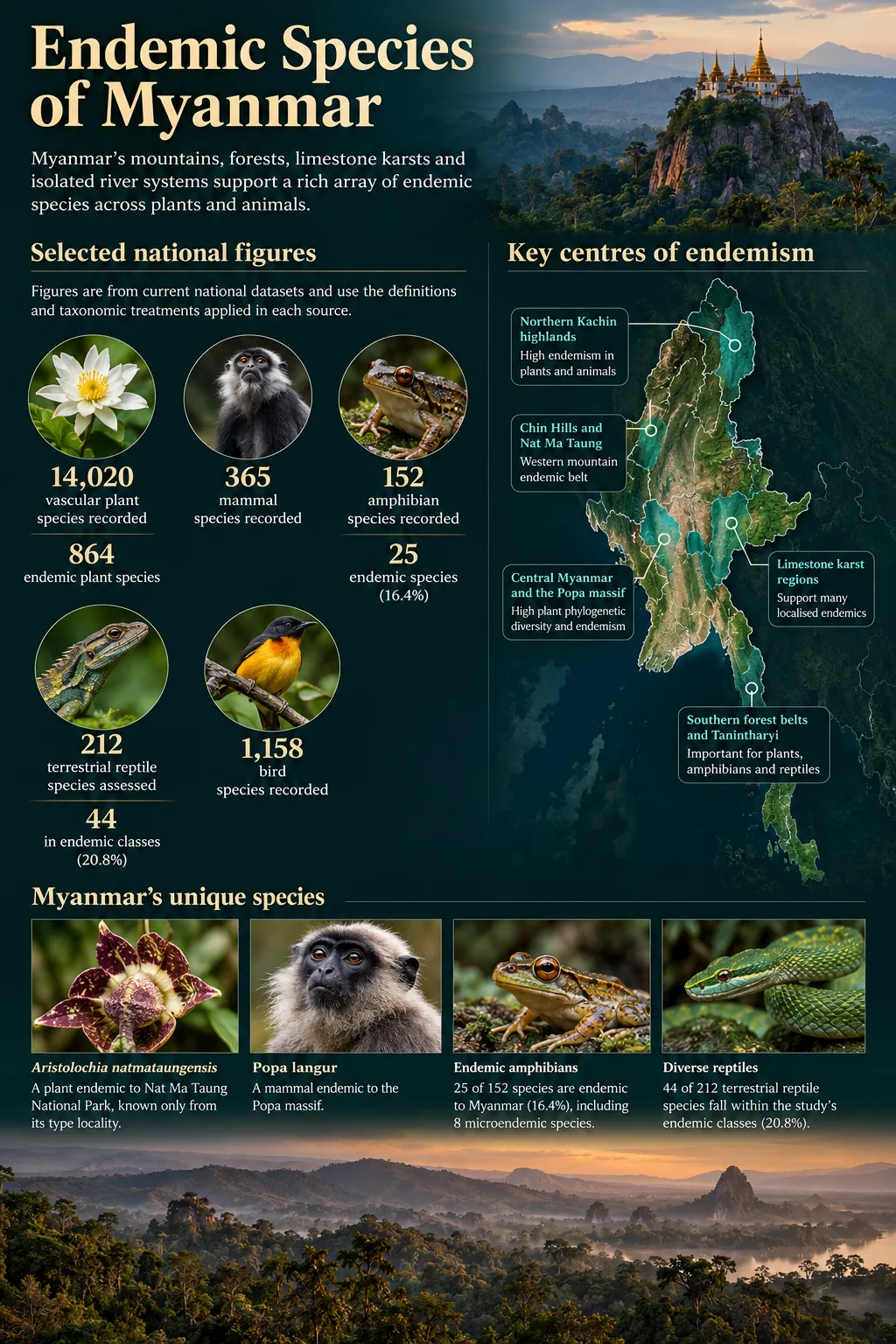
Myanmar has no defensible single all-taxa total for endemic species. Current national datasets cover different biological groups, use different taxonomic treatments, and in some cases define endemism differently, so the figures below are kept as separate measures instead of being added together.
| Measure | Value |
|---|---|
| Vascular plant species recorded | 14,020 species [S1] |
| Native vascular plant species | 13,314 species [S1] |
| Endemic vascular plant species | 864 species [S1] |
| Mammal species recorded | 365 species [S2] |
| Amphibian species recorded | 152 species [S3] |
| Amphibian species endemic to Myanmar | 25 species (16.4%) [S3] |
| Microendemic amphibian species | 8 species [S3] |
| Terrestrial reptile species assessed | 212 species [S4] |
| Terrestrial reptiles in the study’s endemic classes | 44 species (20.8%) [S4] |
| Bird species recorded | 1,158 species [S5] |
Data boundary: the reptile total of 44 uses the 2025 study’s CE, RE and ME classes. Its RE definition can include a locality spanning a country border, and the analysis includes Trimeresurus kanburiensis, which is confirmed from western Thailand but only predicted for adjacent Myanmar. The 44-species figure is therefore retained as a source-defined reptile measure, not converted into a strict Myanmar-only total. [S4]
Geographic centres of endemism
Myanmar’s endemics are distributed across several isolation systems: dry-zone massifs, western and northern mountains, limestone karst, southern forest belts, and separate freshwater drainages. A 2026 vascular-plant analysis adds an evolutionary layer to that pattern: central Myanmar has relatively high phylogenetic diversity and phylogenetic endemism despite only moderate modeled species richness. [S6]
| Area | Endemism pattern | Evidence |
|---|---|---|
| Central Myanmar and the Popa massif | Dry and seasonally hot landscapes contain high plant phylogenetic diversity and endemism relative to modeled species richness. The Popa langur is also part of the mammal checklist’s named endemic set. | [S6] [S2] |
| Chin Hills and Nat Ma Taung | Western mountain systems are part of the main paleo-endemism belt. Aristolochia natmataungensis, described in 2026, is known only from its type locality in Nat Ma Taung National Park at 2,400–2,500 m. | [S6] [S7] |
| Northern Kachin highlands | Cool, topographically complex northern mountains form the main neoendemism belt in the 2026 plant analysis. Sadiria kachinensis was described in 2026 from Kachin State, and the Hkakaborazi tube-nosed bat appears in the mammal checklist’s endemic set. | [S6] [S8] [S2] |
| Shan Hills and Salween karst | Isolated limestone ridges, caves and towers function as habitat islands. A single taxonomic study described 12 karst-adapted Cyrtodactylus species; nine were microendemics restricted to isolated caves or towers. | [S9] |
| Eastern and southern Myanmar | Amphibian richness is highest along the Shan Plateau into peninsular Myanmar, while the reptile analysis shows corrected weighted endemism peaks in eastern and southern ecoregions. | [S3] [S4] |
| Inle–Hopong freshwater systems | Lake and spring populations show how apparent micro-ranges can change with field sampling: seven fishes formerly treated as Inle Lake endemics were later recorded at Hopong, 35 km northeast of the lake. | [S10] [S11] |
| Sittaung River drainage | Laubuka sittaungensis was described in 2026 from 23 specimens collected in a tributary of the Sittaung drainage, adding another narrowly documented freshwater lineage to Myanmar’s inventory. | [S12] |
Vascular plants: 864 endemic species in the national checklist
The 2025 vascular-plant checklist records 14,020 species in 2,701 genera and 292 families. It treats 13,314 species as native, 706 as introduced and 864 as endemic to Myanmar. [S1] Because all three values come from the same checklist and rank, the endemic share of the native vascular flora is about 6.5%.
The 864-species figure is the stronger national baseline than older floristic estimates that circulated before the accepted-name list was rebuilt. The checklist added 2,220 species relative to the earlier 11,800-species inventory while resolving names, synonyms and native status. [S1]
Paleo-endemism and neoendemism occupy different regions
The 2026 phylogenetic study used a dated megaphylogeny containing 4,943 vascular-plant species and modeled habitat suitability for 2,453 species. Its CANAPE analysis separates areas dominated by old, geographically restricted lineages from areas shaped by more recent diversification. [S6]
| Phylogenetic endemism class | Main geographic pattern | Mapped area | Protected-area overlap |
|---|---|---|---|
| Paleo-endemism | Warm, fragmented western and central mountain systems | ~21,976 km² | 6.95% [S6] |
| Neoendemism | Cool, topographically complex northern montane regions | ~31,230 km² | 58.63% [S6] |
{
  "type": "bar",
  "title": "Protected-area overlap of plant endemism regions",
  "description": "Share of CANAPE-defined paleo-endemism and neoendemism regions overlapping current protected areas in the 2026 vascular-plant analysis.",
  "unit": "percent",
  "data": [
    {"label": "Paleo-endemism regions", "value": 6.95},
    {"label": "Neoendemism regions", "value": 58.63}
  ]
}
Species described after the 2025 plant baseline
A national checklist is a dated taxonomic baseline. Species published after that baseline should not be arithmetically added to its endemic count without a revised checklist that reconciles names and distributions.
| Species | Published record | Documented range |
|---|---|---|
| Aristolochia natmataungensis | Described in 2026 | Known only from the type locality in Nat Ma Taung National Park, Chin State; montane wet evergreen forest at 2,400–2,500 m. [S7] |
| Sadiria kachinensis | Described in 2026 | Described from Kachin State, Myanmar; the original taxonomic paper identifies it as a species new to science from that state. [S8] |
Amphibians: 25 country-endemic species in the 2024 assessment
The amphibian assessment records 152 species in Myanmar and identifies 25 as endemic to the country. Within that endemic set, ten are classed as country endemics (CE), seven as regional endemics (RE), and eight as microendemics (ME); these grades describe how narrowly the species is distributed within Myanmar, not whether the species is endemic to Myanmar. [S3]
| Endemism grade | Species | Share of the 25-species endemic set |
|---|---|---|
| Country endemic (CE) | 10 | 40% |
| Regional endemic (RE) | 7 | 28% |
| Microendemic (ME) | 8 | 32% |
{
  "type": "bar",
  "title": "Range grades within Myanmar's endemic amphibian set",
  "description": "The 25 species are all treated as endemic to Myanmar; CE, RE and ME distinguish their internal range extent in the 2024 assessment.",
  "unit": "species",
  "data": [
    {"label": "Country endemic (CE)", "value": 10},
    {"label": "Regional endemic (RE)", "value": 7},
    {"label": "Microendemic (ME)", "value": 8}
  ]
}
Five of the 25 endemics were formally in IUCN threatened categories in the study’s Red List snapshot. Seventeen more were DD or NE, so the authors treated 22 of 25 as threatened or potentially threatened for their screening analysis. That 88% figure is not an IUCN threatened-species percentage. The same study found 12 endemic amphibians—48% of the endemic set—outside the protected-area layer used in the analysis. [S3]
Endemic amphibian checklist
| Scientific name | Status in study | Grade | Documented Myanmar range |
|---|---|---|---|
| Hylarana margariana | DD | CE | Eastern Shwegu Township, west of Bhamo, and Kachin more generally |
| Amolops latopalmatus | NE | CE | Extreme southern Myanmar, Tanintharyi |
| Amolops longimanus | DD | ME | Kambaiti Village, Kachin, around 2,000 m |
| Amolops marmoratus | LC | CE | Mon, Shan, Kayin, Kayah, Bago, Kachin, Mandalay and Tanintharyi |
| Ansonia kyaiktiyoensis | EN | ME | Kyaiktiyo Pagoda, Mon, around 1,033 m |
| Ansonia thinthinae | EN | RE | Me Kyauklonegyi Stream in Tanintharyi Nature Reserve |
| Duttaphrynus crocus | DD | RE | Two nearby localities adjacent to Rakhine Yoma Elephant Sanctuary, Gwa Township, Rakhine |
| Feihyla punctata | DD | CE | Gwa Township, Rakhine; Ngaputaw Township, Ayeyarwady |
| Fejervarya kupitzi | NT | CE | Alaungdaw Kathapa National Park, Sagaing; Bago Yoma, Bago |
| Hylarana oatesii | DD | CE | Bago and Yangon |
| Hylarana roberti | VU | CE | Dawei, Tanintharyi |
| Kalophrynus anya | LC | CE | Chatthin Wildlife Sanctuary, Sagaing; south-central Kachin |
| Leptobrachium rakhinense | EN | CE | Rakhine Hills in Rakhine and Bago |
| Limnonectes bagoensis | NE | CE | Bago and Yangon |
| Limnonectes bagoyoma | NE | RE | Bago Yoma mountain range, Bago |
| Microhyla fodiens | DD | ME | Kan Pauk, Yesagyo Township, Magway, around 230 m |
| Microhyla irrawaddy | DD | RE | Pakokku on the Irrawaddy River and the vicinity of Kan Pauk village, Yesagyo Township, Magway |
| Nanorana feae | DD | RE | Kakhyen Hills, Kachin |
| Occidozyga myanhessei | NE | RE | Dawei and East Yangon University at Mingalardon, as listed in the source dataset |
| Philautus cinerascens | DD | ME | Ataran River east of Moulmein, Mon; type locality |
| Philautus tytthus | DD | ME | Htingnam, Kachin; type locality |
| Rhacophorus turpes | DD | ME | Htingnam, Kachin; type locality |
| Tylototriton kachinorum | DD | ME | Slopes of Ingyn Taung Mountain, Mohnyin Township, southern Kachin Hills |
| Tylototriton ngarsuensis | DD | ME | Baw Hto Chang, Ngar Su Village, Ywangan Township, Shan, around 1,212 m |
| Tylototriton shanorum | VU | RE | Taunggyi, Kalaw, Pindaya, Nyaungshwe and Pinlaung townships, Shan |
Reptiles: the 44-species figure needs its original definition
The 2025 terrestrial-reptile assessment covers 212 species: 187 Squamata, 24 Testudines and one Crocodylia. It places 44 species in its endemic classes, including 23 CE, 17 RE and four ME. Seven of the 24 turtles and 37 squamates fall into those classes. [S4]
The terminology is broader than strict country endemism. ME means a species known from one locality; RE can include one ecoregion or a locality extending across an ecoregional or national border; CE can include taxa occurring on Myanmar’s border with another country plus another locality in Myanmar. The analysis also retained Trimeresurus kanburiensis even though its confirmed range was in Kanchanaburi, Thailand, because the authors considered occurrence in adjacent Kayin State likely. [S4]
Four microendemic reptiles in the 2025 analysis
The study’s ME category is the narrowest and is tied to a single documented locality. All four ME species are bent-toed geckos. [S4]
| Scientific name | Status in study | Range class |
|---|---|---|
| Cyrtodactylus brevidactylus | EN | ME |
| Cyrtodactylus chrysopylos | VU | ME |
| Cyrtodactylus lenya | DD | ME |
| Cyrtodactylus payarhtanensis | DD | ME |
Karst habitat-islands create much narrower ranges
Limestone systems in east-central and southern Myanmar can isolate populations at the scale of a ridge, cave or tower. A study of the Shan Hills and Salween River Basin described 12 new karst-adapted Cyrtodactylus species. Three occurred in rocky habitats along karst ridges; nine were microendemics restricted to isolated caves and towers. The authors described the pattern as archipelago-like because separated limestone formations act as terrestrial habitat islands. [S9]
That pattern explains why a national reptile count alone misses much of the biological information: two species can both be Myanmar endemics while one occupies a broad portion of the country and another is confined to one limestone formation.
Mammals: species rank changes the published endemic count
The 2024 annotated checklist records 365 mammals, including 332 terrestrial and 33 marine species. It states that Myanmar has at least nine endemic mammals and names nine entries. One of those entries, Eld’s deer Rucervus eldii thamin, is a subspecies rather than a species. The species-rank checklist below therefore contains the other eight named entries and keeps the endemic subspecies separate. [S2]
| Scientific name | Common name used in the checklist | Broad group |
|---|---|---|
| Naemorhedus cranbrooki | Cranbrook’s goral | Mammal |
| Trachypithecus popa | Popa langur | Mammal |
| Millardia kathleenae | Popa soft-furred rat | Mammal |
| Mus nitidulus | Blyth’s mouse | Mammal |
| Mus lepidoides | Little Burmese field mouse | Mammal |
| Crocidura cranbrooki | Cranbrook’s white-toothed shrew | Mammal |
| Hypsugo lophurus | Burmese pipistrelle | Mammal |
| Murina hkakaboraziensis | Hkakaborazi tube-nosed bat | Mammal |
Rucervus eldii thamin is retained as an endemic subspecies record, not counted as a species in the table above. The same mammal checklist also removes Anthony’s pipistrelle, Hypsugo anthonyi, from the endemic set because it is treated as a junior synonym of H. joffrei, whose range extends beyond Myanmar. [S2]
Birds: the count changes with checklist treatment
Avibase’s Myanmar checklist follows Clements version 2025 and contains 1,158 species. Its page-level summary reports eight endemics, but the species rows make a useful distinction: seven species are tagged simply as “Endemic,” while Gurney’s Pitta is tagged “Endemic (country/region).” The table below keeps only the seven rows carrying the strict “Endemic” tag. [S5]
| Scientific name | Common name | Checklist tag |
|---|---|---|
| Pericrocotus albifrons | Jerdon’s Minivet | Endemic |
| Crypsirina cucullata | Hooded Treepie | Endemic |
| Plocealauda microptera | Burmese Bushlark | Endemic |
| Pycnonotus davisoni | Pale-eyed Bulbul | Endemic |
| Napothera naungmungensis | Naung Mung Scimitar-Babbler | Endemic |
| Argya gularis | White-throated Babbler | Endemic |
| Sitta victoriae | White-browed Nuthatch | Endemic |
Hydrornis gurneyi is not silently converted into a strict country-endemic record because the same checklist uses the broader “Endemic (country/region)” tag for that species. Pycnonotus blanfordi is tagged “Near-endemic,” and Streptopelia xanthocycla is present without an endemic tag under this treatment. [S5]
Freshwater endemism: Inle Lake shows how range labels can change
The 2016 Inle Lake dataset recorded 49 fish species from the lake and surrounding waters. Thirteen species from 12 genera were grouped as endemic or nearly endemic to the lake system, a combined category that should not be rewritten as 13 strict lake endemics. [S10]
Later sampling altered the geographic picture. Surveys at Hopong, about 35 km northeast of Inle Lake in the Salween basin, recorded 25 fish species. Seven—including Inlecypris auropurpureus and Sawbwa resplendens—had previously been considered endemic to Inle Lake. At least three of those Hopong populations were genetically distinct in the study. [S11]
A range extension outside Inle Lake removes a strict “Inle Lake-only” interpretation, but it does not by itself determine whether a species is still endemic to Myanmar. Country endemism requires the species’ full natural global distribution, while lake endemism concerns a much narrower geographic unit.
| Freshwater dataset | Observed result | Endemism implication |
|---|---|---|
| Inle Lake and surrounding waters, 2014–2016 | 49 species; 13 classed together as endemic or nearly endemic to the lake system | The combined category cannot be treated as 13 strict lake endemics. [S10] |
| Hopong spring field, surveys in 2016, 2019 and 2020 | 25 species; seven formerly considered Inle Lake endemics were recorded there | Several lake-only range labels required revision. [S11] |
| Sittaung River drainage | Laubuka sittaungensis described in 2026 from 23 specimens from a tributary | A new narrowly documented species is added to the drainage inventory, without creating a synthetic national endemic count. [S12] |
Why Myanmar’s endemic counts move between datasets
Myanmar’s numbers change for several biological reasons. New species continue to be described, as shown by Sadiria kachinensis, Aristolochia natmataungensis and Laubuka sittaungensis in 2026. [S8] [S7] [S12] Previously narrow ranges can expand after field surveys, as the Inle–Hopong fish records demonstrate. [S11] Taxonomic synonymy can remove an endemic name, as occurred with Hypsugo anthonyi in the mammal checklist. [S2]
Definitions also matter. The amphibian paper’s 25 species are explicitly endemic to Myanmar and then subdivided by internal range size, while the reptile paper’s RE category can cross a national border. The bird checklist distinguishes “Endemic” from “Endemic (country/region).” These are different evidence structures and should remain separate even when they use the same word. [S3] [S4] [S5]
Sources
[S1] ↩ PhytoKeys — An updated checklist of vascular plants of Myanmar. Published in 2025; national vascular-plant checklist used for recorded, native and endemic species counts.
[S2] ↩ Mammalia — Mammals of Myanmar: an annotated checklist. Published in 2024; national mammal checklist, distribution treatment and named endemic entries.
[S3] ↩ Integrative Conservation — Gaps in the protection of the amphibians of Myanmar—threat status, endemism, protected area coverage and One Plan Approach conservation. Published in 2024; national amphibian dataset, endemic-species table, internal endemism grades and protected-area analysis.
[S4] ↩ Integrative Conservation — Gaps in the Protection of the Reptiles of Myanmar—Threat Status, Endemism, Protected Area Coverage, and One Plan Approach Conservation. Published in 2025; terrestrial-reptile inventory, source-defined CE/RE/ME classes and range analysis.
[S5] ↩ Avibase / Birds Canada — Avibase bird checklist: Myanmar. Clements version 2025 treatment; used for the current checklist total and endemic row tags.
[S6] ↩ Biological Conservation — Spatial patterns of phylogenetic diversity and endemism enhance biodiversity conservation in Myanmar. Published in 2026; nationwide vascular-plant phylogenetic diversity, paleo-endemism, neoendemism and protected-area overlap.
[S7] ↩ Annales Botanici Fennici — New Species of Aristolochia (Aristolochiaceae) from China and Myanmar. Published in 2026; original description and type-locality record for Aristolochia natmataungensis.
[S8] ↩ Phytotaxa — Sadiria kachinensis (Myrsinoideae, Primulaceae), a new species from Myanmar. Published in 2026; original taxonomic description from Kachin State.
[S9] ↩ Zoological Journal of the Linnean Society — Twelve new species of Cyrtodactylus Gray (Squamata: Gekkonidae) from isolated limestone habitats in east-central and southern Myanmar demonstrate high localized diversity and unprecedented microendemism. Karst-gecko study documenting 12 new species and nine cave- or tower-restricted microendemics.
[S10] ↩ Biodiversity Data Journal — A dataset of fishes in and around Inle Lake, an ancient lake of Myanmar, with DNA barcoding, photo images and CT/3D models. Published in 2016; Inle Lake fish inventory and lake-system endemism categories.
[S11] ↩ Biodiversity Data Journal — Fish diversity of a spring field in Hopong Town, Taunggyi District, Shan State, Myanmar (the Salween River Basin), with genetic comparisons to some “species endemic to Inle Lake”. Published in 2022; Hopong records that revised several Inle Lake-only range interpretations.
[S12] ↩ Journal of Fish Biology — A new species of Laubuka (Cypriniformes: Danionidae) from the Sittaung River drainage, Myanmar. Published in 2026; original description of Laubuka sittaungensis.