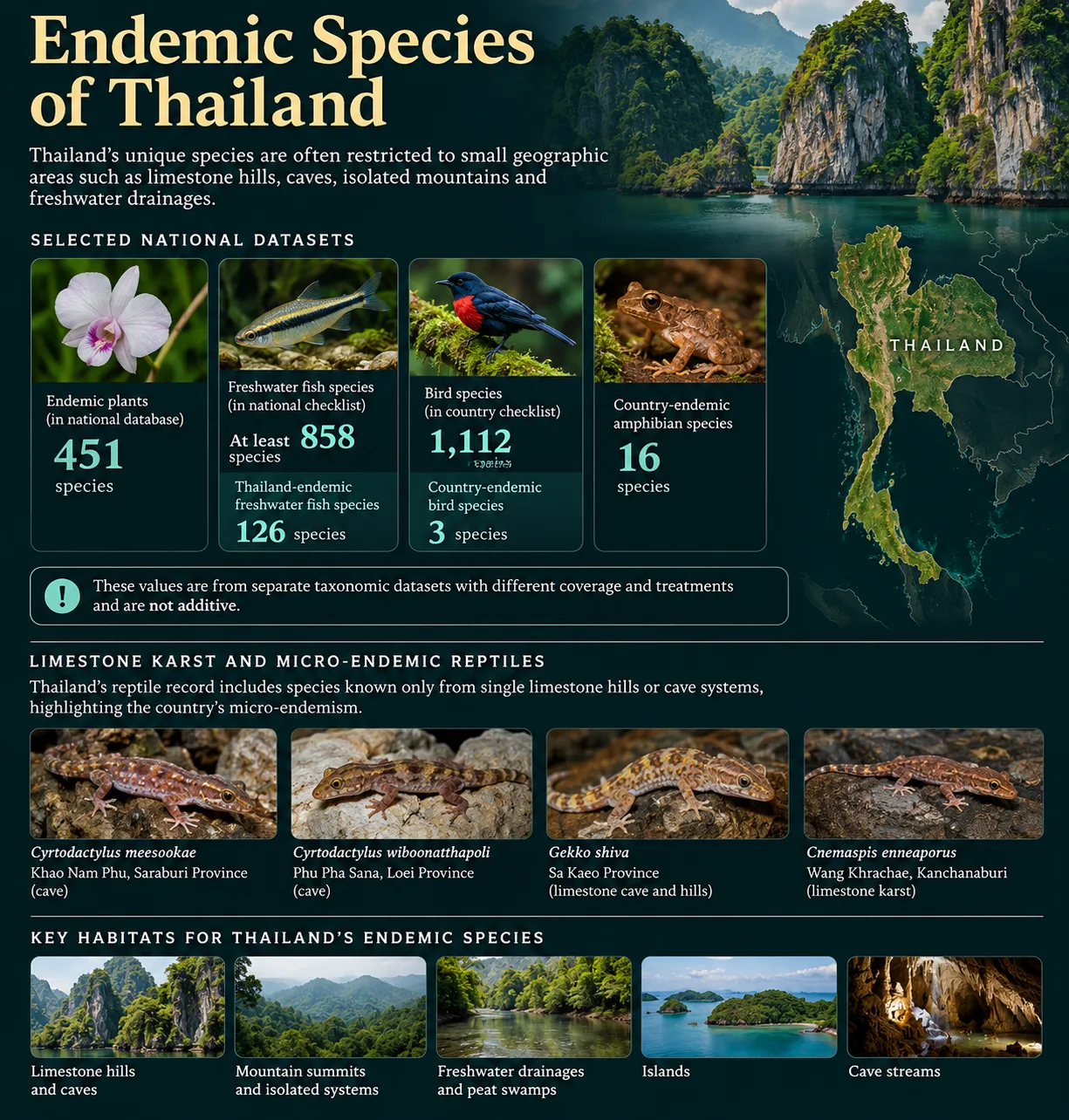
Thailand’s country-endemic biota is often concentrated in small geographic units: limestone hills, caves, isolated mountain systems and freshwater drainages. National datasets cover different taxonomic groups and definitions, so they are kept separate instead of being added into a synthetic all-taxa total.
| Measure | Value |
|---|---|
| Endemic plants in national database | 451 species [S1] |
| Freshwater fish species in published national checklist | At least 858 species [S2] |
| Thailand-endemic freshwater fish species | 126 species [S2] |
| Bird species in country checklist | 1,112 species [S3] |
| Country-endemic bird species | 3 species [S3] |
| Country-endemic amphibian species | 16 species [S4] |
Data boundary: these rows are not additive. The plant, freshwater-fish, bird and amphibian values come from separate taxonomic datasets with different coverage and treatments.
Geography of micro-endemism
Thailand’s endemic records repeatedly resolve to units much smaller than the country. The national plant database associates endemic plants with ecologically restricted settings such as islands, mountain summits, limestone cliffs and peat swamps. [S1] The national freshwater-fish checklist records species across headwaters, lowland streams, peat swamps, floodplains, estuaries and cave streams, with 10 freshwater fishes recorded from cave-stream habitat. [S2]
This produces a nested range pattern. A species can be endemic to Thailand at country scale while its documented native range is only one limestone hill, one cave system, one mountain block or a small drainage inside Thailand. The narrower supported unit is therefore more informative than the country name alone when a specialist source provides it.
Limestone karst and micro-endemic reptiles
Karst is one of the clearest recurring range structures in Thailand’s reptile record. In 2024, Cyrtodactylus meesookae was described from a cave on Khao Nam Phu, a limestone hill in Saraburi Province, and Cyrtodactylus wiboonatthapoli from a cave on Phu Pha Sana in Loei Province. The describing study explicitly treated both as micro-endemic trogloxene species; their type localities are about 300 km apart. [S5]
Gekko shiva, described in 2025, is currently recorded from eastern Thailand in Sa Kaeo Province, including limestone cave and hill localities in Khlong Hat District. [S6] Cnemaspis enneaporus, also described in 2025, is known only from its type locality in Wang Khrachae, Sai Yok District, Kanchanaburi, at a karst formation in the Tenasserim Mountain Range. [S7]
The same pattern occurs in western and peninsular Thailand. Dixonius chotjuckdikuli is recorded from Khao Ebid in Phetchaburi and was described as a micro-endemic limestone-dwelling gecko. [S8] Cyrtodactylus samroiyot is recorded from Sam Roi Yot District, Prachuap Khiri Khan Province, with its type locality at Ban Bang Pu. [S9] These records show why limestone hills should be treated as biological range units rather than merged into a broad “Thailand” distribution label.
Mountain and cave amphibians
IUCN-derived country data list 16 amphibian species endemic to Thailand for 2025. [S4] Several current species accounts show how narrow those ranges can be.
Limnonectes sirindhornae, described in 2025, is known only from its type locality in Sakon Nakhon Province within the Phu Phan Mountain Range. [S10] Leptobrachella korifi is known only from the region near the summit of Doi Inthanon in Chiang Mai Province, around 2,300 m at the type locality. [S11]
Tylototriton phukhaensis is known only from its type locality at a temporary swamp on Doi Dong Ya Wai Mountain in Doi Phu Kha National Park, Nan Province, at 1,795 m. [S12] At the cave end of the range spectrum, Siamophryne troglodytes is known only from a limestone-cave type locality in Sai Yok District, Kanchanaburi Province. [S13]
Freshwater endemism in isolated drainages and karst waters
ONEP’s published national checklist records 126 freshwater fish species endemic to Thailand. [S2] The list covers a much larger freshwater fauna, so the endemic count should be read within that fish-specific inventory rather than combined with plant, bird or amphibian totals.
The cave angel fish Cryptotora thamicola is an extreme range example. FishBase records it as endemic to Thailand and apparently restricted to two caves, Tham Susa and Tham Mae Lana in Mae Hong Son Province. [S14]
Betta simplex, the Krabi mouth-brooding betta, occurs in limestone-karst streams and pools in Krabi Province and is listed as Critically Endangered. Documented pressures include conversion of habitat to residential and agricultural land, pollution, tourism-related alteration and collection for trade. [S15] Devario maetaengensis provides a northern hillstream example: Thailand’s biodiversity database records it as endemic and distributed in northern Thailand. [S16]
Thailand’s three country-endemic birds
The Clements 2025 treatment used by the Thailand country checklist contains 1,112 bird species but only three marked as endemic: Psilopogon chersonesus (Turquoise-throated Barbet), Pseudochelidon sirintarae (White-eyed River Martin) and Gypsophila calcicola (Rufous Limestone Babbler). The same checklist marks the river martin as Critically Endangered and the limestone babbler as Vulnerable. [S3]
The Rufous Limestone Babbler also demonstrates how a country endemic can be tied to a narrow geological system. Its entire global range is associated with the Saraburi Group limestones shared among Saraburi, Lopburi and Nakhon Ratchasima. A published range assessment reported that about 10% of suitable habitat had been lost to quarrying by 2020 and that 2.66 km², or 1.4% of the species’ range, had formal national-park habitat protection. [S17]
Plant endemism across restricted habitats
The Department of National Parks, Wildlife and Plant Conservation database records 451 endemic plant species. Its endemic-plant description points to islands, mountain summits, limestone cliffs and peat swamps as recurring restricted environments. [S1]
Current Kew taxonomy provides species-level examples that can be checked against accepted names and native range. Brachylophon sirindhorniae, first published in 2025, is accepted by Plants of the World Online with a native range of Thailand. [S18] Zingiber citriodorum is also accepted and has Thailand as its native range. [S19]
Taxonomy and range boundaries can change endemic status
A Thai type locality does not establish Thailand-only endemism. Gekko dam, described in 2026 from type specimens collected on a limestone hill in Trang Province, is also recorded from Satun Province and Perlis in northwestern Peninsular Malaysia. It is therefore a Thai-Malay species, not a Thailand endemic. [S20]
Name changes can alter a checklist as well. Cyrtodactylus phuketensis, originally described from Phuket, is currently treated by The Reptile Database as a synonym of Cyrtodactylus macrotuberculatus. The accepted species occurs in western Malaysia, while the former phuketensis population is from Phuket. Counting the old name as a separate Thailand-endemic species would duplicate a taxon under the current treatment. [S21]
Endemic status follows natural native range under the accepted taxonomic treatment. A type locality, a country-specific common name or a concentration of records inside Thailand is not enough when native populations also occur beyond the border or when an older name has been synonymized.
Range-resolved endemic species checklist
| Scientific name | Group | Native endemic range |
|---|---|---|
| Psilopogon chersonesus | Bird | Thailand; country-endemic under Clements 2025 [S3] |
| Pseudochelidon sirintarae | Bird | Thailand; country-endemic under Clements 2025 [S3] |
| Gypsophila calcicola | Bird | Saraburi Group limestones in central Thailand [S17] |
| Cyrtodactylus meesookae | Reptile | Khao Nam Phu limestone cave, Saraburi Province [S5] |
| Cyrtodactylus wiboonatthapoli | Reptile | Phu Pha Sana limestone cave, Loei Province [S5] |
| Gekko shiva | Reptile | Sa Kaeo Province, eastern Thailand [S6] |
| Cnemaspis enneaporus | Reptile | Wang Khrachae, Sai Yok District, Kanchanaburi Province [S7] |
| Dixonius chotjuckdikuli | Reptile | Khao Ebid, Khao Yoi District, Phetchaburi Province [S8] |
| Cyrtodactylus samroiyot | Reptile | Sam Roi Yot District, Prachuap Khiri Khan Province [S9] |
| Limnonectes sirindhornae | Amphibian | Type-locality area in the Phu Phan Mountain Range, Sakon Nakhon Province [S10] |
| Leptobrachella korifi | Amphibian | Near the summit of Doi Inthanon, Chiang Mai Province [S11] |
| Tylototriton phukhaensis | Amphibian | Doi Dong Ya Wai Mountain, Doi Phu Kha National Park, Nan Province [S12] |
| Siamophryne troglodytes | Amphibian | Limestone-cave type locality in Sai Yok District, Kanchanaburi Province [S13] |
| Odorrana indeprensa | Amphibian | Khao Yai National Park and Sarika Waterfalls [S22] |
| Leptobrachella zhangyapingi | Amphibian | Phang Num Poo, Doi Saket, Chiang Mai Province [S23] |
| Tylototriton soimalai | Amphibian | Doi Soi Malai, Mae Tuen Wildlife Sanctuary, Tak Province [S24] |
| Ichthyophis youngorum | Amphibian | Doi Suthep and Doi Angkang in Chiang Mai Province, plus Kamphaeng Phet Province [S25] |
| Hoplobatrachus salween | Amphibian | Salawin National Park, Mae Sariang District, Mae Hong Son Province [S26] |
| Xenophrys takensis | Amphibian | Tak and Ratchaburi provinces [S27] |
| Micryletta dissimulans | Amphibian | Saba Yoi District, Songkhla Province [S28] |
| Leptobrachella sinorensis | Amphibian | Huay Sa Kud, Mae Hong Son Province [S29] |
| Leptobrachella murphyi | Amphibian | Doi Inthanon and Doi Chiang Dao, Chiang Mai Province [S30] |
| Cryptotora thamicola | Fish | Tham Susa and Tham Mae Lana caves, Mae Hong Son Province [S14] |
| Betta simplex | Fish | Limestone-karst streams and pools in Krabi Province [S15] |
| Devario maetaengensis | Fish | Northern Thailand hillstreams [S16] |
| Brachylophon sirindhorniae | Plant | Thailand [S18] |
| Zingiber citriodorum | Plant | Thailand [S19] |
Sources
[S1] ↩ Department of National Parks, Wildlife and Plant Conservation — Thai plant threatened. National endemic-plant database and habitat description.
[S2] ↩ ONEP — Biodiversity Series Vol. 24: Checklist of Freshwater Fishes in Thailand. National freshwater-fish inventory; first published in 2017, web record updated in 2024.
[S3] ↩ Avibase — Bird checklist: Thailand. Thailand checklist using Clements version 2025 and BirdLife threat categories.
[S4] ↩ Our World in Data — Endemic amphibian species, 2025. Country-endemic amphibian count derived from IUCN Red List summary statistics.
[S5] ↩ Zootaxa — Two new cave-dwelling species of Bent-toed Geckos from Saraburi and Loei provinces, Thailand. Original 2024 description of Cyrtodactylus meesookae and C. wiboonatthapoli.
[S6] ↩ The Reptile Database — Gekko shiva. Current accepted name and documented distribution in Sa Kaeo, Thailand.
[S7] ↩ ZooKeys — Another new karst-dwelling rock gecko in the Cnemaspis siamensis group from Kanchanaburi Province. Original description and known range of Cnemaspis enneaporus.
[S8] ↩ The Reptile Database — Dixonius chotjuckdikuli. Current accepted name and Phetchaburi distribution.
[S9] ↩ The Reptile Database — Cyrtodactylus samroiyot. Current accepted name and Prachuap Khiri Khan distribution.
[S10] ↩ Amphibian Species of the World — Limnonectes sirindhornae. Current taxonomic account and Thailand-only range.
[S11] ↩ Amphibian Species of the World — Leptobrachella korifi. Current taxonomic account and Doi Inthanon range.
[S12] ↩ Amphibian Species of the World — Tylototriton phukhaensis. Current taxonomic account and Doi Phu Kha range.
[S13] ↩ Amphibian Species of the World — Siamophryne troglodytes. Current taxonomic account and Sai Yok cave range.
[S14] ↩ FishBase — Cryptotora thamicola summary page. Thailand endemic record and two-cave range.
[S15] ↩ IUCN — The fight to save Krabi’s endemic Betta fish. Range, Red List category and documented pressures on Betta simplex.
[S16] ↩ Thailand Biodiversity Information Facility — Devario maetaengensis. Official species account with endemic status and northern Thailand distribution.
[S17] ↩ Mahidol University — The threatened Rufous Limestone Babbler Gypsophila calcicola. Range and limestone-quarrying assessment based on the Bird Conservation International study.
[S18] ↩ Plants of the World Online — Brachylophon sirindhorniae. Accepted name and native range in the 2026 Kew backbone.
[S19] ↩ Plants of the World Online — Zingiber citriodorum. Accepted name and Thailand native range in the 2026 Kew backbone.
[S20] ↩ Zootaxa — Gekko dam, a new dark-colored tokay gecko from the Thai-Malay border. 2026 description documenting native records in Thailand and Malaysia.
[S21] ↩ The Reptile Database — Cyrtodactylus macrotuberculatus. Current synonymy and Malaysia–Thailand distribution treatment.
[S22] ↩ Amphibian Species of the World — Odorrana indeprensa. Current taxonomic account and Thailand endemic range.
[S23] ↩ Amphibian Species of the World — Leptobrachella zhangyapingi. Current taxonomic account and type-locality range.
[S24] ↩ Amphibian Species of the World — Tylototriton soimalai. Current taxonomic account and Doi Soi Malai range.
[S25] ↩ Amphibian Species of the World — Ichthyophis youngorum. Current taxonomic account and northwestern Thailand range.
[S26] ↩ Amphibian Species of the World — Hoplobatrachus salween. Current taxonomic account and Mae Hong Son range.
[S27] ↩ Amphibian Species of the World — Xenophrys takensis. Current taxonomic account and Tak–Ratchaburi range.
[S28] ↩ Amphibian Species of the World — Micryletta dissimulans. Current taxonomic account and Songkhla type-locality range.
[S29] ↩ Amphibian Species of the World — Leptobrachella sinorensis. Current taxonomic account and Mae Hong Son type-locality range.
[S30] ↩ Amphibian Species of the World — Leptobrachella murphyi. Current taxonomic account and Chiang Mai montane range.