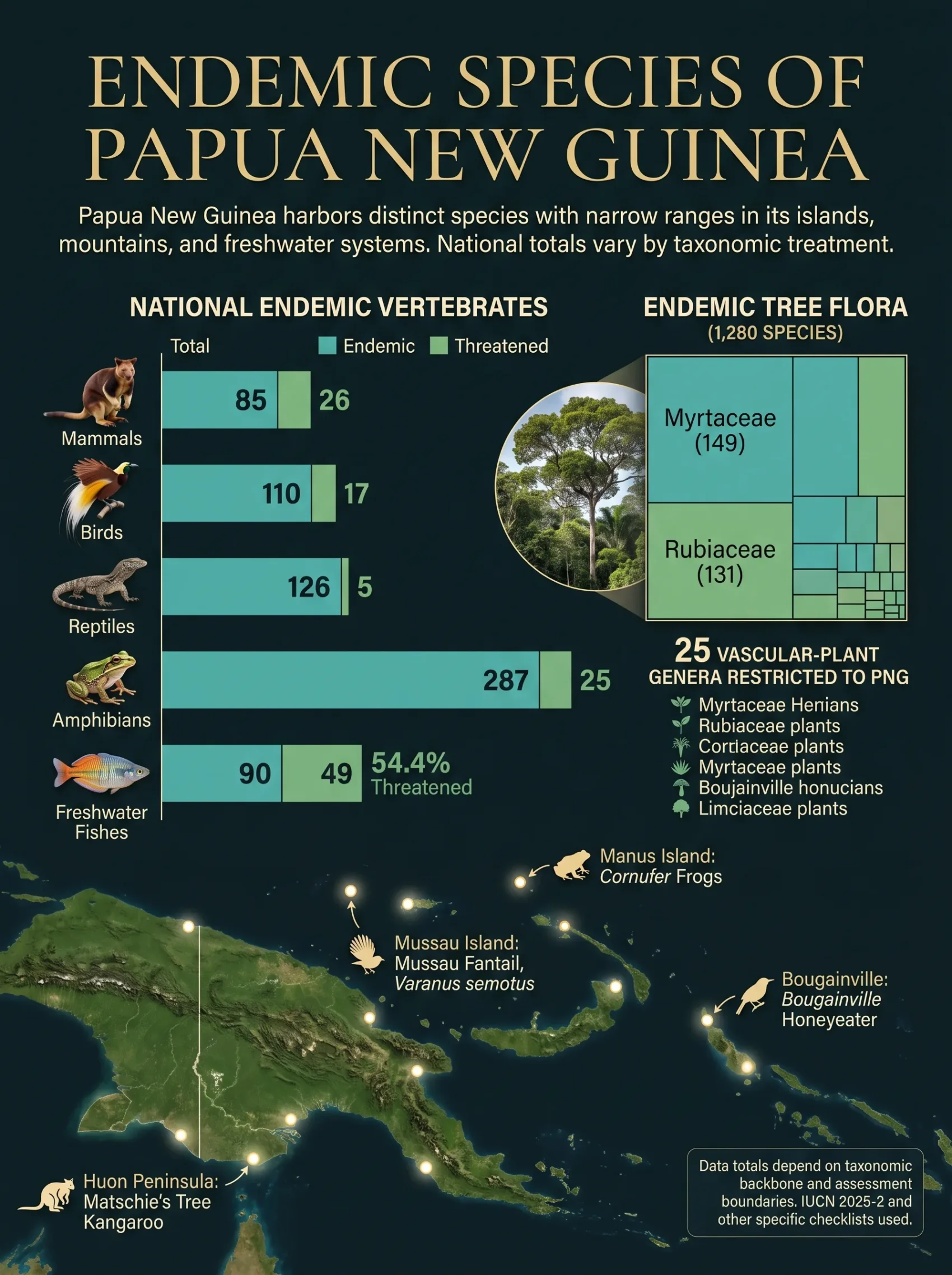
Papua New Guinea has no defensible single all-taxa endemic-species total. National counts differ by taxonomic group and data treatment, while island, mountain and freshwater systems contain many species with much narrower native ranges.
| Measure | Value |
|---|---|
| Endemic mammal species | 85 species [S1] |
| Threatened endemic mammal species | 26 species [S1] |
| EX/EW endemic mammal species | 0 species [S1] |
| Endemic bird species | 110 species [S1] |
| Threatened endemic bird species | 17 species [S1] |
| EX/EW endemic bird species | 0 species [S1] |
| Endemic reptile species | 126 species [S1] |
| Threatened endemic reptile species | 5 species [S1] |
| EX/EW endemic reptile species | 0 species [S1] |
| Endemic amphibian species | 287 species [S1] |
| Threatened endemic amphibian species | 25 species [S1] |
| EX/EW endemic amphibian species | 0 species [S1] |
| Endemic freshwater fish species | 90 species [S2] |
| Threatened endemic freshwater fish species | 49 species [S2] |
| EX/EW endemic freshwater fish species | 0 species [S2] |
| Endemic conifer species | 2 species [S3] |
| Threatened endemic conifer species | 0 species [S3] |
| Endemic cycad species | 2 species [S3] |
| Threatened endemic cycad species | 0 species [S3] |
| Endemic Proteaceae species | 18 species [S3] |
| Threatened endemic Proteaceae species | 13 species [S3] |
| Endemic tree species | 1,280 species [S3] |
| Threatened endemic tree species | 542 species [S3] |
| EX/EW endemic tree species | 0 species [S3] |
| Described plant species | 10,973 species [S4] |
| Native tree species | 2,854 species [S4] |
{
  "type": "bar",
  "title": "Country-endemic vertebrates in assessed groups",
  "description": "Species-level endemic and threatened-endemic counts from IUCN Red List 2025-2 country tables.",
  "unit": "species",
  "orientation": "horizontal",
  "categories": ["Mammals", "Birds", "Reptiles", "Amphibians", "Freshwater fishes"],
  "series": [
    {"name": "Endemic", "values": [85, 110, 126, 287, 90]},
    {"name": "Threatened endemic", "values": [26, 17, 5, 25, 49]}
  ],
  "source": "[S1][S2] IUCN Red List 2025-2 Tables 8a and 8b"
}
Standardized national endemism data
IUCN Table 8 treats an endemic as a species known to occur naturally within one country only, and it reports species rather than subspecies, varieties or isolated populations. The table is limited to groups for which more than 80% of species have been assessed. The IUCN summary-statistics portal is on Red List version 2026-1; the exact country values above come from the archived 2025-2 Table 8 files and are therefore retained as 2025-2 figures. [S5]
Within the same IUCN 2025-2 treatment, threatened endemics account for about 30.6% of endemic mammals, 15.5% of endemic birds, 4.0% of endemic reptiles, 8.7% of endemic amphibians and 54.4% of endemic freshwater fishes. These percentages use each group’s endemic count as the denominator.
| Group | Endemic species | Threatened endemic species | Threatened share |
|---|---|---|---|
| Mammals | 85 | 26 | 30.6% [S1] |
| Birds | 110 | 17 | 15.5% [S1] |
| Reptiles | 126 | 5 | 4.0% [S1] |
| Amphibians | 287 | 25 | 8.7% [S1] |
| Freshwater fishes | 90 | 49 | 54.4% [S2] |
{
  "type": "bar",
  "title": "Threatened share of country-endemic vertebrates",
  "description": "Threatened endemic species as a percentage of the endemic count in each IUCN 2025-2 assessed group.",
  "unit": "%",
  "orientation": "horizontal",
  "min": 0,
  "max": 100,
  "data": [
    {"label": "Freshwater fishes", "value": 54.4, "display": "54.4%"},
    {"label": "Mammals", "value": 30.6, "display": "30.6%"},
    {"label": "Birds", "value": 15.5, "display": "15.5%"},
    {"label": "Amphibians", "value": 8.7, "display": "8.7%"},
    {"label": "Reptiles", "value": 4.0, "display": "4.0%"}
  ],
  "source": "[S1][S2] IUCN Red List 2025-2 Tables 8a and 8b"
}
The IUCN groups above can be compared within the Table 8 system, but they do not form an all-taxa national total. Adding mammals, birds, reptiles, amphibians, freshwater fishes and plant subsets would omit many unassessed groups and would also mix overlapping plant categories.
Endemic tree flora
A country-level tree inventory published by Barstow, Jimbo and Davies identified 1,284 tree species endemic to Papua New Guinea, distributed among 65 families and 222 genera. Of those, 1,153 had Red List assessments in the study dataset. The study classified 460 species as threatened: 143 Critically Endangered, 217 Endangered and 100 Vulnerable. [S4]
The later IUCN 2025-2 country table records 1,280 endemic trees and 542 threatened endemic trees. [S3] The difference between the two snapshots cannot by itself be read as biological change: reassessment, added assessments and taxonomic revision can alter Red List summary counts between releases. [S5]
Status composition in the 1,284-species tree inventory
The assessment categories below sum to the 1,284 endemic tree species in the study inventory. [S4]
| Assessment category | Species |
|---|---|
| Critically Endangered | 143 |
| Endangered | 217 |
| Vulnerable | 100 |
| Data Deficient | 289 |
| Not Evaluated | 131 |
| Least Concern | 360 |
| Near Threatened | 44 |
{
  "type": "treemap",
  "title": "Assessment status of endemic trees in the 2023 inventory",
  "description": "The seven categories sum to the study inventory of 1,284 endemic tree species.",
  "unit": "species",
  "data": [
    {"name": "Critically Endangered", "value": 143},
    {"name": "Endangered", "value": 217},
    {"name": "Vulnerable", "value": 100},
    {"name": "Data Deficient", "value": 289},
    {"name": "Not Evaluated", "value": 131},
    {"name": "Least Concern", "value": 360},
    {"name": "Near Threatened", "value": 44}
  ],
  "source": "[S4] Barstow, Jimbo & Davies (2023)"
}
Largest endemic-tree families in the inventory
Five families each contained at least 80 endemic tree species in the 1,284-species inventory. The threatened percentage refers only to species assessed within each family. [S4]
| Family | Endemic tree species | Species assessed | Threatened among assessed |
|---|---|---|---|
| Myrtaceae | 149 | 65 | 12.3% |
| Rubiaceae | 131 | 131 | 42.0% |
| Lauraceae | 120 | 120 | 92.5% |
| Arecaceae | 89 | 71 | 31.0% |
| Euphorbiaceae | 81 | 81 | 34.6% |
{
  "type": "bar",
  "title": "Largest endemic-tree families in the 2023 inventory",
  "description": "Endemic tree species counts for the five largest families in the study dataset.",
  "unit": "species",
  "orientation": "horizontal",
  "data": [
    {"label": "Myrtaceae", "value": 149},
    {"label": "Rubiaceae", "value": 131},
    {"label": "Lauraceae", "value": 120},
    {"label": "Arecaceae", "value": 89},
    {"label": "Euphorbiaceae", "value": 81}
  ],
  "source": "[S4] Barstow, Jimbo & Davies (2023)"
}
Species-rich endemic-tree genera
The same inventory records the following five genera as the largest by endemic-tree species count. [S4]
| Genus | Endemic tree species | Species assessed | Threatened among assessed |
|---|---|---|---|
| Syzygium | 121 | 37 | 0% |
| Cryptocarya | 54 | 54 | 92.6% |
| Psychotria | 47 | 47 | 53.2% |
| Ficus | 46 | 46 | 23.9% |
| Elaeocarpus | 40 | 40 | 20.0% |
{
  "type": "bar",
  "title": "Largest endemic-tree genera in the 2023 inventory",
  "description": "Endemic tree species counts for the five largest genera in the study dataset.",
  "unit": "species",
  "orientation": "horizontal",
  "data": [
    {"label": "Syzygium", "value": 121},
    {"label": "Cryptocarya", "value": 54},
    {"label": "Psychotria", "value": 47},
    {"label": "Ficus", "value": 46},
    {"label": "Elaeocarpus", "value": 40}
  ],
  "source": "[S4] Barstow, Jimbo & Davies (2023)"
}
Plant endemism across country and island boundaries
New Guinea island and Papua New Guinea are different biological scopes. The expert-verified vascular-plant checklist for mainland New Guinea and surrounding islands contains 13,634 species, with 68% reported as endemic to that island-level study area. [S6] Those island-level endemics cannot be treated as Papua New Guinea country endemics because western New Guinea lies in Indonesia.
A POWO-based compilation identifies 25 vascular-plant genera restricted to Papua New Guinea. The same source notes 4,901 species endemic solely to the Papua New Guinea portion of the New Guinea flora dataset, but that figure excludes Bougainville Province and therefore is not a full-country vascular-plant endemic total. [S7]
Vascular-plant genera restricted to Papua New Guinea
| Genus | Family | Species in source treatment |
|---|---|---|
| Gymnophragma | Acanthaceae | 1 |
| Jadunia | Acanthaceae | 2 |
| Papuahoya | Apocynaceae | 3 |
| Brassiophoenix | Arecaceae | 2 |
| Piora | Asteraceae | 1 |
| Lamiodendron | Bignoniaceae | 1 |
| Crucicaryum | Boraginaceae | 1 |
| Rosselia | Burseraceae | 1 |
| Ruthiella | Campanulaceae | 4 |
| Decatoca | Ericaceae | 1 |
| Papuodendron | Malvaceae | 2 |
| Bamlera | Melastomataceae | 2 |
| Lauterbachia | Monimiaceae | 1 |
| Paramyristica | Myristicaceae | 1 |
| Basisperma | Myrtaceae | 1 |
| Ophioglossella | Orchidaceae | 1 |
| Kairothamnus | Picrodendraceae | 1 |
| Ruhooglandia | Poaceae | 1 |
| Rheopteris | Pteridaceae | 1 |
| Anthorrhiza | Rubiaceae | 9 |
| Dolianthus | Rubiaceae | 13 |
| Rhadinopus | Rubiaceae | 2 |
| Siphonandrium | Rubiaceae | 1 |
| Magodendron | Sapotaceae | 2 |
| Sahulia | Sapotaceae | 1 |
{
  "type": "bar",
  "title": "Species counts in Papua New Guinea-endemic vascular-plant genera",
  "description": "Counts reported for the 25 genera in the POWO 2024-based country compilation.",
  "unit": "species",
  "orientation": "horizontal",
  "height": 760,
  "data": [
    {"label": "Dolianthus", "value": 13},
    {"label": "Anthorrhiza", "value": 9},
    {"label": "Ruthiella", "value": 4},
    {"label": "Papuahoya", "value": 3},
    {"label": "Jadunia", "value": 2},
    {"label": "Brassiophoenix", "value": 2},
    {"label": "Papuodendron", "value": 2},
    {"label": "Bamlera", "value": 2},
    {"label": "Rhadinopus", "value": 2},
    {"label": "Magodendron", "value": 2},
    {"label": "Gymnophragma", "value": 1},
    {"label": "Piora", "value": 1},
    {"label": "Lamiodendron", "value": 1},
    {"label": "Crucicaryum", "value": 1},
    {"label": "Rosselia", "value": 1},
    {"label": "Decatoca", "value": 1},
    {"label": "Lauterbachia", "value": 1},
    {"label": "Paramyristica", "value": 1},
    {"label": "Basisperma", "value": 1},
    {"label": "Ophioglossella", "value": 1},
    {"label": "Kairothamnus", "value": 1},
    {"label": "Ruhooglandia", "value": 1},
    {"label": "Rheopteris", "value": 1},
    {"label": "Siphonandrium", "value": 1},
    {"label": "Sahulia", "value": 1}
  ],
  "source": "[S7] POWO 2024-based Papua New Guinea endemic vascular-plant genera checklist"
}
Bird totals depend on the taxonomic backbone
The Avibase Papua New Guinea checklist using IOC World Bird Names 15.2 contains 908 species, of which 106 are marked endemic; 44 are globally threatened and 5 are introduced. The checklist was last modified on 17 February 2026. [S8] Within that single IOC-based list, endemics make up about 11.7% of recorded species.
| IOC 15.2 checklist measure | Value |
|---|---|
| Recorded species | 908 |
| Endemic species | 106 |
| Globally threatened species | 44 |
| Introduced species | 5 |
| Endemic share of recorded species | 11.7% [S8] |
The IOC-based count of 106 endemics and the IUCN 2025-2 count of 110 are not interchangeable. They use different taxonomic and assessment systems, so the difference should remain visible rather than being averaged into a new number.
Freshwater fish checklist
An Eschmeyer’s Catalog of Fishes 2023-based compilation lists 104 freshwater fish species as endemic to Papua New Guinea and marks several species added to the Catalog after the February 2023 download. [S9] This is a source-specific checklist snapshot, not a replacement for the IUCN Table 8 freshwater-fish count of 90. The two values use different coverage, dates and taxonomic treatments.
| Scientific name | Order | Family | Common name |
|---|---|---|---|
| Craterocephalus kailolae | Atheriniformes | Atherinidae | Kailola’s Hardyhead |
| Craterocephalus lacustris | Atheriniformes | Atherinidae | Kutubu Hardyhead |
| Craterocephalus pimatuae | Atheriniformes | Atherinidae | Pima Hardyhead |
| Chilatherina axelrodi | Atheriniformes | Melanotaeniidae | Axelrod’s Rainbowfish |
| Chilatherina bulolo | Atheriniformes | Melanotaeniidae | Bulolo Rainbowfish |
| Chilatherina campsi | Atheriniformes | Melanotaeniidae | Highland Rainbowfish |
| Chilatherina pagwiensis | Atheriniformes | Melanotaeniidae | Pagwi Rainbowfish |
| Glossolepis kabia | Atheriniformes | Melanotaeniidae | Sepik Rainbowfish |
| Glossolepis maculosa | Atheriniformes | Melanotaeniidae | Spotted Rainbowfish |
| Glossolepis ramuensis | Atheriniformes | Melanotaeniidae | Ramu Rainbowfish |
| Glossolepis wanamensis | Atheriniformes | Melanotaeniidae | Lake Wanam Rainbowfish |
| Melanotaenia caerulea | Atheriniformes | Melanotaeniidae | Blue Rainbowfish |
| Melanotaenia herbertaxelrodi | Atheriniformes | Melanotaeniidae | Lake Tebera Rainbowfish |
| Melanotaenia iris | Atheriniformes | Melanotaeniidae | Strickland Rainbowfish |
| Melanotaenia lacustris | Atheriniformes | Melanotaeniidae | Lake Kutubu Rainbowfish |
| Melanotaenia monticola | Atheriniformes | Melanotaeniidae | Mountain Rainbowfish |
| Melanotaenia mubiensis | Atheriniformes | Melanotaeniidae | Mubi Rainbowfish |
| Melanotaenia oktediensis | Atheriniformes | Melanotaeniidae | Oktedi Rainbowfish |
| Melanotaenia papuae | Atheriniformes | Melanotaeniidae | Papuan Rainbowfish |
| Melanotaenia parkinsoni | Atheriniformes | Melanotaeniidae | Parkinson’s Rainbowfish |
| Melanotaenia pimaensis | Atheriniformes | Melanotaeniidae | Pima River Rainbowfish |
| Melanotaenia sexlineata | Atheriniformes | Melanotaeniidae | Fly River Rainbowfish |
| Melanotaenia sylvatica | Atheriniformes | Melanotaeniidae | Forest Rainbowfish |
| Kiunga auromarginata | Atheriniformes | Pseudomugilidae | Goldmargined Blue-eye |
| Kiunga ballochi | Atheriniformes | Pseudomugilidae | Glass Blue-eye |
| Kiunga bleheri | Atheriniformes | Pseudomugilidae | Bleher’s Blue-eye |
| Kiunga filamentosa | Atheriniformes | Pseudomugilidae | Filamentfinned Blue-eye |
| Kiunga leucozona | Atheriniformes | Pseudomugilidae | Whitebelt Blue-eye |
| Pseudomugil connieae | Atheriniformes | Pseudomugilidae | Popondetta Blue-eye |
| Pseudomugil furcatus | Atheriniformes | Pseudomugilidae | Forktail Blue-eye |
| Pseudomugil majusculus | Atheriniformes | Pseudomugilidae | Cape Blue-eye |
| Pseudomugil paskai | Atheriniformes | Pseudomugilidae | Paska’s Blue-eye |
| Zenarchopterus robertsi | Beloniformes | Zenarchopteridae | Robert’s River Garfish |
| Leptachirus bensbach | Carangiformes | Soleidae | Bensbach River Sole |
| Leptachirus kikori | Carangiformes | Soleidae | Kikori River Sole |
| Leptachirus robertsi | Carangiformes | Soleidae | Robert’s Sole |
| Amniataba affinis | Centrarchiformes | Terapontidae | Tiger Grunter |
| Hephaestus adamsoni | Centrarchiformes | Terapontidae | Adamson’s Grunter |
| Hephaestus komaensis | Centrarchiformes | Terapontidae | Koma Grunter |
| Hephaestus raymondi | Centrarchiformes | Terapontidae | Raymond’s Grunter |
| Hephaestus transmontanus | Centrarchiformes | Terapontidae | Sepik Grunter |
| Hephaestus trimaculatus | Centrarchiformes | Terapontidae | Threespot Grunter |
| Tetracentrum apogonoides | Cichliformes | Ambassidae | Four-spined Glass Perchlet |
| Tetracentrum caudovittatus | Cichliformes | Ambassidae | Kokoda Glass Perchlet |
| Tetracentrum honessi | Cichliformes | Ambassidae | Honess’ Glass Perchlet |
| Nematalosa papuensis | Clupeiformes | Dorosomatidae | Strickland River Gizzard Shad |
| Thryssa rastrosa | Clupeiformes | Engraulidae | Fly River Thryssa |
| Allomogurnda flavimarginata | Gobiiformes | Eleotridae | Yellowmargin Gudgeon |
| Allomogurnda hoesei | Gobiiformes | Eleotridae | Hoese’s Gudgeon |
| Allomogurnda insularis | Gobiiformes | Eleotridae | Island Gudgeon |
| Allomogurnda landfordorum | Gobiiformes | Eleotridae | Landford’s Gudgeon |
| Allomogurnda montana | Gobiiformes | Eleotridae | Mountain Gudgeon |
| Allomogurnda multicincta | Gobiiformes | Eleotridae | Malas Gudgeon |
| Allomogurnda papua | Gobiiformes | Eleotridae | Papuan Gudgeon |
| Eleotris aquadulcis | Gobiiformes | Eleotridae | Freshwater Gudgeon |
| Giuris caussei | Gobiiformes | Eleotridae | — |
| Hypseleotris ebneri | Gobiiformes | Eleotridae | — |
| Hypseleotris moncktoni | Gobiiformes | Eleotridae | — |
| Mogurnda furva | Gobiiformes | Eleotridae | Black Mogurnda |
| Mogurnda kutubuensis | Gobiiformes | Eleotridae | Lake Kutubu Mogurnda |
| Mogurnda lineata | Gobiiformes | Eleotridae | Kokoda Mogurnda |
| Mogurnda maccuneae | Gobiiformes | Eleotridae | — |
| Mogurnda malsmithi | Gobiiformes | Eleotridae | — |
| Mogurnda mosa | Gobiiformes | Eleotridae | Mosa Mogurnda |
| Mogurnda orientalis | Gobiiformes | Eleotridae | Eastern Mogurnda |
| Mogurnda pulchra | Gobiiformes | Eleotridae | Moresby Mogurnda |
| Mogurnda spilota | Gobiiformes | Eleotridae | Blotched Mogurnda |
| Mogurnda variegata | Gobiiformes | Eleotridae | Variegated Mogurnda |
| Mogurnda vitta | Gobiiformes | Eleotridae | Striped Mogurnda |
| Oxyeleotris caeca | Gobiiformes | Eleotridae | Kikori Blind Gudgeon |
| Tateurndina ocellicauda | Gobiiformes | Eleotridae | Peacock Gudgeon |
| Boleophthalmus poti | Gobiiformes | Gobiidae | — |
| Glossogobius asaro | Gobiiformes | Gobiidae | — |
| Glossogobius brunnoides | Gobiiformes | Gobiidae | Dusky Mountain Goby |
| Glossogobius coatesi | Gobiiformes | Gobiidae | Coates’ Goby |
| Glossogobius macrocephalus | Gobiiformes | Gobiidae | Bighead Goby |
| Glossogobius multipapillus | Gobiiformes | Gobiidae | Papillate Goby |
| Glossogobius muscorum | Gobiiformes | Gobiidae | Fly Goby |
| Glossogobius robertsi | Gobiiformes | Gobiidae | — |
| Glossogobius torrentis | Gobiiformes | Gobiidae | Whitewater Goby |
| Gymnoamblyopus novaeguineae | Gobiiformes | Gobiidae | — |
| Lentipes watsoni | Gobiiformes | Gobiidae | Watson’s Goby |
| Mugilogobius fusculus | Gobiiformes | Gobiidae | Obscure Mangrove Goby |
| Pseudogobiopsis rubrimaculosa | Gobiiformes | Gobiidae | — |
| Schismatogobius alleni | Gobiiformes | Gobiidae | — |
| Schismatogobius baitabag | Gobiiformes | Gobiidae | — |
| Sicyopterus elomionearum | Gobiiformes | Gobiidae | — |
| Sicyopus beremeensis | Gobiiformes | Gobiidae | — |
| Stenogobius alleni | Gobiiformes | Gobiidae | Allen’s Goby |
| Stenogobius watsoni | Gobiiformes | Gobiidae | Watson’s Goby |
| Stiphodon larson | Gobiiformes | Gobiidae | Larson’s Cling Goby |
| Rhyacichthys novaeguineae | Gobiiformes | Rhyacichthyidae | — |
| Glossamia abo | Kurtiformes | Apogonidae | — |
| Glossamia narindica | Kurtiformes | Apogonidae | Slender Mouth Almighty |
| Brustiarius nox | Siluriformes | Ariidae | Comb-gilled Catfish |
| Nemapteryx augusta | Siluriformes | Ariidae | Short-barbelled Catfish |
| Neoarius coatesi | Siluriformes | Ariidae | Coate’s Catfish |
| Neoarius taylori | Siluriformes | Ariidae | Taylor’s Catfish |
| Neosilurus coatesi | Siluriformes | Plotosidae | — |
| Neosilurus gjellerupi | Siluriformes | Plotosidae | Northern Tandan |
| Oloplotosus luteus | Siluriformes | Plotosidae | Pale Yellow Tandan |
| Oloplotosus torobo | Siluriformes | Plotosidae | Kutubu Tandan |
| Coelonotus kaipuae | Syngnathiformes | Syngnathidae | — |
| Microphis spinachioides | Syngnathiformes | Syngnathidae | Spinach Pipefish |
{
  "type": "treemap",
  "title": "Order composition of the 104-species freshwater checklist",
  "description": "Species counts by order in the Eschmeyer 2023-based Papua New Guinea endemic freshwater-fish checklist.",
  "unit": "species",
  "data": [
    {"name": "Gobiiformes", "value": 45},
    {"name": "Atheriniformes", "value": 32},
    {"name": "Siluriformes", "value": 8},
    {"name": "Centrarchiformes", "value": 6},
    {"name": "Carangiformes", "value": 3},
    {"name": "Cichliformes", "value": 3},
    {"name": "Clupeiformes", "value": 2},
    {"name": "Kurtiformes", "value": 2},
    {"name": "Syngnathiformes", "value": 2},
    {"name": "Beloniformes", "value": 1}
  ],
  "source": "[S9] Eschmeyer 2023-based Papua New Guinea endemic freshwater-fish checklist"
}
Island and mountain concentrations
Country endemism often resolves to much smaller native ranges. The records below use specialist taxonomic accounts that identify a Papua New Guinea-only country distribution or explicitly mark the species as endemic to Papua New Guinea. They are a range-resolved reference layer rather than a national all-species checklist.
| Scientific name | Group | Narrowest supported native range |
|---|---|---|
| Dendrolagus scottae | Mammal | Torricelli Mountains, Sandaun Province [S10] |
| Dendrolagus matschiei | Mammal | Huon Peninsula, Morobe Province; Umboi and West New Britain records are introduced [S11] |
| Rhipidura matthiae | Bird | Mussau Island, St Matthias group [S12] |
| Symposiachrus menckei | Bird | Mussau Island, St Matthias group [S13] |
| Stresemannia bougainvillei | Bird | Bougainville Island [S14] |
| Varanus semotus | Reptile | Mussau Island [S15] |
| Toxicocalamus goodenoughensis | Reptile | Known from Goodenough Island, Milne Bay Province [S16] |
| Nactus panaeati | Reptile | Panaeati Island, Milne Bay Province [S17] |
| Cornufer latro | Amphibian | Manus, Los Negros, Rambutyo and Pak islands, Admiralty Archipelago [S18] |
| Cornufer admiraltiensis | Amphibian | Manus and Los Negros islands, Admiralty Archipelago [S19] |
| Cornufer manus | Amphibian | Manus Island, Admiralty Archipelago [S20] |
| Lamiodendron magnificum | Plant | Milne Bay area of eastern Papua New Guinea [S21] |
Mussau supports narrowly distributed vertebrates from several lineages, including Rhipidura matthiae, Symposiachrus menckei and Varanus semotus. The Admiralty group contains several Papua New Guinea-endemic Cornufer species, while the Huon Peninsula and Torricelli Mountains hold tree-kangaroo endemics with mainland mountain distributions. Bougainville, Goodenough and Panaeati provide separate island-restricted or island-centred records.
Data boundaries that change the numbers
- Country endemism and New Guinea endemism are different. Species native to both Indonesian New Guinea and Papua New Guinea are New Guinea endemics but not Papua New Guinea country endemics.
- Taxonomic backbones change totals. IOC 15.2 reports 106 bird endemics, while IUCN 2025-2 Table 8a reports 110. Neither value should be converted into the other.
- Assessment tables are bounded datasets. IUCN Table 8 reports groups with more than 80% assessment coverage; it is not an inventory of every endemic lineage in the country.
- Plant categories overlap. Trees, conifers, cycads and Proteaceae are not additive units. A tree may also belong to one of the other plant groups.
- Native range controls endemicity. Introduced or translocated populations do not expand the natural endemic range. Dendrolagus matschiei illustrates this directly: its Huon Peninsula range is native, while the Mammal Diversity Database records Umboi Island and Mount Agulupella in West New Britain as introduced. [S11]
- Checklist dates matter. The 104-species freshwater list is tied to an Eschmeyer 2023-based treatment with later additions noted by the source; it should remain labelled as that snapshot rather than presented as an independently revalidated 2026 national total.
Sources
[S1] ↩ IUCN — Red List version 2025-2, Table 8a: endemic mammals, birds, reptiles and amphibians by country. Species-level totals, threatened endemics and EX/EW endemics for assessed groups.
[S2] ↩ IUCN — Red List version 2025-2, Table 8b: endemic fish species by country. Freshwater-fish endemic, threatened-endemic and EX/EW counts for Papua New Guinea.
[S3] ↩ IUCN — Red List version 2025-2, Table 8d: endemic plant species by country. Country counts for conifers, cycads, Proteaceae and trees.
[S4] ↩ Barstow, Jimbo & Davies — Extinction risk to the endemic trees of Papua New Guinea. Plants, People, Planet 5(4), 508–519; tree inventory, assessment categories, families, genera and national plant context.
[S5] ↩ IUCN — Red List Summary Statistics. Version 2026-1 summary portal and definitions for species rank, country endemics and Table 8 coverage.
[S6] ↩ Cámara-Leret et al. — New Guinea has the world’s richest island flora. Expert-verified vascular-plant checklist for New Guinea island and surrounding islands.
[S7] ↩ Living National Treasures — Papua New Guinea Endemic Vascular Plant Genera Checklist. POWO 2024-based compilation of 25 country-endemic vascular-plant genera and the stated Bougainville exclusion for the 4,901-species figure.
[S8] ↩ Avibase — Papua New Guinea bird checklist, IOC World Bird Names 15.2. National bird-list totals and endemic count; modified 17 February 2026.
[S9] ↩ Living National Treasures — Papua New Guinea Endemic Freshwater Fish Checklist. Eschmeyer 2023-based 104-species compilation with post-download additions marked by the source.
[S10] ↩ ASM Mammal Diversity Database — Dendrolagus scottae. Accepted species account, Papua New Guinea distribution and Torricelli Mountains type locality.
[S11] ↩ ASM Mammal Diversity Database — Dendrolagus matschiei. Native Huon Peninsula distribution and introduced island records.
[S12] ↩ Avibase — Rhipidura matthiae (Mussau Fantail). Accepted bird name and Mussau range.
[S13] ↩ Avibase — Symposiachrus menckei (Mussau Monarch). Accepted bird name and Mussau range treatment.
[S14] ↩ Avibase — Stresemannia bougainvillei (Bougainville Honeyeater). Accepted bird name and Bougainville Island range.
[S15] ↩ The Reptile Database — Varanus semotus. Accepted species account with distribution restricted to Mussau Island.
[S16] ↩ The Reptile Database — Toxicocalamus goodenoughensis. Papua New Guinea distribution with known specimens from Goodenough Island.
[S17] ↩ The Reptile Database — Nactus panaeati. Species distribution restricted to Panaeati Island, Milne Bay Province.
[S18] ↩ Amphibian Species of the World — Cornufer latro. Papua New Guinea-endemic species distributed on Manus, Los Negros, Rambutyo and Pak islands.
[S19] ↩ Amphibian Species of the World — Cornufer admiraltiensis. Papua New Guinea-endemic species on Manus and Los Negros islands.
[S20] ↩ Amphibian Species of the World — Cornufer manus. Papua New Guinea-endemic species restricted to Manus Island.
[S21] ↩ Royal Botanic Gardens, Kew — Plants of the World Online: Lamiodendron. Accepted monotypic genus account placing Lamiodendron magnificum in the Milne Bay area of eastern Papua New Guinea.