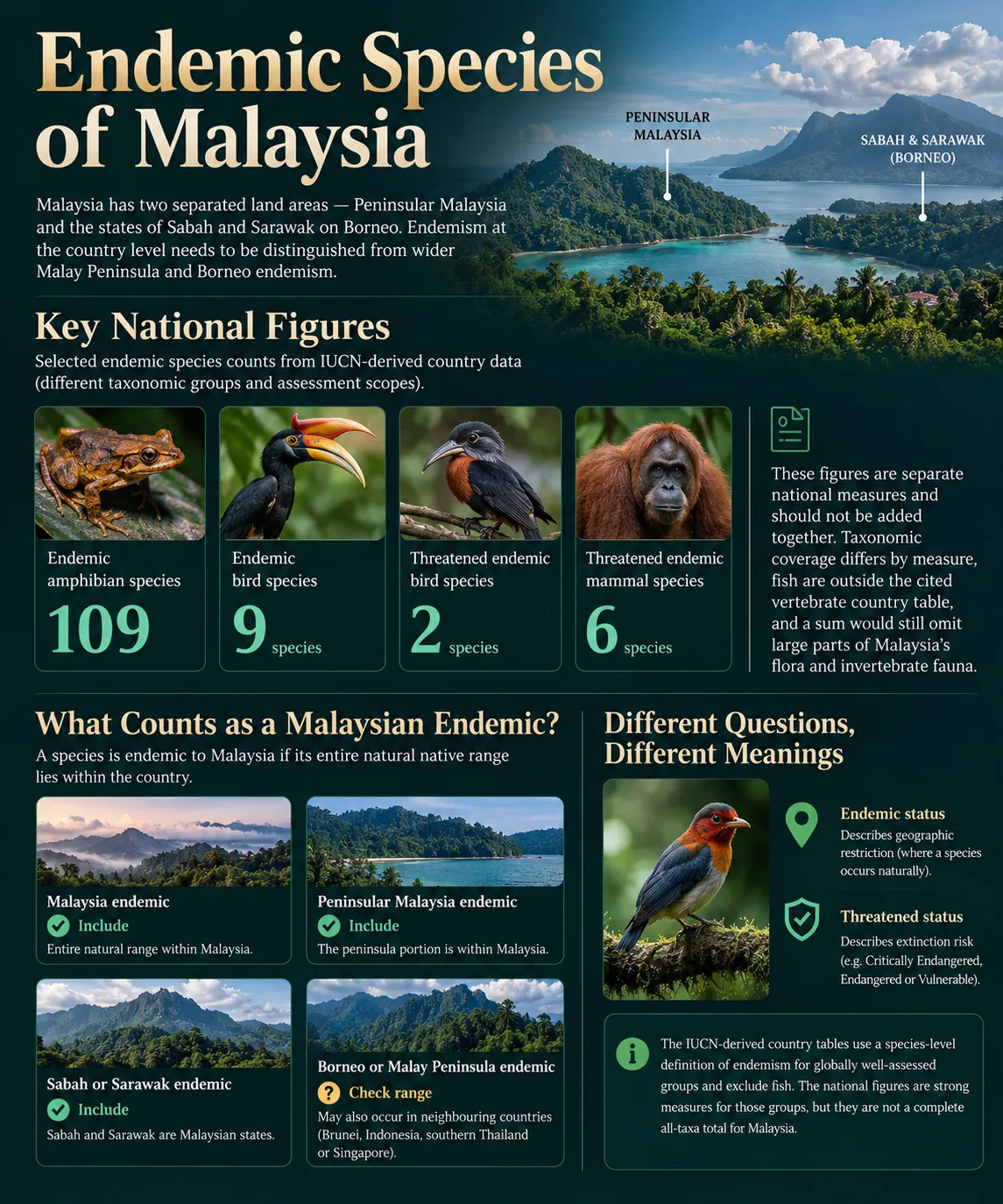
Malaysia combines two separated land areas—Peninsular Malaysia and the Malaysian states of Sabah and Sarawak on Borneo—so country endemism has to be distinguished from wider Malay Peninsula and Borneo endemism. A single synchronized all-taxa endemic-species total is not used here because the strongest national datasets cover different taxonomic groups and assessment universes.
| Measure | Value |
|---|---|
| Endemic amphibian species | 109 species [S1] |
| Endemic bird species | 9 species [S2] |
| Threatened endemic bird species | 2 species [S3] |
| Threatened endemic mammal species | 6 species [S4] |
The four rows above are separate national measures from IUCN-derived country data. They should not be added together: taxonomic coverage differs by measure, fish are outside the cited vertebrate country table, and a sum would still omit large parts of Malaysia’s flora and invertebrate fauna.
What counts as a Malaysian endemic?
Endemism is based on a species’ natural native distribution. A species confined naturally to Sabah, Sarawak, or Peninsular Malaysia is also endemic to Malaysia because that entire native range lies within the country. The reverse does not hold for broader regional labels. Borneo includes Malaysian territory, Brunei, and Indonesian Kalimantan; the Malay Peninsula extends north of Malaysia. A species described as “Borneo endemic” or “Malay Peninsula endemic” therefore needs a country-level range check before it can enter a Malaysia-only checklist.
| Range label | Country-endemic treatment | Reason |
|---|---|---|
| Malaysia endemic | Include | Entire natural native range lies within Malaysia. |
| Peninsular Malaysia endemic | Include | The peninsula portion named here is within Malaysia. |
| Sabah endemic | Include | Sabah is a Malaysian state. |
| Sarawak endemic | Include | Sarawak is a Malaysian state. |
| Borneo endemic | Check range | The species may also occur in Brunei or Kalimantan. |
| Malay Peninsula endemic | Check range | The native range may extend into southern Thailand or Singapore. |
| Potentially endemic | Keep provisional | No known outside record is weaker evidence than a settled country-range treatment. |
| Endemic subspecies or variety | Keep separate | Infraspecific taxa do not belong in a species-level endemic count. |
A Malaysian government biodiversity poster published in 2022 provides a finite set of 25 selected endemic-species records rather than a national total. [S5] Current range and taxonomy checks matter because several records in that set no longer pass a strict species-level Malaysia-only test.
National figures have different taxonomic boundaries
The 2025 IUCN-derived country tables define an endemic species as one known to occur naturally within one country. Their vertebrate statistics apply to globally well-assessed groups and exclude fish. [S1] The 109 amphibians and 9 birds are therefore strong national species-level measures, but they are not components of a complete Malaysian all-taxa total.
The threat rows answer a different question. Of the nine endemic bird species in the same IUCN-derived country data family, two are classified as Critically Endangered, Endangered, or Vulnerable. [S2] [S3] Endemic status describes geographic restriction; threatened status describes extinction risk. A Malaysia-only species can fall outside the threatened categories, and a threatened species can have a range extending far beyond Malaysia.
Peninsular Malaysia: karst, mountains and blackwater
Peninsular Malaysia contains several forms of narrow-range endemism that operate at different spatial scales. Limestone outcrops can isolate plants and land snails on individual hills; montane forest separates cool-adapted lineages from surrounding lowlands; acidic peat-swamp and blackwater systems isolate freshwater species by drainage and water chemistry.
Limestone hills can hold whole global ranges
FRIM’s 2026 photographic guide is a current reference for Peninsular Malaysian limestone plants. The MyBIS publication record links 107 species records to the guide; that database count is a curated publication set, not a total for all limestone flora. [S6]
A focused Gesneriaceae study shows the scale of range concentration. Peninsular Malaysia had 210 species in 25 genera in the study treatment; 42 grew on limestone hills, 28 of those limestone species were endemic, and 16 were restricted to a single hill or adjacent hills. The study considered 570 limestone outcrops. [S7]
| Gesneriaceae measure | Species |
|---|---|
| Peninsular Malaysia total in the study treatment | 210 |
| Species growing on limestone hills | 42 |
| Endemic species among the limestone group | 28 |
| Species restricted to one or adjacent limestone hills | 16 |
{
  "type": "bar",
  "title": "Range concentration in limestone Gesneriaceae",
  "description": "Nested species counts within the Peninsular Malaysia limestone-associated group; the endemic count includes the narrower single- or adjacent-hill subset.",
  "unit": "species",
  "orientation": "horizontal",
  "data": [
    {"label": "Limestone-associated", "value": 42},
    {"label": "Endemic", "value": 28},
    {"label": "One or adjacent hills", "value": 16}
  ],
  "source": "[S7] Sibbaldia 2018"
}
Plectostoma retrovertens makes the geographic meaning of micro-endemism unusually clear. The land snail is known from Bukit Chintamanis in Pahang, a single limestone hill; the taxonomic revision documenting it also described severe quarry-related habitat loss at the locality. [S8] Microchirita hairulii is another karst specialist, described from Perlis limestone and documented from five localities in its original species account. [S9]
Montane ranges isolate peninsula endemics
Peninsular mountain endemics are often distributed along only part of the central highlands rather than across Malaysia as a whole. The 2022 MyBIS set includes several Malaysian endemic records, while highland isolation provides a separate range boundary from the lowlands. [S5] Elevation and forest continuity can define the biologically relevant range more closely than the national boundary.
Blackwater endemism follows habitat and drainage boundaries
Betta livida is a Peninsular Malaysian freshwater endemic associated with peat-swamp and blackwater habitat in northern Selangor and southern Perak. [S10] For such fishes, two nearby water bodies are not biologically interchangeable. Drainage separation, peat conditions, acidity, forest cover, and hydrological disturbance can divide suitable habitat within the same state.
Sabah: narrow ranges from montane slopes to lowland forest
Sabah contains Malaysia-only species at several scales: Mount Kinabalu and nearby highlands, isolated ultramafic and montane habitats, lowland forest localities, and individual river or waterfall systems. A Sabah-only species is also Malaysia-endemic; a species distributed across Sabah and Indonesian Borneo is not.
Ardisia condensiflora shows how the inventory can grow
Ardisia condensiflora was described as a new species in 2026 from Tawau Hills Park. The taxonomic paper recognizes it from Sabah, while Universiti Malaysia Sabah reported that a 2014 herbarium specimen remained unidentified for years before the species was resolved. Only two collections were available to the describing authors, who made a preliminary Vulnerable D2 assessment; that preliminary assessment is not the same as a formal IUCN Red List listing. [S11]
This kind of addition does not mean a species appeared in 2026. It means the taxonomic boundary became clear enough for an existing biological population to receive a species name and a documented distribution.
Dung beetles expose uncertainty in insect endemism
A 2026 Sabah dung-beetle assessment evaluated 159 named species using 33,889 cleaned global occurrence records. Forty-nine species were treated as potentially endemic to Sabah because the study found no known records elsewhere. The authors kept that wording provisional. The study also held a separate dataset of 83 morphospecies from Sabah, which should not be mixed into a species-level endemic count. [S12]
| Sabah dung-beetle dataset measure | Value |
|---|---|
| Named species assessed | 159 species |
| Cleaned global occurrence records | 33,889 records |
| Potentially Sabah-endemic named species | 49 species |
| Separate Sabah morphospecies dataset | 83 morphospecies |
Other well-defined Sabah records illustrate different range scales. Kew treats Paphiopedilum rothschildianum as native to Borneo (Sabah). [S13] Kew gives the same Sabah-only native range for Rafflesia keithii. [S14] BirdLife treats Erythropitta ussheri as a Malaysian endemic centered in Sabah. [S15] The Reptile Database lists Garthius chaseni from Sabah. [S16] At a still narrower scale, Grouvellinus leonardodicaprioi was described from Giluk Falls in the Maliau Basin and was known only from that type locality in the describing study. [S17]
Sarawak endemics need a Borneo-wide range check
Sarawak records are especially vulnerable to a scope error: “endemic to Borneo” can include Kalimantan or Brunei, while “endemic to Sarawak” remains wholly inside Malaysia. Forest Department Sarawak identifies Rafflesia tuan-mudae as endemic to Sarawak and records it from localities including Gunung Gading National Park, Lanjak-Entimau, Padawan, and the Kelabit Highlands. [S18]
Dipterocarpus glabrigemmatus shows why old locality records need re-evaluation. Its IUCN assessment treats the tree as endemic to Sarawak and excludes an old Kalimantan record as invalid. The assessment gives an extent of occurrence of 6,327 km², an area of occupancy of 52 km², and five locations, and lists the species as Endangered. [S19] Removing one unsupported outside record changes the country-endemism interpretation without any biological population moving.
Verified species-level reference checklist
The checklist below is a source-bounded reference set, not a claim to list every endemic species in Malaysia. It retains 21 species-level records from the finite 25-record MyBIS 2022 set after excluding four records that fail or remain unresolved under a current strict country-range test, then adds ten species with current specialist, government, or peer-reviewed range accounts. [S5]
Current specialist backbones and range accounts also support Malaysia-only treatment for Rhinolophus luctoides, [S20] Thismia kinabaluensis, [S21] Barringtonia latiffiana, [S22] Nepenthes latiffiana, [S23] Zoothera everetti, [S24] Helosis ruficeps, [S25] and Rhinolophus chiewkweeae. [S26]
| Scientific name | Group | Supported native endemic range | Evidence |
|---|---|---|---|
| Acrogomphus malayanus | Insect | Malaysia | [S5] |
| Arborophila campbelli | Bird | Malaysia | [S5] |
| Ardisia condensiflora | Plant | Tawau Hills Park, Sabah | [S11] |
| Barringtonia latiffiana | Plant | Pulau Langkawi, Peninsular Malaysia | [S22] |
| Begonia abdullahpieei | Plant | Malaysia | [S5] |
| Begonia foxworthyi | Plant | Malaysia | [S5] |
| Betta livida | Fish | Northern Selangor and southern Perak | [S10] |
| Buxus rupicola | Plant | Malaysia | [S5] |
| Codonoboea leiophylla | Plant | Malaysia | [S5] |
| Cycas cantafolia | Cycad | Malaysia | [S5] |
| Dipterocarpus glabrigemmatus | Plant | Sarawak | [S19] |
| Erythropitta ussheri | Bird | Sabah | [S15] |
| Garthius chaseni | Reptile | Sabah | [S16] |
| Grouvellinus leonardodicaprioi | Insect | Giluk Falls, Maliau Basin, Sabah | [S17] |
| Helosis ruficeps | Plant | Peninsular Malaysia | [S25] |
| Johannesteijsmannia lanceolata | Plant | Malaysia | [S5] |
| Meghimatium uniforme | Mollusk | Malaysia | [S5] |
| Microchirita hairulii | Plant | Perlis limestone, Peninsular Malaysia | [S9] |
| Myophonus robinsoni | Bird | Malaysia | [S5] |
| Nepenthes latiffiana | Plant | Terengganu, Peninsular Malaysia | [S23] |
| Paphiopedilum rothschildianum | Plant | Sabah | [S13] |
| Plectostoma retrovertens | Mollusk | Bukit Chintamanis, Pahang | [S8] |
| Rafflesia keithii | Plant | Sabah | [S14] |
| Rafflesia tuan-mudae | Plant | Sarawak | [S18] |
| Rhinolophus chiewkweeae | Mammal | Peninsular Malaysia | [S26] |
| Rhinolophus luctoides | Mammal | Peninsular Malaysia | [S20] |
| Saurauia malayana | Plant | Malaysia | [S5] |
| Thismia kinabaluensis | Plant | Sabah | [S21] |
| Thismia latiffiana | Plant | Malaysia | [S5] |
| Vatica flavida | Plant | Malaysia | [S5] |
| Zoothera everetti | Bird | Sabah and Sarawak | [S24] |
This reference set is intentionally evidence-bounded. It is broader than a short example list, but it does not substitute for a synchronized national flora-and-fauna inventory across all taxonomic groups.
Records that fail a strict species-level country test
Four records from the 25-record MyBIS 2022 set require different treatment under current range evidence. They are excluded from the 31-row checklist above.
| Taxon | Current issue | Treatment |
|---|---|---|
| Arielulus cuprosus | The Mammal Diversity Database lists Malaysia and “Indonesia?” in country distribution. [S27] | Do not treat as a settled Malaysia-only species while the outside-country record remains unresolved. |
| Epithema membranaceum | Kew gives a native range from southern Thailand to northeastern Sumatra. [S28] | Exclude from Malaysia-endemic species. |
| Panthera tigris | The tiger species is native across multiple Asian countries, including Malaysia. [S29] | Exclude at species rank. “Malayan Tiger” is an infraspecific or regional treatment, not evidence that P. tigris is Malaysia-endemic. |
| Trimeresurus nebularis | The Reptile Database lists West Malaysia and Thailand. [S30] | Exclude from Malaysia-endemic species. |
Endemic does not mean threatened
Endemic status and extinction-risk category measure different properties. The IUCN-derived 2025 country data record nine endemic bird species for Malaysia and two threatened endemic bird species. [S2] [S3] Within that data family, seven of the nine country-endemic birds are outside the three threatened categories used by the indicator. That does not make them secure; it only means their current Red List category is not CR, EN, or VU in that dataset.
The opposite distinction matters as well. A species can be highly threatened in Malaysia yet fail the country-endemic test because its native range crosses a border. The tiger is an obvious example: severe conservation concern does not turn a multi-country species into a Malaysian endemic. [S29]
Why Malaysia’s endemic inventory can change
| Mechanism | Malaysia example | Effect on endemic treatment |
|---|---|---|
| New species description | Ardisia condensiflora was formally described from Sabah in 2026. [S11] | Adds a newly recognized species-level record when the range supports country endemism. |
| Outside-country record rejected | The old Kalimantan record of Dipterocarpus glabrigemmatus is not accepted in its IUCN range treatment. [S19] | A previously wider-looking range becomes Sarawak-only under the revised evidence. |
| Outside-country record confirmed | Trimeresurus nebularis is listed from Thailand as well as West Malaysia. [S30] | Removes the species from a strict Malaysia-only list. |
| Taxonomic rank clarified | Panthera tigris is a multi-country species even when a Malaysian population carries a regional or subspecific label. [S29] | Prevents an endemic subspecies or population label from inflating a species-level total. |
| Survey coverage expands | Forty-nine Sabah dung-beetle species were classed as potentially endemic because no records elsewhere were known in the study dataset. [S12] | A future record outside Sabah could change the regional endemic interpretation. |
Malaysia’s endemism is therefore best recorded as nested, source-defined ranges: country, peninsula, state, mountain system, drainage, limestone complex, and sometimes a single hill or locality. Keeping those ranges explicit preserves the difference between a species that is Malaysia-wide, one confined to Sabah or Sarawak, and a micro-endemic whose entire known native distribution occupies one small site.
Sources
[S1] ↩ Our World in Data / IUCN — Endemic amphibian species. 2025 country data derived from IUCN Red List country summary statistics.
[S2] ↩ Our World in Data / IUCN — Endemic bird species. 2025 country data derived from IUCN Red List country summary statistics.
[S3] ↩ Our World in Data / IUCN — Threatened endemic bird species. 2025 country data; threatened means CR, EN, or VU.
[S4] ↩ Our World in Data / IUCN — Number of threatened endemic mammal species. 2025 country data derived from IUCN Red List country summary statistics.
[S5] ↩ Malaysia Biodiversity Information System — Some Endemic Species in Malaysia (2022). Government/FRIM poster with 25 selected records.
[S6] ↩ Forest Research Institute Malaysia / MyBIS — Limestone Flora of Peninsular Malaysia: A Photographic Guide to Selected Species from Limestone Hills. 2026 publication record and linked species set.
[S7] ↩ Sibbaldia — Strategy to Conserve Maximum Biodiversity of Limestone Flora in Peninsular Malaysia. Gesneriaceae and limestone-outcrop range-concentration data.
[S8] ↩ ZooKeys — A cybertaxonomic revision of the micro-landsnail genus Plectostoma Adam (Mollusca, Caenogastropoda, Diplommatinidae), from Peninsular Malaysia, Sumatra and Indochina. Distribution and locality treatment for Plectostoma retrovertens.
[S9] ↩ PhytoKeys — Microchirita hairulii (Gesneriaceae), a new species from Perlis, Peninsular Malaysia. Species description, limestone habitat, and locality data.
[S10] ↩ Malaysia Biodiversity Information System — Betta livida. Native-range and habitat account.
[S11] ↩ Phytotaxa — Ardisia condensiflora, a new species of Primulaceae (Myrsinoideae) from Sabah, Borneo. 2026 species description from Tawau Hills Park.
[S12] ↩ Insect Conservation and Diversity — Towards red listing understudied tropical insects: A case study of the dung beetles of Sabah, Malaysian Borneo. 2026 species, occurrence, and potential-endemism dataset.
[S13] ↩ Plants of the World Online — Paphiopedilum rothschildianum. Accepted name and Sabah native range.
[S14] ↩ Plants of the World Online — Rafflesia keithii. Accepted name and Sabah native range.
[S15] ↩ BirdLife DataZone — Black-crowned Pitta Erythropitta ussheri species factsheet. Country-range treatment.
[S16] ↩ The Reptile Database — Garthius chaseni. Current species and Sabah distribution treatment.
[S17] ↩ ZooKeys — Three new species of Grouvellinus Champion, 1923 from Maliau Basin, Sabah, Borneo, discovered by citizen scientists during the first Taxon Expedition (Insecta, Coleoptera, Elmidae). Species description and type-locality range evidence.
[S18] ↩ Forest Department Sarawak — Rafflesiaceae_Bunga Pakma. Sarawak endemic treatment and localities for Rafflesia tuan-mudae.
[S19] ↩ IUCN Red List — Dipterocarpus glabrigemmatus. Sarawak range, invalidated Kalimantan record, range metrics, and Endangered assessment.
[S20] ↩ Mammal Diversity Database — Rhinolophus luctoides • Selangor Woolly Horseshoe Bat. Accepted living species with Malaysian distribution.
[S21] ↩ Plants of the World Online — Thismia kinabaluensis. Accepted name and Sabah native range.
[S22] ↩ Plants of the World Online — Barringtonia latiffiana. Accepted name and Pulau Langkawi native range.
[S23] ↩ Plants of the World Online — Nepenthes latiffiana. Accepted name and Terengganu native range.
[S24] ↩ BirdLife DataZone — Everett’s Thrush Zoothera everetti species factsheet. Sabah and Sarawak native range; no Kalimantan record in the current account.
[S25] ↩ Plants of the World Online — Helosis ruficeps. Accepted name and Peninsular Malaysia native range.
[S26] ↩ Mammal Diversity Database — Rhinolophus chiewkweeae • Chiew Kwee’s Horseshoe Bat. Accepted living species with Malaysia-only country distribution.
[S27] ↩ Mammal Diversity Database — Arielulus cuprosus • Southern Coppery Sprite. Current country distribution lists Malaysia and a questioned Indonesia record.
[S28] ↩ Plants of the World Online — Epithema membranaceum. Accepted name; native range extends from southern Thailand to northeastern Sumatra.
[S29] ↩ IUCN Red List — Panthera tigris (Tiger). Global species assessment showing a multi-country native range.
[S30] ↩ The Reptile Database — Trimeresurus nebularis. Current distribution lists West Malaysia and Thailand.