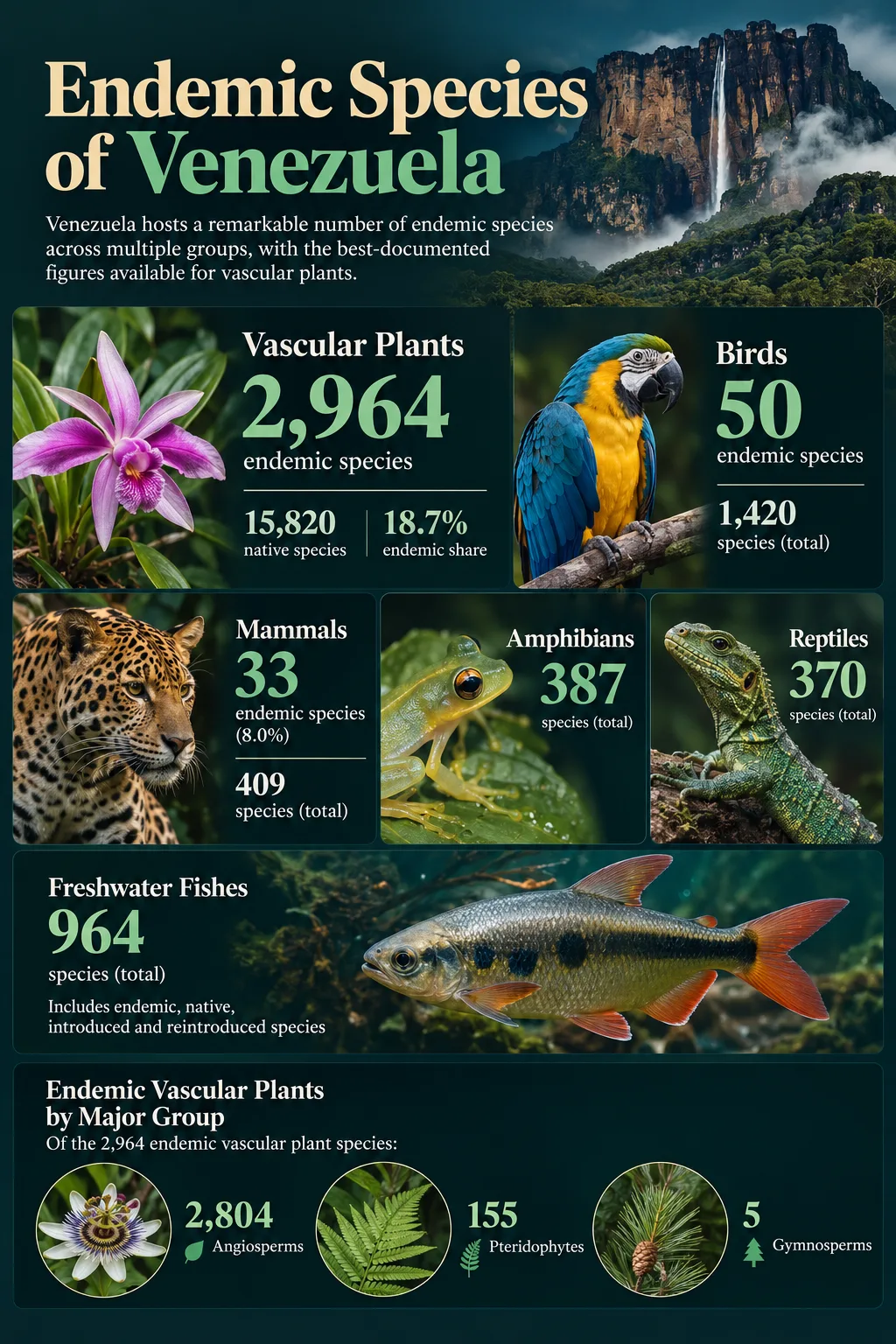
Venezuela’s endemism is split among several biological inventories and several isolation systems. The strongest national datasets do not use one synchronized taxonomic treatment, so vascular plants, birds, mammals, amphibians, reptiles, and freshwater fishes are kept as separate measures rather than added into a synthetic all-taxa total.
| Measure | Value |
|---|---|
| Native vascular plant species in the 2009 floristic treatment | 15,820 species [S1] |
| Endemic vascular plant species in that treatment | 2,964 species [S1] |
| Endemic share of vascular plants in that treatment | 18.7% [S1] |
| Bird species with verified evidence in the June 2024 national list | 1,420 species [S2] |
| Venezuela-endemic bird species in that list | 50 species [S2] |
| Mammal species in the 2023 national list | 409 species [S3] |
| Endemic mammals in the 2023 national treatment | 33 species (8.0%) [S3] |
| Living mammal species in the current MDD country account | 416 species [S4] |
| Amphibian species in the 2019 national catalogue | 387 species [S5] |
| Reptile species in the 2012 national checklist | 370 species [S6] |
| Freshwater fishes currently present in the FishBase country checklist | 964 species [S7] |
Data boundary. These rows are not components of one total. The vascular-plant figures use a 2009 floristic treatment; the 2023 mammal list and the current Mammal Diversity Database use different taxonomic treatments; the reptile checklist includes four exotic species; and the FishBase “currently present” figure includes endemic, native, introduced, and reintroduced records. The amphibian, reptile, and freshwater rows are richness baselines, not national endemic-species totals. [S3] [S4] [S6] [S7]
Vascular plants form the largest quantified national endemic dataset
The national floristic treatment recorded 2,964 endemic vascular plant species, equal to 18.7% of its 15,820 native species. It placed the highest vascular-plant richness in the Guayana region, followed by the Andes and the Coastal Cordillera, while the Llanos had the fewest endemic taxa. [S1]
A national biodiversity report based on the same flora catalogue separates those 2,964 endemic species into 2,804 angiosperms, 155 pteridophytes, and five gymnosperms. It also reports 100 endemic subspecies and 1,181 endemic varieties. Those infraspecific categories are separate taxonomic ranks and are not added to the species total. [S8]
| Plant group | Endemic species | Share of the 2,964 endemic species |
|---|---|---|
| Angiosperms | 2,804 | 94.60% |
| Pteridophytes | 155 | 5.23% |
| Gymnosperms | 5 | 0.17% |
| Total | 2,964 | 100% |
{
  "type": "bar",
  "title": "Endemic vascular plant species by major group",
  "description": "Species-level composition of the 2,964 endemic vascular plants in the national flora baseline.",
  "unit": "species",
  "orientation": "horizontal",
  "data": [
    {"label": "Angiosperms", "value": 2804},
    {"label": "Pteridophytes", "value": 155},
    {"label": "Gymnosperms", "value": 5}
  ],
  "source": "Venezuela Fourth National Report to the Convention on Biological Diversity"
}
Endemism is concentrated in different mountain systems
Venezuela does not have a single geographic mechanism behind its endemic biota. Guayana and its tepuis, the Mérida Andes, and the northern Coastal Cordillera produce different patterns of range restriction. The 2009 flora treatment ranks Guayana first for vascular-plant richness, followed by the Andes and Coastal Cordillera. [S1]
Pantepui endemism is not automatically Venezuela endemism
Pantepui extends across southern Venezuela, northern Brazil, and western Guyana. Its sandstone table mountains rise to nearly 3,000 m and can be bounded by cliffs approaching 1,000 m. Literature summarized in a 2012 genetic study reported endemism as high as 25% for vascular plants and 68.5% for amphibians and reptiles on individual tepuis. The same study found evidence of recent faunal interchange among separated summits, so the tepuis should not be treated as perfectly sealed biological islands. [S9]
| Range label | What the label means | Country-page treatment |
|---|---|---|
| Venezuela endemic | Natural global range is confined to Venezuela | Included as a country endemic at species rank |
| Pantepui endemic | Natural range is confined to the Pantepui biogeographic region | Included only if the entire natural range also lies inside Venezuela |
| Single-tepui endemic | Known natural range is confined to one tepui or one summit system | Also Venezuela-endemic when that complete native range lies within Venezuela |
New frog descriptions show how small a Venezuelan endemic range can be
A 2024 taxonomic revision split cryptic populations formerly associated with Stefania satelles. It described Stefania imawari from Angasima-tepui and Stefania upuigmae from Upuigma-tepui, both in Bolívar. Each is known from a summit smaller than 3 km². The same revision restricts S. satelles to Aprada-tepui. [S10]
| Scientific name | Restricted range in the revision | Range scale |
|---|---|---|
| Stefania imawari | Angasima-tepui summit, Bolívar | Less than 3 km² |
| Stefania upuigmae | Upuigma-tepui summit, Bolívar | Less than 3 km² |
| Stefania satelles | Aprada-tepui | Single type-locality tepui after revision |
Canaima National Park contains major Venezuelan tepui landscapes. A 2026 UNESCO World Heritage Committee decision recorded recurring fires within the property and again requested clarification on impact assessment for planned and existing mining operations near the property in the Orinoco Mining Arc. This is a landscape-level pressure statement, not a threat category assigned to every tepui endemic. [S11]
The Central Coastal Range and Paria contain separate restricted-range sets
A biogeographic study of amphibians and reptiles in the northern coastal mountain complex found 47 species restricted to its Central Coastal Range unit and 17 restricted to its Paria Region unit. The study describes the Unare Depression as a roughly 90 km separation between the eastern and Central Coastal ranges. These are study-defined regional exclusives; they should not be converted directly into national endemic totals. [S12]
| Study region | Exclusive amphibians | Exclusive reptiles | Exclusive total | Reported share |
|---|---|---|---|---|
| Central Coastal Range | 31 | 16 | 47 | 32% |
| Paria Region | 12 | 5 | 17 | 23% |
The national endemic-bird list contains 50 species
The Unión Venezolana de Ornitólogos and its records committee list 50 Venezuela-endemic bird species in the June 2024 national treatment. The published endemic list uses Clements et al. 2023 taxonomy; the accompanying UVO update states that Synallaxis beverlyae was removed from the endemic set in this version. [S13] [S2]
| English name | Scientific name |
|---|---|
| Tepui Tinamou | Crypturellus ptaritepui |
| Venezuelan Wood-Quail | Odontophorus columbianus |
| Ashy-tailed Swift | Chaetura andrei |
| Tepui Goldenthroat | Polytmus milleri |
| Merida Sunangel | Heliangelus spencei |
| Venezuelan Sylph | Aglaiocercus berlepschi |
| White-bearded Helmetcrest | Oxypogon lindenii |
| Green Inca | Coeligena conradii |
| Merida Starfrontlet | Coeligena eos |
| Scissor-tailed Hummingbird | Hylonympha macrocerca |
| Green-tailed Emerald | Chlorostilbon alice |
| Plain-flanked Rail | Rallus wetmorei |
| Rusty-flanked Crake | Laterallus levraudi |
| Red-eared Parakeet | Pyrrhura hoematotis |
| Rose-headed Parakeet | Pyrrhura rhodocephala |
| Great Antpitta | Grallaria excelsa |
| Tachira Antpitta | Grallaria chthonia |
| Gray-naped Antpitta | Grallaria griseonucha |
| Scallop-breasted Antpitta | Grallaricula loricata |
| Sucre Antpitta | Grallaricula cumanensis |
| Caracas Tapaculo | Scytalopus caracae |
| Merida Tapaculo | Scytalopus meridanus |
| Guttulate Foliage-gleaner | Syndactyla guttulata |
| White-throated Barbtail | Premnoplex tatei |
| Ochre-browed Thistletail | Asthenes coryi |
| Delta Amacuro Softtail | Thripophaga amacurensis |
| Black-throated Spinetail | Synallaxis castanea |
| Handsome Fruiteater | Pipreola formosa |
| Venezuelan Bristle-Tyrant | Pogonotriccus venezuelanus |
| Rufous-lored Tyrannulet | Phylloscartes flaviventris |
| Maracaibo Tody-Flycatcher | Todirostrum viridanum |
| Urich’s Tyrannulet | Phyllomyias urichi |
| Venezuelan Tyrannulet | Zimmerius petersi |
| Blackish Chat-Tyrant | Ochthoeca nigrita |
| Rufous-browed Chat-Tyrant | Ochthoeca superciliosa |
| Merida Wren | Cistothorus meridae |
| Caracas Brushfinch | Arremon phaeopleurus |
| Paria Brushfinch | Arremon phygas |
| Gray-headed Warbler | Myiothlypis griseiceps |
| Paria Redstart | Myioborus pariae |
| Saffron-breasted Redstart | Myioborus cardonai |
| White-faced Redstart | Myioborus albifacies |
| White-fronted Redstart | Myioborus albifrons |
| Carrizal Seedeater | Amaurospiza carrizalensis |
| Gray-capped Hemispingus | Kleinothraupis reyi |
| Rufous-cheeked Tanager | Tangara rufigenis |
| Merida Flowerpiercer | Diglossa gloriosa |
| Venezuelan Flowerpiercer | Diglossa venezuelensis |
| Slaty-backed Hemispingus | Poospiza goeringi |
| Duida Grass-Finch | Emberizoides duidae |
Mammal endemism changes when species limits change
The 2023 national mammal list recognized 409 species and classified 33, or 8.0%, as endemic to Venezuela. That update itself recorded 16 newly described species, 36 accepted taxonomic changes, seven new geographic records, and 40 exclusions relative to the preceding national compilation. [S3]
The current Mammal Diversity Database country account lists 416 living species in 13 orders, 48 families, and 192 genera. That current country richness figure cannot be paired mechanically with the 33 endemic species from the 2023 national treatment because the underlying taxonomy is no longer identical. [S4]
Three current mammal treatments show why the old endemic count cannot simply be carried forward
| Taxon involved | Current specialist treatment | Effect on endemic interpretation |
|---|---|---|
| Nasuella meridensis | Treated as a synonym within Nasua olivacea [S14] | Nasua olivacea has a native range extending beyond Venezuela, so the former name is not a current Venezuela-endemic species in this treatment. |
| Odocoileus lasiotis and O. margaritae | Both appear as synonyms under Odocoileus virginianus [S15] | The accepted species has a broad American native range and is not Venezuela-endemic at species rank. |
| Bisbalus citus | Accepted as a living species with country distribution restricted to Venezuela; split from Passalites nemorivagus and placed in the genus Bisbalus [S16] | A newer species treatment can add a Venezuela-only species even while other older endemic names are synonymized. |
A current Venezuela-endemic mammal total therefore requires a single current taxonomic treatment to be rerun against species-level native ranges. Subtracting old synonyms and adding selected new splits to the 2023 figure would create a partial, unvalidated total.
Amphibian and reptile baselines use different publication dates
The amphibian catalogue documents strong taxonomic turnover
The 2019 catalogue, current through December 2018, recognized 387 amphibian species: 370 anurans, 10 caecilians, and seven salamanders. It included 28 forms that had not yet been formally described or properly identified. Relative to the preceding list, the catalogue added 50 species and four genera, removed 25 species, and incorporated 47 nomenclatural changes. [S5]
Those changes are one reason an older endemic-amphibian numerator should not be divided by the 387-species catalogue total unless both values come from the same taxonomic treatment. The 2024 Stefania revision provides a later example: one previously broad name was narrowed and two microendemic summit species were described separately. [S10]
The 2012 reptile checklist is a dated national richness baseline
The national reptile checklist published in 2012 reported 370 species in 122 genera, 30 families, and three orders; four of the 370 species were exotic. The authors estimated that Venezuela could exceed 400 reptile species after probable border records and undescribed taxa were resolved. This source is useful as a documented national baseline, but its 370-species figure is not a current endemic-reptile count. [S6]
The checklist also treated Pantepui as a distinct Venezuelan bioregion above 1,500 m, alongside units such as the Cordillera de Mérida, Sierra de Perijá, Central Coastal Range, Eastern Coastal Range, Guayana, and Amazonia. That geographic partition helps explain why national reptile richness cannot be reduced to one uniform endemism pattern. [S6]
Freshwater occurrence and freshwater endemism are different datasets
FishBase currently lists 964 freshwater fish species as present in Venezuela, but its presence table explicitly combines endemic, native, introduced, and reintroduced records. The same country page reports 995 freshwater species altogether when possible and absent records are included. Neither number is a country-endemic fish total. [S7]
For freshwater fishes, a country-endemic classification requires the full natural range of each species. A species confined to an Orinoco, Casiquiare, Amazonian, or other drainage can remain a drainage endemic while crossing an international boundary. Country occurrence alone cannot establish Venezuela endemism.
Sources
[S1] ↩ Duno de Stefano et al. — Assessment of vascular plant diversity and endemism in Venezuela. Candollea 64(2), 2009; national vascular-plant richness, endemism, and regional patterns.
[S2] ↩ Unión Venezolana de Ornitólogos — Aves de Venezuela. June 2024 national bird totals and endemic-bird update.
[S3] ↩ Boher Bentti, Salazar Candelle & Ferreira Marques — Mamíferos de Venezuela: lista actualizada 2023 y comentarios taxonómicos. National mammal checklist and endemic count.
[S4] ↩ Mammal Diversity Database — Venezuela Mammal Diversity Statistics. Current country-level mammal richness and taxonomic structure.
[S5] ↩ Barrio-Amorós, Rojas-Runjaic & Señaris — Catalogue of the amphibians of Venezuela. Amphibian & Reptile Conservation 13(1), 2019.
[S6] ↩ Rivas et al. — Reptiles of Venezuela: an updated and commented checklist. Zootaxa 3211, 2012.
[S7] ↩ FishBase — List of Freshwater Fishes reported from Venezuela. Country occurrence checklist and presence categories.
[S8] ↩ Convention on Biological Diversity — Venezuela Fourth National Report. Source-defined endemic vascular-plant composition and infraspecific counts based on the national flora catalogue.
[S9] ↩ Kok et al. — Low genetic diversity in tepui summit vertebrates. Current Biology 22(15), 2012; Pantepui geography, reported single-tepui endemism, and evidence of faunal interchange.
[S10] ↩ Kok — Head in the clouds: two new microendemic tepui-summit species of Stefania. Zoological Letters 10:14, 2024.
[S11] ↩ UNESCO World Heritage Committee — Decision 48 COM 7B.87, Canaima National Park. 2026 decision on fires, management, and mining-impact assessment near the property.
[S12] ↩ Rojas-Runjaic et al. — Biogeographical patterns of amphibians and reptiles in the northernmost coastal montane complex of South America. PLOS ONE, 2021.
[S13] ↩ Unión Venezolana de Ornitólogos / CRAV — Lista oficial de las aves endémicas de Venezuela. June 2024 species-level endemic list.
[S14] ↩ Mammal Diversity Database — Nasua olivacea. Current synonymy and country distribution relevant to Nasuella meridensis.
[S15] ↩ Mammal Diversity Database — Odocoileus virginianus. Current synonymy and broad native distribution relevant to O. lasiotis and O. margaritae.
[S16] ↩ Mammal Diversity Database — Bisbalus citus. Current accepted treatment and Venezuela-only country distribution.