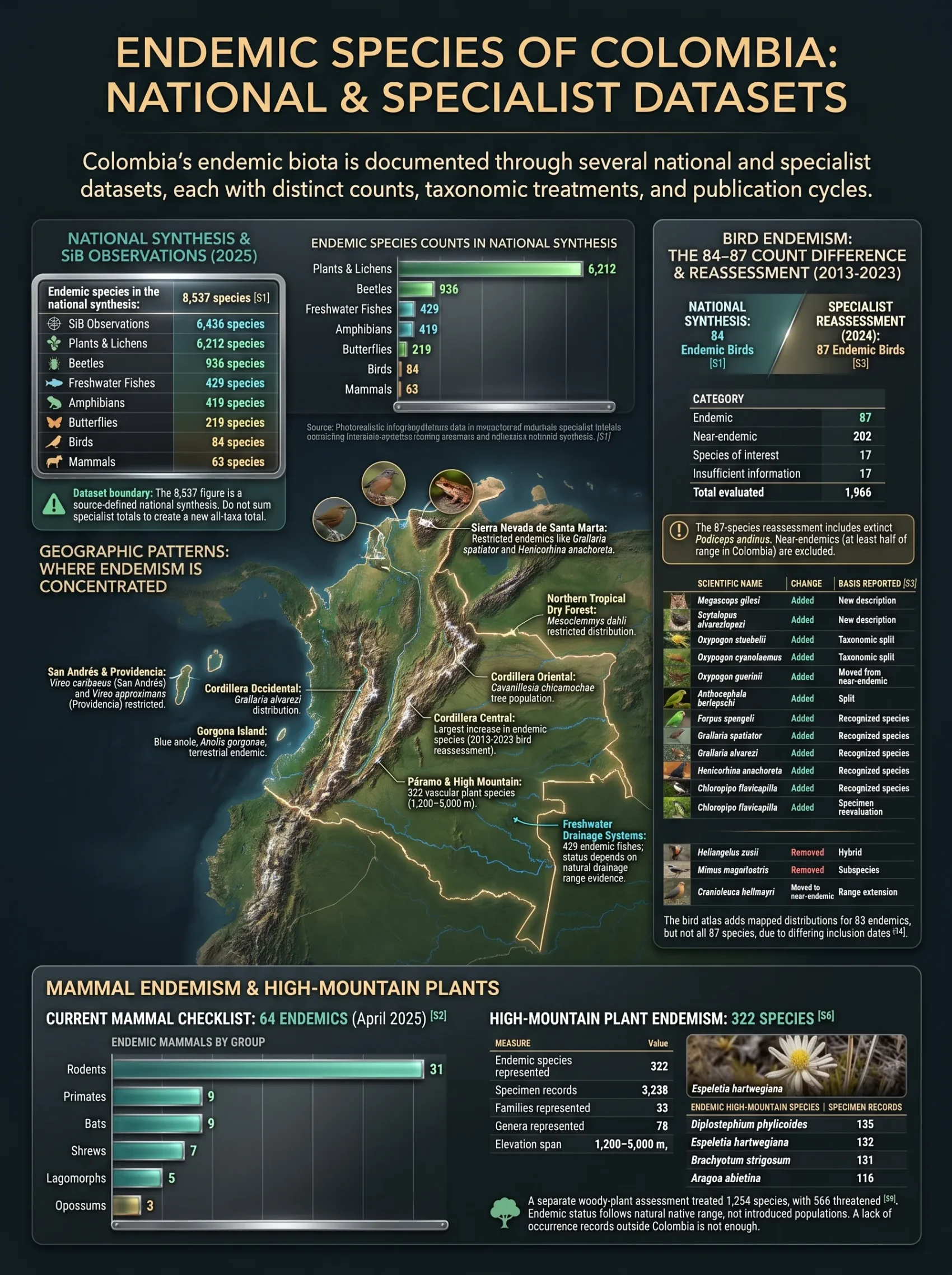
Colombia’s endemic biota is documented through several national and specialist datasets rather than one permanently fixed checklist. A 2025 SiB Colombia synthesis reported 8,537 endemic species, while newer or differently scoped taxonomic lists already produce different counts for birds and mammals. Those figures are kept in their original dataset contexts below.
| Measure | Value |
|---|---|
| Endemic species in the national synthesis | 8,537 species [S1] |
| Endemic species represented by SiB observations | 6,436 species [S1] |
| Endemic plants and lichens | 6,212 species [S1] |
| Endemic beetles | 936 species [S1] |
| Endemic freshwater fishes | 429 species [S1] |
| Endemic amphibians | 419 species [S1] |
| Endemic butterflies | 219 species [S1] |
| Endemic birds in the national synthesis | 84 species [S1] |
| Endemic mammals in the national synthesis | 63 species [S1] |
| Mammal species in the specialist checklist | 553 species [S2] |
| Endemic mammals in the specialist checklist | 64 species [S2] |
| Endemic birds in the 2013–2023 reassessment | 87 species [S3] |
Dataset boundary: the 8,537 figure is a source-defined national synthesis. Its 84-bird and 63-mammal values should not be silently replaced with the 87-bird specialist reassessment or the later 64-mammal checklist to create a new all-taxa total. The underlying taxonomic treatments and publication cycles are different.
{
  "type": "bar",
  "title": "Endemic species counts reported in the national synthesis",
  "description": "Source-defined counts for seven named groups reported together by SiB Colombia. The groups do not exhaust the 8,537-species total.",
  "unit": "species",
  "orientation": "horizontal",
  "data": [
    {"label": "Plants and lichens", "value": 6212},
    {"label": "Beetles", "value": 936},
    {"label": "Freshwater fishes", "value": 429},
    {"label": "Amphibians", "value": 419},
    {"label": "Butterflies", "value": 219},
    {"label": "Birds", "value": 84},
    {"label": "Mammals", "value": 63}
  ],
  "source": "[S1] SiB Colombia biodiversity figures 2025",
  "ariaDescription": "Horizontal bar chart comparing source-defined Colombian endemic species counts for plants and lichens, beetles, freshwater fishes, amphibians, butterflies, birds, and mammals."
}
Where Colombian endemism is concentrated
Colombia’s national borders cut across several very different biological systems. Endemic ranges cluster in isolated mountains, high-elevation habitat islands, offshore islands, dry-forest remnants and freshwater networks. The Andes are especially fragmented within Colombia because the cordillera divides into western, central and eastern ranges separated by major valleys. That topography repeatedly limits contact among upland populations.
| Geographic setting | Endemism signal |
|---|---|
| Sierra Nevada de Santa Marta | The bird reassessment recognizes restricted endemics including Grallaria spatiator and Henicorhina anachoreta; the endemic-bird atlas also contains multiple Santa Marta taxa. [S3] [S4] |
| Cordillera Occidental | Grallaria alvarezi was added as a Colombian endemic with distribution in the Western Cordillera. [S3] |
| Cordillera Central | The 2013–2023 bird reassessment recorded its largest increase in endemic species in the Central Cordillera. [S3] |
| San Andrés and Providencia | Vireo caribaeus is restricted to San Andrés and Vireo approximans to Providencia in Humboldt’s SeaFlower bird dataset. [S5] |
| Páramo and high mountain | A specialist dataset contains 3,238 specimen records representing 322 vascular plant species considered endemic to Colombian páramos and high mountains, collected from 1,200 to 5,000 m. [S6] |
| Gorgona Island | The blue anole, Anolis gorgonae, is identified by Colombia’s national parks authority as a terrestrial endemic species of Gorgona. [S7] |
| Northern tropical dry forest | Mesoclemmys dahli is restricted to northern Colombia, with documented native distribution in Córdoba, Sucre, Atlántico, Bolívar, Magdalena and Cesar. [S8] |
| Freshwater drainage systems | The national synthesis reports 429 endemic freshwater fish species. Endemic status for fishes must follow natural drainage-range evidence; occurrence in a Colombian portion of a transboundary basin does not by itself make a species Colombian-endemic. [S1] |
The mountain pattern is visible within the bird reassessment itself. At high elevations, the authors recorded additions in the Western, Central and Eastern cordilleras, while medium-elevation endemic and near-endemic changes were also concentrated along particular Andean slopes. The regional figures in that study overlap because one bird can occupy more than one elevation band or region, so they cannot be summed into a new national total. [S3]
Bird endemism and the 84–87 count difference
Two source-defined bird counts are useful for Colombia, but they answer slightly different dataset questions. The 2025 SiB national synthesis reports 84 endemic birds. A specialist reassessment published in 2024, using SACC 2023 taxonomy and evaluating 1,966 Colombian bird species, recognized 87 endemic species, 202 near-endemics, 17 species of interest and 17 species with insufficient information. [S1] [S3]
| Category in the 2013–2023 reassessment | Species |
|---|---|
| Endemic | 87 |
| Near-endemic | 202 |
| Species of interest | 17 |
| Insufficient information | 17 |
| Bird species evaluated | 1,966 |
The 87-species reassessment is not an extant-only count: it explicitly retains the extinct Colombian Grebe, Podiceps andinus. The authors also define a near-endemic as a species with at least half of its known geographic distribution in Colombia, with a separate island-related criterion. Near-endemics should therefore remain outside a Colombia-endemic species total. [S3]
The 11 additions and three removals behind the bird revision
The specialist reassessment did not change the endemic total through one mechanism. New species descriptions, taxonomic splits, revised specimen identifications and cross-border range evidence all altered the list. The complete set of endemic-category additions and removals reported against the 2013 list is shown here. [S3]
| Scientific name | Change | Basis reported in the reassessment |
|---|---|---|
| Megascops gilesi | Added as endemic | Species description published after the earlier national list. |
| Scytalopus alvarezlopezi | Added as endemic | Species description published after the earlier national list. |
| Oxypogon stuebelii | Added as endemic | Taxonomic reorganization of the Oxypogon complex produced a species with a Colombian-restricted distribution. |
| Oxypogon cyanolaemus | Added as endemic | Taxonomic reorganization of the Oxypogon complex produced a species with a Colombian-restricted distribution. |
| Oxypogon guerinii | Added as endemic | Recognized within the revised Oxypogon complex and moved from near-endemic to endemic. |
| Anthocephala berlepschi | Added as endemic | Recognized as a species following separation within the Anthocephala complex. |
| Forpus spengeli | Added as endemic | Recognized as a species in the Forpus passerinus complex; distribution reported in Colombia’s Caribbean region. |
| Grallaria spatiator | Added as endemic | Species recognized from the Grallaria rufula complex; restricted to the Sierra Nevada de Santa Marta. |
| Grallaria alvarezi | Added as endemic | Species recognized from the Grallaria rufula complex; distributed in the Cordillera Occidental. |
| Henicorhina anachoreta | Added as endemic | Recognized within the Henicorhina leucophrys complex; restricted to the Sierra Nevada de Santa Marta. |
| Chloropipo flavicapilla | Added as endemic | Three specimens attributed to Ecuador were reevaluated as another species, removing the evidence for a native range outside Colombia. |
| Heliangelus zusii | Removed from endemic list | Not treated as a valid species entity; the published reassessment identifies it as a hybrid. |
| Mimus magnirostris | Removed from endemic list | Treated as a subspecies of Mimus gilvus, so it no longer qualifies as a species-rank endemic. |
| Cranioleuca hellmayri | Moved to near-endemic | Records in Venezuela extend its native distribution outside Colombia. |
The last three rows show why a national endemic list can shrink without a population disappearing. One former “species” became a hybrid taxon, another was treated at subspecies rank, and a third gained verified range evidence in a neighboring country. Conversely, several additions arose from splits or newly described species rather than newly discovered national borders.
What the endemic-bird atlas adds
The Humboldt endemic-bird atlas provides a different layer: mapped distributions. Its dataset describes maps for 83 Colombian-endemic bird species, including the historical distribution of extinct Podiceps andinus. Expert-reviewed potential distributions were modeled for 79 species. The atlas explicitly says that Grallaria alvarezi, Grallaria spatiator and Chloropipo flavicapilla were not included in that edition because they entered the endemic treatment too late for the modeling workflow; Chlorostilbon olivaresi was also not modeled because available information was too sparse. [S4]
This makes the atlas useful for spatial patterns without making its 79 modeled species a replacement for the 87-species specialist classification. A mapped dataset and a taxonomic-status list can legitimately contain different numbers when their inclusion dates and purposes differ.
The current mammal checklist: 64 endemics
The April 2025 national mammal checklist recognizes 553 species in 13 orders, 50 families and 220 genera. Of those, 64 are endemic. The same dataset breaks the endemic set into six order-level groups, allowing a direct composition comparison. It also excludes four still-undescribed mammal entities from the species count until they are formally described. [S2]
| Mammal group | Endemic species |
|---|---|
| Rodents | 31 |
| Primates | 9 |
| Bats | 9 |
| Shrews | 7 |
| Lagomorphs | 5 |
| Opossums | 3 |
{
  "type": "bar",
  "title": "Endemic mammals by group",
  "description": "Composition of the 64 endemic mammal species in the April 2025 Colombian mammal checklist.",
  "unit": "species",
  "orientation": "horizontal",
  "data": [
    {"label": "Rodents", "value": 31},
    {"label": "Primates", "value": 9},
    {"label": "Bats", "value": 9},
    {"label": "Shrews", "value": 7},
    {"label": "Lagomorphs", "value": 5},
    {"label": "Opossums", "value": 3}
  ],
  "source": "[S2] Sociedad Colombiana de Mastozoología / SiB Colombia",
  "ariaDescription": "Horizontal bar chart showing 31 endemic rodents, 9 primates, 9 bats, 7 shrews, 5 lagomorphs and 3 opossums in the 2025 Colombian mammal checklist."
}
The 64-species value is one higher than the 63 mammals carried by the national biodiversity synthesis. The checklist itself also records recent taxonomic adjustments, including the use of Casiomys alfaroi, replacement of Coendou quichua by Coendou vossi, addition of Coendou rothschildi, treatment of Leopardus pardinoides, and the split of nine-banded armadillo material between Dasypus fenestratus and Dasypus novemcinctus across different Colombian regions. [S2]
High-mountain plant endemism
The national synthesis groups plants and lichens together at 6,212 endemic species. A separate Humboldt dataset resolves one narrower ecological subset: vascular plants considered endemic to Colombian páramos and high mountains. Its latest published dataset version contains 322 species represented by 3,238 specimen records. [S1] [S6]
| High-mountain vascular-plant dataset measure | Value |
|---|---|
| Endemic species represented | 322 |
| Specimen records | 3,238 |
| Families represented | 33 |
| Genera represented | 78 |
| Elevation span of records | 1,200–5,000 m |
Asteraceae, Melastomataceae, Plantaginaceae and Ericaceae are the best-represented families in that dataset. The most represented genera include Diplostephium, Espeletia, Pentacalia, Aragoa and Miconia. [S6]
| Endemic high-mountain species | Specimen records in the dataset |
|---|---|
| Diplostephium phylicoides | 135 |
| Espeletia hartwegiana | 132 |
| Brachyotum strigosum | 131 |
| Aragoa abietina | 116 |
These record counts measure representation in the specimen dataset, not population size or national abundance. The collection dates in the resource span 1918–2017 even though the dataset itself has a newer publication version, so the 3,238 records should not be read as a current field census. [S6]
A separate tree and shrub assessment
A national assessment of endemic trees and shrubs treated 1,254 species, of which 566 were placed in threatened Red List categories in that assessment, equal to 45%. This is a defined woody-plant assessment and should not be added to the 6,212 plants-and-lichens figure as though the datasets were separate, non-overlapping inventories. [S9]
The assessment also documents sharply restricted examples. Cavanillesia chicamochae is a Colombian-endemic tree with known populations in the Chicamocha River Canyon in Santander on the Cordillera Oriental. Aphelandra taborensis is a Colombian-endemic shrub known from a single locality in the municipality of Trujillo, Valle del Cauca. [S9]
Freshwater fishes, amphibians and invertebrate counts
Several of Colombia’s largest source-defined endemic totals are outside birds and mammals. SiB’s national synthesis reports the following groups together, which makes their counts directly traceable to one publication even though they do not form an exhaustive partition of all 8,537 endemics. [S1]
| Group | Endemic species in the national synthesis |
|---|---|
| Beetles | 936 |
| Freshwater fishes | 429 |
| Amphibians | 419 |
| Butterflies | 219 |
Freshwater endemism needs especially careful range interpretation. Colombia contains portions of river systems that continue into neighboring countries, so a fish recorded only from Colombian databases is not automatically endemic. Natural watershed distribution has to be established independently of gaps in occurrence records. The 429 figure is therefore best retained as the national synthesis value rather than reconstructed from occurrence points.
Species rank, island forms and native range
Gorgona shows why rank control matters. Colombia’s national parks authority identifies Anolis gorgonae as an endemic terrestrial species. The same park account also lists island forms such as Bradypus variegatus gorgonae, Thamnophilus punctatus gorgonae and Cyanerpes cyaneus gigas; the last is explicitly identified there as an endemic subspecies. Those infraspecific names should not be counted as additional species in a species-rank national endemic total. [S7]
Range evidence can change status without changing rank. Mesoclemmys dahli remains a species-level Colombian endemic, but its documented range expanded well beyond the original type-locality area as populations were confirmed across several northern departments. The specialist account still restricts its natural distribution to Colombia. [S8]
Endemic status follows natural native range. Introduced, cultivated, translocated or naturalized populations do not enlarge a species’ original native distribution. Likewise, a lack of occurrence records outside Colombia is not enough to establish endemism.
Verified species-rank reference records
| Scientific name | Group | Source-defined endemic range or status |
|---|---|---|
| Megascops gilesi | Bird | Colombia; added to the specialist endemic list after species description. [S3] |
| Scytalopus alvarezlopezi | Bird | Colombia; added to the specialist endemic list after species description. [S3] |
| Oxypogon stuebelii | Bird | Colombia-restricted species recognized through taxonomic reorganization. [S3] |
| Oxypogon cyanolaemus | Bird | Colombia-restricted species recognized through taxonomic reorganization. [S3] |
| Oxypogon guerinii | Bird | Colombia; moved from near-endemic to endemic in the reassessment. [S3] |
| Anthocephala berlepschi | Bird | Colombia; species recognized following a taxonomic split. [S3] |
| Forpus spengeli | Bird | Caribbean region of Colombia. [S3] |
| Grallaria spatiator | Bird | Sierra Nevada de Santa Marta. [S3] |
| Grallaria alvarezi | Bird | Cordillera Occidental. [S3] |
| Henicorhina anachoreta | Bird | Sierra Nevada de Santa Marta. [S3] |
| Chloropipo flavicapilla | Bird | Colombia; Ecuador specimens formerly attributed to the species were reassigned. [S3] |
| Vireo caribaeus | Bird | San Andrés Island. [S5] |
| Vireo approximans | Bird | Providencia Island. [S5] |
| Diplostephium phylicoides | Plant | Colombian páramo and high-mountain endemic dataset; 135 specimen records. [S6] |
| Espeletia hartwegiana | Plant | Colombian páramo and high-mountain endemic dataset; 132 specimen records. [S6] |
| Brachyotum strigosum | Plant | Colombian páramo and high-mountain endemic dataset; 131 specimen records. [S6] |
| Aragoa abietina | Plant | Colombian páramo and high-mountain endemic dataset; 116 specimen records. [S6] |
| Cavanillesia chicamochae | Plant | Known populations in the Chicamocha River Canyon, Santander, Cordillera Oriental. [S9] |
| Aphelandra taborensis | Plant | Known from one locality in Trujillo, Valle del Cauca, in the cited assessment. [S9] |
| Anolis gorgonae | Reptile | Gorgona Island. [S7] |
| Mesoclemmys dahli | Reptile | Northern Colombia: Córdoba, Sucre, Atlántico, Bolívar, Magdalena and Cesar. [S8] |
Podiceps andinus is not mixed into the extant-looking reference table above. The bird reassessment retains it within the 87 endemic-bird total but explicitly identifies it as extinct. [S3]
Why Colombia’s endemic counts change
The bird and mammal datasets show several routes by which a national endemic count can move. A taxonomic split can turn one widespread complex into multiple narrower species. A synonym or rank change can remove a former species from a species-level count. A newly verified record across a border can convert an endemic into a near-endemic. A specimen reidentification can have the opposite effect. Newly described species can enter a checklist only after formal publication.
| Type of revision | Colombian example | Effect on endemic accounting |
|---|---|---|
| New species description | Megascops gilesi; Scytalopus alvarezlopezi | Added species-level endemics in the bird reassessment. [S3] |
| Species-complex split | Oxypogon and Grallaria rufula complexes | Produced narrower accepted species, several restricted to Colombia. [S3] |
| Rank reduction | Mimus magnirostris | Removed from the endemic-species list when treated as a subspecies of Mimus gilvus. [S3] |
| Cross-border range evidence | Cranioleuca hellmayri | Moved from endemic to near-endemic after Venezuelan records were recognized. [S3] |
| Specimen reidentification | Chloropipo flavicapilla | Moved into the endemic category after purported Ecuador specimens were identified as another species. [S3] |
| Checklist update | Colombian mammals | The national mammal checklist now recognizes 64 endemics, while the broader SiB synthesis carries 63 from an earlier treatment. [S2] [S1] |
A changed count therefore does not automatically mean that a species expanded or contracted its biological range. The change may exist entirely in taxonomy, rank, identification or evidence coverage. For Colombia, retaining the source treatment beside each number is necessary because the country’s endemic totals are being revised at different speeds across taxonomic groups.
Sources
[S1] ↩ SiB Colombia — Cifras sobre biodiversidad de Colombia, cifras 2025. National synthesis used for the 8,537 total and the published group counts.
[S2] ↩ Sociedad Colombiana de Mastozoología / SiB Colombia — Mamíferos de Colombia. Latest checklist version published April 23, 2025.
[S3] ↩ Ornitología Colombiana — Listado de las aves Endémicas y Casi-Endémicas de Colombia: Evaluación 2013-2023. Specialist bird reassessment published in 2024.
[S4] ↩ Instituto Humboldt I2D — Atlas de la Biodiversidad de Colombia Aves endémicas. Distribution-model dataset and atlas metadata.
[S5] ↩ Instituto Humboldt I2D — Aves de San Andrés y Providencia, Expedición SeaFlower Plus 2021. Island-bird dataset identifying the San Andrés and Providencia endemic vireos.
[S6] ↩ Instituto Humboldt I2D — Plantas vasculares endémicas de los páramos y de la alta montaña en Colombia. Dataset version published June 17, 2026.
[S7] ↩ Parques Nacionales Naturales de Colombia — Parque Nacional Natural Gorgona. Official park species account used for species-rank and subspecies distinctions.
[S8] ↩ IUCN/SSC Tortoise and Freshwater Turtle Specialist Group — Mesoclemmys dahli, account 069. Native-range account for Dahl’s toad-headed turtle.
[S9] ↩ Instituto Humboldt — Evaluación del riesgo de extinción de árboles y arbustos endémicos de Colombia. National endemic tree and shrub assessment.