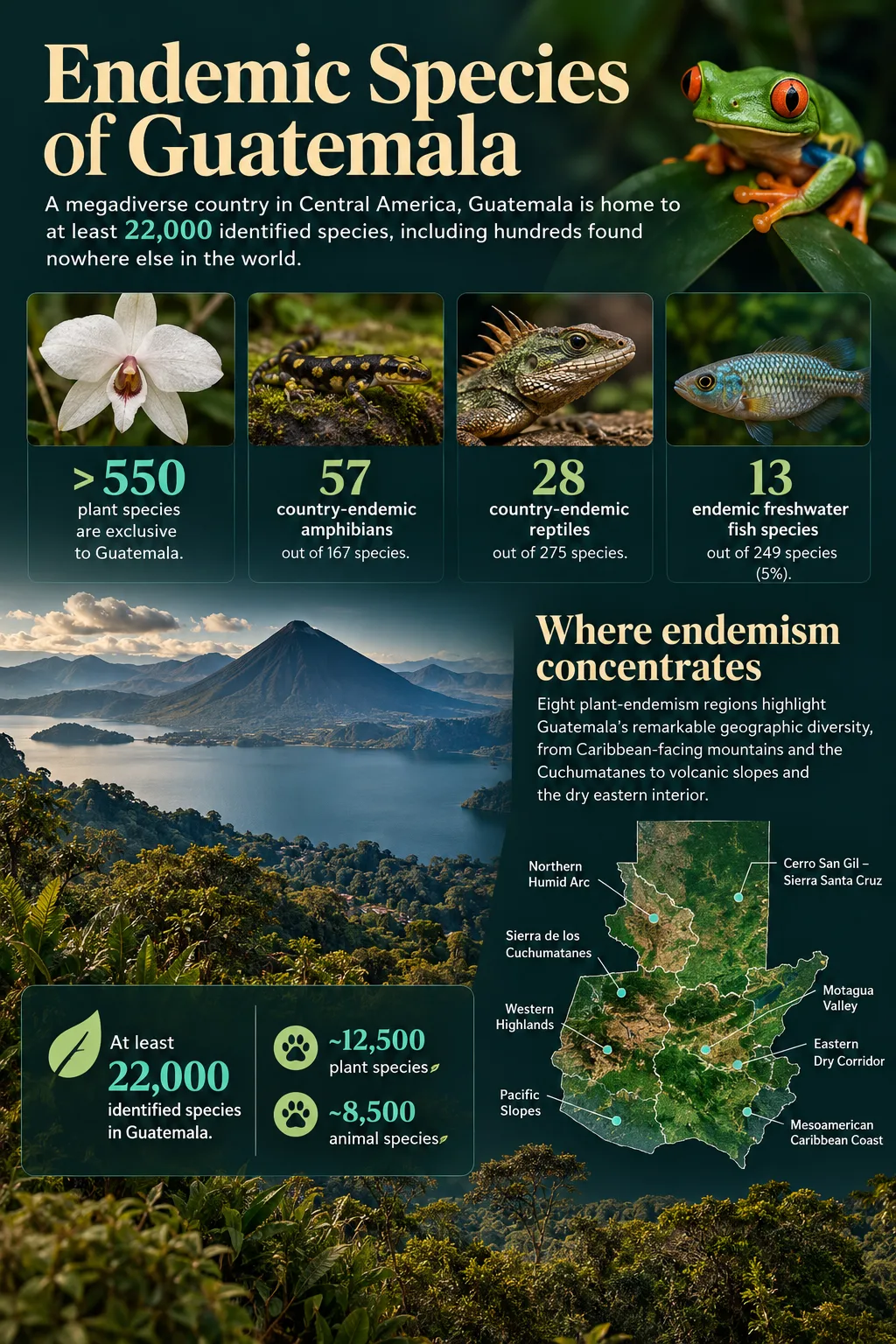
Guatemala has at least 22,000 identified species, while its best national endemism figures are reported by taxonomic group rather than as one compatible all-taxa total. More than 550 plant species are reported as exclusive to Guatemala, and the 2026 national herpetofauna treatment recognizes 57 country-endemic amphibians and 28 country-endemic reptiles. [S1] [S2]
| Measure | Value |
|---|---|
| Identified species | At least 22,000 [S1] |
| Recorded plant species | Approximately 12,500 [S1] |
| Recorded animal species | Approximately 8,500 [S1] |
| Plant species with some degree of endemism | Approximately 900 [S1] |
| Plant species exclusive to Guatemala | More than 550 [S1] |
| Amphibian species | 167 [S2] |
| Country-endemic amphibian species | 57 [S2] |
| Reptile species | 275 [S2] |
| Country-endemic reptile species | 28 [S2] |
| Strict country-endemic share of herpetofauna | 19% [S2] |
| Endemic freshwater fishes in the 2022 assessment | 13 of 249 species (5%) [S3] |
| Threatened endemic freshwater fishes in that assessment | 8 of 13 (62%) [S3] |
| Living mammal species in the current MDD country inventory | 251 [S4] |
Data boundary: the national plant, herpetofauna, freshwater-fish and mammal datasets do not use one shared taxonomic universe or assessment method. Their values should remain separate; adding them would create an artificial national endemic-species total. [S1] [S2] [S3] [S4]
Where Guatemala’s endemism concentrates
Guatemala’s national floristic synthesis identifies eight plant-endemism regions. These are floristic regions, not a universal set of hotspots for every animal group. Together they show how sharply the country changes from humid Caribbean-facing mountains and the Cuchumatanes to volcanic slopes and the dry eastern interior. [S5]
| Plant-endemism region | Geographic context |
|---|---|
| Cerro San Gil–Sierra Santa Cruz | Izabal; Caribbean-facing mountains |
| Northern Humid Arc | Northern Izabal through Alta Verapaz, Quiché and Huehuetenango |
| Sierra de los Cuchumatanes | High mountains of Huehuetenango |
| Central Chiapas Depression | The Guatemalan extension in Huehuetenango |
| Volcanic piedmont | Pacific-facing volcanic foothills |
| Montaña de Xalapán | Jalapa highlands |
| Eastern thorn scrub | El Progreso, Zacapa and Chiquimula |
| Trifinio | Southeastern highlands around Chiquimula |
Micro-endemism is especially visible in salamanders. Bolitoglossa qeqom is known from an isolated cloud forest at Cerro Guachmalén, Alta Verapaz, at about 1,862 m; Amphibian Species of the World treats its natural occurrence as Guatemala-only. [S6] The same pattern appears in several other highland salamanders whose ranges are tied to single volcanoes, mountain blocks or cloud-forest systems.
Amphibian endemism is dominated by plethodontid salamanders
The 2026 USAC treatment recognizes 57 amphibian species endemic to Guatemala. Plethodontidae contributes 36 species, Craugastoridae 11 and Hylidae 10. This is strict country endemism; a separate 75 amphibian species are described as restricted to Nuclear Central America and therefore belong to a broader regional-endemic category. [S2]
| Family | Guatemala-endemic species |
|---|---|
| Plethodontidae | 36 |
| Craugastoridae | 11 |
| Hylidae | 10 |
{
  "type": "bar",
  "title": "Guatemala-endemic amphibians by family",
  "description": "The 57 strict country-endemic amphibians in the 2026 USAC treatment.",
  "unit": "species",
  "orientation": "horizontal",
  "data": [
    {"label": "Plethodontidae", "value": 36},
    {"label": "Craugastoridae", "value": 11},
    {"label": "Hylidae", "value": 10}
  ],
  "source": "[S2] Unidad de Vida Silvestre, FMVZ-USAC"
}
Plethodontid country-endemic checklist
The national biodiversity portal’s amphibian checklist is based on literature and scientific collections and is revised from Acevedo’s Guatemalan herpetofauna treatment. The following species-rank records form the 36-species plethodontid component used here; the national 2026 family total is kept separate from the portal’s update cycle. [S7] [S2]
| Scientific name |
|---|
| Bolitoglossa centenorum |
| Bolitoglossa cuchumatana |
| Bolitoglossa daryorum |
| Bolitoglossa eremia |
| Bolitoglossa helmrichi |
| Bolitoglossa huehuetenanguensis |
| Bolitoglossa jacksoni |
| Bolitoglossa kaqchikelorum |
| Bolitoglossa la |
| Bolitoglossa meliana |
| Bolitoglossa morio |
| Bolitoglossa ninadormida |
| Bolitoglossa nussbaumi |
| Bolitoglossa omniumsanctorum |
| Bolitoglossa pacaya |
| Bolitoglossa psephena |
| Bolitoglossa qeqom |
| Bolitoglossa suchitanensis |
| Bolitoglossa tenebrosa |
| Bolitoglossa tzultacaj |
| Bolitoglossa xibalba |
| Bolitoglossa zacapensis |
| Cryptotriton monzoni |
| Cryptotriton sierraminensis |
| Cryptotriton veraepacis |
| Cryptotriton xucaneborum |
| Dendrotriton bromeliacius |
| Dendrotriton chujorum |
| Dendrotriton cuchumatanus |
| Dendrotriton kekchiorum |
| Dendrotriton rabbi |
| Nototriton brodiei |
| Oedipina motaguae |
| Oedipina stenopodia |
| Oedipina tzutujilorum |
| Pseudoeurycea exspectata |
Pseudoeurycea exspectata is retained in the checklist because the portal treats it as a Guatemala endemic at species rank and labels it extinct. Extinct and living records therefore should not be silently combined when deriving extant-endemic counts. [S7]
Reptile endemism includes mountain lizards and narrow-range snakes
USAC reports 28 reptile species endemic to Guatemala in a 275-species national reptile fauna. [S2] The Guatemala Biodiversity Portal checklist was last updated on 5 November 2025 and contains 277 reptile species under its own treatment. Because those two versions are not identical, the national total and the portal-resolved endemic identities are not forced into one synchronized count. [S8]
Portal-resolved strict endemics: 22 species-rank records are shown below because their Guatemala-endemic flag can be resolved directly in the cited portal treatment. The six-record difference from the 2026 USAC national total is left unresolved rather than filled by inference.
| Scientific name |
|---|
| Abronia anzuetoi |
| Abronia aurita |
| Abronia campbelli |
| Abronia fimbriata |
| Abronia frosti |
| Abronia gaiophantasma |
| Abronia meledona |
| Anolis haguei |
| Adelphicos daryi |
| Adelphicos ibarrorum |
| Adelphicos veraepacis |
| Chapinophis xanthocheilus |
| Ninia pavimentata |
| Rhadinella hempsteadae |
| Rhadinella stadelmani |
| Rhadinella xerophila |
| Sibon merendonensis |
| Micrurus stuarti |
| Heloderma charlesbogerti |
| Ctenosaura palearis |
| Tantilla bairdi |
| Tantilla tecta |
Tantilla bairdi shows how sparse the record can be even for a named country endemic: a 2025 paper reported only the fifth documented record of the species and described its rediscovery in Guatemala. [S9]
Freshwater fishes: the count is stable, the species set is not
A 2022 Central American assessment recognized 13 Guatemala-endemic freshwater fishes among 249 species. Eight were in threatened categories, four were Data Deficient and one was Least Concern. [S3] A current FishBase country checklist also returns 13 endemic fishes, but four names differ between the two treatments. [S10] The two lists therefore should not be merged into a larger synthetic set.
| Scientific name | Assessment class |
|---|---|
| Amphilophus margaritifer | Threatened |
| Astyanax baileyi | Data Deficient |
| Astyanax dorioni | Data Deficient |
| Poecilia rositae | Threatened |
| Pseudoxiphophorus attenuatus | Threatened |
| Pseudoxiphophorus cataractae | Threatened |
| Pseudoxiphophorus diremptus | Threatened |
| Pseudoxiphophorus litoperas | Least Concern |
| Pseudoxiphophorus obliquus | Data Deficient |
| Rocio spinosissima | Threatened |
| Scolichthys greenwayi | Data Deficient |
| Scolichthys iota | Threatened |
| Xiphophorus signum | Threatened |
{
  "type": "donut",
  "title": "Assessment classes among the 13 endemic freshwater fishes",
  "description": "The 2022 assessment classified eight as threatened, four as Data Deficient and one as Least Concern.",
  "unit": "species",
  "data": [
    {"label": "Threatened", "value": 8},
    {"label": "Data Deficient", "value": 4},
    {"label": "Least Concern", "value": 1}
  ],
  "source": "[S3] Diversity 14(10):793 (2022)"
}
How the two 13-species treatments differ
| Comparison | Species |
|---|---|
| Shared by both treatments | Amphilophus margaritifer, Pseudoxiphophorus cataractae, Pseudoxiphophorus diremptus, Pseudoxiphophorus litoperas, Pseudoxiphophorus obliquus, Rocio spinosissima, Scolichthys greenwayi, Scolichthys iota, Xiphophorus signum |
| Present only in the 2022 assessment set | Astyanax baileyi, Astyanax dorioni, Poecilia rositae, Pseudoxiphophorus attenuatus [S3] |
| Present only in the current FishBase set | Heterandria attenuata, Poecilia petenensis, Pseudophallus galadrielae, Xenodexia ctenolepis [S10] |
Mammal endemism is concentrated in small highland species
The Mammal Diversity Database records 251 living mammal species for Guatemala. [S4] Country-only distributions in the current species accounts are concentrated in shrews, deer mice and one bat rather than Guatemala’s larger, wider-ranging mammals.
| Scientific name | Family | Current range signal |
|---|---|---|
| Myotis cobanensis | Vespertilionidae | Guatemala; type locality at Cobán, Alta Verapaz, 1,305 m [S11] |
| Cryptotis eckerlini | Soricidae | Guatemala; Cerro Cucurucho, Sacatepéquez, 2,640 m [S12] |
| Cryptotis lacertosus | Soricidae | Guatemala; western highlands near San Mateo Ixtatán, Huehuetenango [S13] |
| Cryptotis matsoni | Soricidae | Guatemala; Mataquescuintla area, Jalapa, 2,560 m [S14] |
| Cryptotis oreoryctes | Soricidae | Guatemala; Chelemhá cloud forest, Alta Verapaz, about 2,090 m [S15] |
| Sorex ibarrai | Soricidae | Guatemala; Sierra de las Minas, Cerro Pinalón, 2,700 m [S16] |
| Sorex madrensis | Soricidae | Guatemala; Cabricán area, Quetzaltenango, 3,100 m [S17] |
| Sorex veraepacis | Soricidae | Guatemala under the current MDD treatment [S18] |
| Peromyscus bakeri | Cricetidae | Guatemala; Fuentes Georginas near Zunil, Quetzaltenango, 2,433 m [S19] |
| Peromyscus gardneri | Cricetidae | Northern Sierra de los Cuchumatanes, western Guatemala [S20] |
| Peromyscus grandis | Cricetidae | Southern Alta Verapaz and northeastern Baja Verapaz [S21] |
| Peromyscus guatemalensis | Cricetidae | Altos Cuchumatanes, Guatemala [S22] |
| Peromyscus mayensis | Cricetidae | Known only from the type locality and close vicinity in western-central Guatemala [S23] |
Taxonomic changes can alter the apparent endemic set without any change on the ground. The current MDD account for Peromyscus guatemalensis limits it to the Altos Cuchumatanes and notes that populations formerly included in it are now assigned to P. carolpattonae and P. bakeri. [S22] Peromyscus mayensis has an even tighter documented range: the type locality and its close vicinity. [S23]
Plant endemism is numerically the largest documented national component
CONAP reports close to 900 plant species with some degree of endemism and more than 550 species found exclusively in Guatemala. [S1] A single country page should not convert that national figure into a short “top species” list. The table below instead provides current accepted-name reference entries from Kew for strict Guatemala-native species across wet, montane and seasonally dry biomes.
| Scientific name | Family | Native range | Growth form / biome |
|---|---|---|---|
| Magnolia guatemalensis | Magnoliaceae | Guatemala | Tree; wet tropical [S24] |
| Passiflora pterocarpa | Passifloraceae | Guatemala | Climber; wet tropical [S25] |
| Erythrostemon guatemalensis | Fabaceae | Guatemala | Seasonally dry tropical; first published in 2025 [S26] |
| Damburneya guatemalensis | Lauraceae | Guatemala | Shrub or tree; wet tropical [S27] |
| Ocotea persicifolia | Lauraceae | Guatemala | Tree; wet tropical [S28] |
| Lonicera guatemalensis | Caprifoliaceae | Guatemala, with Huehuetenango specified by POWO | Shrub or tree; montane tropical [S29] |
| Cordia cardenasiana | Boraginaceae | Eastern Guatemala | Tree; seasonally dry tropical [S30] |
Erythrostemon guatemalensis is a recent addition to the accepted flora: Kew records its first publication in Kew Bulletin in 2025 and its native range as Guatemala, primarily in seasonally dry tropical habitat. [S26] This is the type of taxonomic change that can make older national plant lists lag behind the current accepted-name backbone.
The strict country-endemic bird line is historical
Under the AOS-based Avibase treatment for Guatemala, the single country-endemic bird is Podilymbus gigas, the Atitlán Grebe, and it is listed as extinct. [S31] This makes bird endemism different from the living micro-endemic patterns seen in salamanders, reptiles and small mammals.
| Species | Endemic treatment | Status |
|---|---|---|
| Podilymbus gigas | Guatemala endemic | Extinct [S31] |
The Resplendent Quetzal (Pharomachrus mocinno) is closely associated with Guatemala but is not a Guatemala-only endemic. CONAP describes its native distribution as Mesoamerican, extending from southern Mexico through Central America to Panama. [S32]
Specialist beetle data expose a montane invertebrate pattern
Guatemala lacks a compatible country-wide endemic-invertebrate total comparable with the herpetofauna figures. A taxonomically narrow dataset can still show the spatial pattern. A 2023 synthesis of Chrysina scarab beetles recognized 28 species in Guatemala, including two undescribed species, and treated 12 as Guatemala endemics after examining more than 1,700 specimens from 68 localities. [S33]
| Measure | Value |
|---|---|
| Recognized Chrysina in Guatemala | 28 species, including 2 undescribed |
| Guatemala-endemic Chrysina | 12 species |
| Specimens examined | More than 1,700 |
| Localities represented | 68 |
| Species recorded at 1,500–2,000 m | 22 species (71%) |
| Huehuetenango richness | 14 species |
| San Marcos richness | 10 species |
| Endemic Chrysina in Huehuetenango | 4 species |
| Endemic Chrysina in San Marcos | 3 species |
The same study identifies Los Cuchumatanes, the western Cordillera Volcánica, Merendón, Espíritu Santo and Chamá–Las Minas among its higher-priority biogeographic subzones for Chrysina, showing that montane concentration is not limited to vertebrates. [S33]
Strict endemic, regional endemic or native
Country endemism refers to natural native distribution confined to Guatemala. A species can be characteristic of Guatemala, threatened there, or even carry “guatemalensis” in its scientific name without meeting that geographic test.
| Species | Correct geographic treatment | Range basis |
|---|---|---|
| Bolitoglossa qeqom | Strict Guatemala endemic | Known only from Cerro Guachmalén in the current specialist account [S6] |
| Tantilla bairdi | Strict Guatemala endemic | Guatemala-only snake with only five documented records reported by the 2025 study [S9] |
| Peromyscus mayensis | Strict Guatemala endemic | Known only from the type locality and close vicinity [S23] |
| Erythrostemon guatemalensis | Strict Guatemala endemic | POWO native range: Guatemala [S26] |
| Podilymbus gigas | Strict Guatemala endemic | Extinct; endemic in the AOS-based Guatemala bird treatment [S31] |
| Pharomachrus mocinno | Mesoamerican endemic, not Guatemala-only | Native range extends beyond Guatemala from Mexico through Central America [S32] |
| Abies guatemalensis | Native to Guatemala, not Guatemala-only | POWO native range extends from southern Mexico to Honduras [S34] |
The 2026 herpetofauna dataset makes the same distinction numerically: 57 amphibians and 28 reptiles are strict Guatemala endemics, while 75 amphibians and 93 reptiles are restricted to the wider Nuclear Central America region. [S2] Keeping those categories separate prevents regional endemics from being counted as Guatemala-only species.
Sources
[S1] ↩ CONAP — Congreso Nacional de Diversidad Biológica y Áreas Protegidas Guatemala 2025. National biodiversity totals and plant-endemism figures.
[S2] ↩ Unidad de Vida Silvestre, FMVZ-USAC — Reptiles y anfibios. 2026 Guatemala herpetofauna totals, strict country endemics, regional endemics, and family-level amphibian counts.
[S3] ↩ Diversity — Freshwater Fishes of Central America: Distribution, Assessment, and Major Threats. Guatemala freshwater-fish total, endemic set, and conservation assessment.
[S4] ↩ Mammal Diversity Database — Guatemala Mammal Diversity Statistics. Current country-level mammal inventory.
[S5] ↩ Véliz Pérez et al. — Diversidad florística de Guatemala. National floristic synthesis and eight plant-endemism regions.
[S6] ↩ Amphibian Species of the World — Bolitoglossa qeqom. Accepted taxon and known range at Cerro Guachmalén, Alta Verapaz.
[S7] ↩ Portal de Biodiversidad de Guatemala — Anfibios de Guatemala. Current national amphibian checklist used for species identities and country-endemic flags.
[S8] ↩ Portal de Biodiversidad de Guatemala — Reptiles de Guatemala. National reptile checklist used for species identities and country-endemic flags.
[S9] ↩ Revista Latinoamericana de Herpetología — El quinto registro para la serpiente endémica de Guatemala: redescubrimiento de Tantilla bairdi. 2025 report documenting the fifth known record of Tantilla bairdi.
[S10] ↩ FishBase — List of Endemic Fishes reported from Guatemala. Current FishBase endemic-fish country checklist.
[S11] ↩ Mammal Diversity Database — Myotis cobanensis. Current taxonomy and Guatemala-only distribution.
[S12] ↩ Mammal Diversity Database — Cryptotis eckerlini. Current taxonomy and Guatemala-only distribution.
[S13] ↩ Mammal Diversity Database — Cryptotis lacertosus. Current taxonomy and Guatemala-only distribution.
[S14] ↩ Mammal Diversity Database — Cryptotis matsoni. Current taxonomy and Guatemala-only distribution.
[S15] ↩ Mammal Diversity Database — Cryptotis oreoryctes. Current taxonomy and Guatemala-only distribution.
[S16] ↩ Mammal Diversity Database — Sorex ibarrai. Current taxonomy and Guatemala-only distribution.
[S17] ↩ Mammal Diversity Database — Sorex madrensis. Current taxonomy and Guatemala-only distribution.
[S18] ↩ Mammal Diversity Database — Sorex veraepacis. Current taxonomy and Guatemala-only distribution.
[S19] ↩ Mammal Diversity Database — Peromyscus bakeri. Current taxonomy and Guatemala-only distribution.
[S20] ↩ Mammal Diversity Database — Peromyscus gardneri. Current taxonomy and Guatemala-only distribution.
[S21] ↩ Mammal Diversity Database — Peromyscus grandis. Current taxonomy and Guatemala-only distribution.
[S22] ↩ Mammal Diversity Database — Peromyscus guatemalensis. Current taxonomy, Guatemala distribution, and split-related treatment.
[S23] ↩ Mammal Diversity Database — Peromyscus mayensis. Current taxonomy and extremely narrow Guatemala-only distribution.
[S24] ↩ Plants of the World Online — Magnolia guatemalensis. Accepted plant name and native range.
[S25] ↩ Plants of the World Online — Passiflora pterocarpa. Accepted plant name and native range.
[S26] ↩ Plants of the World Online — Erythrostemon guatemalensis. Accepted 2025 species name, native range, and biome.
[S27] ↩ Plants of the World Online — Damburneya guatemalensis. Accepted plant name, synonyms, native range, and biome.
[S28] ↩ Plants of the World Online — Ocotea persicifolia. Accepted plant name and native range.
[S29] ↩ Plants of the World Online — Lonicera guatemalensis. Accepted plant name and Huehuetenango native range.
[S30] ↩ Plants of the World Online — Cordia cardenasiana. Accepted plant name, eastern Guatemala range, and biome.
[S31] ↩ Avibase — Bird checklist: Guatemala. AOS-based country checklist treatment identifying the Atitlán Grebe as endemic and extinct.
[S32] ↩ CONAP — Conservación del Quetzal: un trabajo conjunto por la biodiversidad. Mesoamerican native range of the Resplendent Quetzal.
[S33] ↩ Monzón Sierra et al. — Actualización del conocimiento del género Chrysina en Guatemala. 2023 specialist synthesis of Chrysina diversity, endemism, elevation, and geographic concentration.
[S34] ↩ Plants of the World Online — Abies guatemalensis. Accepted name and native range from southern Mexico to Honduras.