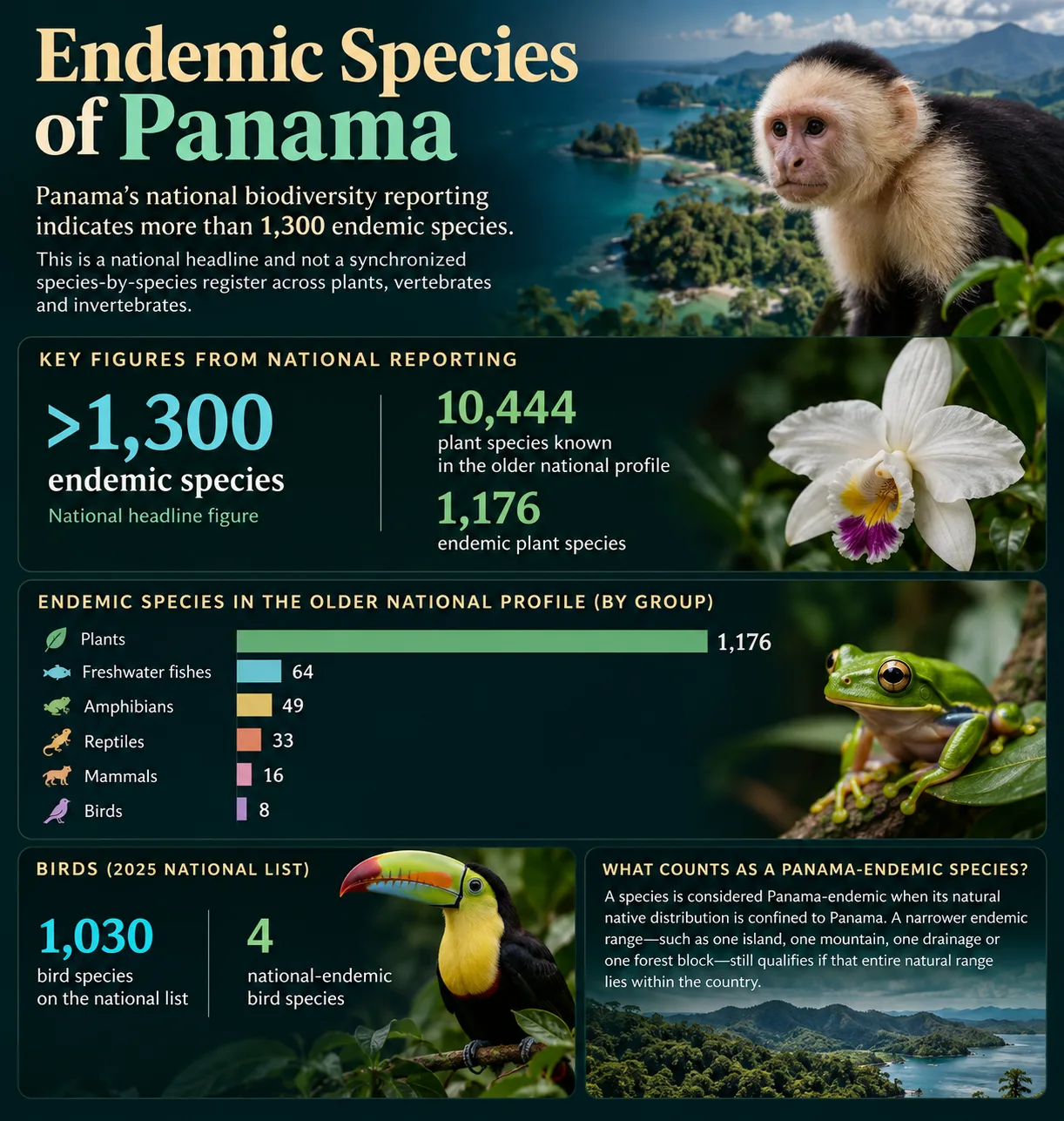
Panama’s current national biodiversity reporting places the country at more than 1,300 endemic species. [S1] The number is a national headline, not a synchronized species-by-species register across plants, vertebrates and invertebrates. Older government group counts remain useful as benchmarks, but several groups now use different specialist taxonomies.
| Measure | Value |
|---|---|
| National endemic-species headline | >1,300 species [S1] |
| Known plant species in the older national profile | 10,444 species [S2] |
| Endemic plants in the older national profile | 1,176 species [S2] |
| Endemic amphibians in the older national profile | 49 species [S2] |
| Endemic reptiles in the older national profile | 33 species [S2] |
| Endemic birds in the older national profile | 8 species [S2] |
| Endemic mammals in the older national profile | 16 species [S2] |
| Endemic freshwater fishes in the older national profile | 64 species [S2] |
| Bird species on the 2025 national list | 1,030 species [S3] |
| National-endemic birds under the 2025 list | 4 species [S3] |
{"type":"bar","title":"Published endemic-group counts in the older MiAmbiente profile","description":"Source-defined national species counts. These values are historical benchmarks and are not a reconciled current all-taxa checklist.","unit":"species","orientation":"horizontal","data":[{"label":"Plants","value":1176},{"label":"Freshwater fishes","value":64},{"label":"Amphibians","value":49},{"label":"Reptiles","value":33},{"label":"Mammals","value":16},{"label":"Birds","value":8}],"source":"[S2]"}
Data boundary: the group values in the older MiAmbiente profile should not be added to the 2026 headline or treated as a current reconciled register. The same older source states a national total of 1,300 while the published group figures sum to 1,346, and the 2025 national bird list now recognizes four national-endemic bird species rather than eight. [S2] [S3]
What counts as a Panama-endemic species
For a country-level checklist, a species is Panama-endemic when its natural native distribution is confined to Panama. A narrower endemic range—one island, one mountain, one drainage or one forest block—still qualifies if that entire natural range lies inside the country.
| Range label | Treatment at species rank |
|---|---|
| Panama endemic | Counted when the accepted species’ entire natural range is within Panama. |
| Panamanian island endemic | Counted when the accepted species is naturally confined to a Panamanian island. |
| Regional endemic shared with Costa Rica or Colombia | Not counted as a national endemic. |
| Endemic subspecies or variety | Kept separate from the species-level count. |
| Boundary-uncertain species | Qualified until the native range is resolved. |
| Introduced or translocated population | Does not enlarge the species’ native range. |
Panama’s position between Costa Rica and Colombia makes this distinction especially relevant. Restricted-range species may cross either international border, while many strict national endemics occupy isolated islands, mountain systems or drainage basins.
Why the endemic-bird count changes with taxonomy
The 2025 national bird list follows eBird/Clements taxonomy and reports four national-endemic bird species: Glow-throated Hummingbird, Coiba Spinetail, Yellow-green Tyrannulet and Yellow-green Brushfinch. [S3] The older government benchmark reported eight endemic birds, so the two numbers should not be blended.
The Azuero parakeet shows how one taxonomic decision changes country endemism. BirdLife treats Pyrrhura eisenmanni as a species restricted to the Cerro Hoya area of Panama. [S4] The 2025 eBird/Clements treatment places eisenmanni and the Colombian subandina together within Pyrrhura subandina. [S5] Under that treatment, the Panamanian Azuero population is not a Panama-endemic species at species rank.
Taxonomic rule: national-endemic totals should follow one stated species treatment. Combining species splits from one authority with species lumps from another produces a count that does not correspond to a single checklist.
Where strict endemism is concentrated
Panama’s strict endemics are unevenly distributed. Islands isolate populations from mainland relatives, mountain crests separate cool and wet habitats, and short drainage systems can confine freshwater and stream-associated species to very small areas.
| Area | Endemism pattern | Range-resolved examples |
|---|---|---|
| Isla Escudo de Veraguas | Small Caribbean island with repeated historical isolation from the mainland | Pygmy three-toed sloth and island-restricted flora; STRI identifies Escudo as a center of endemism. [S6] |
| Coiba | Pacific island isolation | Coiba Spinetail and Coiban Agouti; UNESCO records high endemism in the island’s mammals, birds and plants. [S7] |
| Cerro Hoya and Azuero | Peninsular mountain isolation | The eisenmanni parakeet lineage is geographically restricted here, but its species rank depends on the bird authority used. [S4] [S5] |
| Central Panama and El Copé–Donoso | Short mountain streams, low-dispersal amphibians and isolated forest blocks | Atelopus zeteki is confined to the Cerro Campana–Valle de Antón region. [S8] Andinobates geminisae is known only from the Río Belén Basin. [S9] |
| Darién and the Majé–Sapo–Pirre systems | Mountain and cloud-forest microendemism near the Colombia border | Atelopus certus is restricted to the Cerro Sapo region. [S10] Border proximity means other Darién taxa need country-range checks before being called national endemics. |
| Western highlands | High-elevation isolation within the Talamanca–Barú system | Bolitoglossa magnifica is restricted to the southern Talamanca–Barú slopes within Chiriquí. [S11] |
Regional bird endemism is a different metric
The 2025 Panama bird list also assigns species to five BirdLife Endemic Bird Areas. These are regional-endemic counts, not counts of species confined to Panama. The western highlands EBA, for example, spans highlands in both Costa Rica and Panama. [S3]
| Endemic Bird Area represented in Panama | Regional endemic species |
|---|---|
| Western Caribbean lowlands | 23 |
| Western highlands | 54 |
| Western Pacific lowlands | 24 |
| Eastern lowlands | 16 |
| Eastern highlands | 17 |
{"type":"bar","title":"Regional endemic birds in Panama’s five Endemic Bird Areas","description":"Regional-endemic species counts from the 2025 national bird list. These are not national-endemic species totals.","unit":"species","orientation":"horizontal","data":[{"label":"Western highlands","value":54},{"label":"Western Pacific lowlands","value":24},{"label":"Western Caribbean lowlands","value":23},{"label":"Eastern highlands","value":17},{"label":"Eastern lowlands","value":16}],"source":"[S3]"}
Recent records that change the endemic-species picture
Clusia nanophylla entered the flora as a newly described Panama endemic
Kew accepts Clusia nanophylla as a species with a native range confined to Panama; the name was first published in 2025. [S12] STRI reports that the first known specimen was collected in 2000 in the Ngäbe-Buglé region and that the material was recognized as a new species about a quarter-century later. [S13] The case illustrates how national endemic totals can change when existing collections are revised and formally named.
The Panamanian golden frog returned to field release sites in 2026
Atelopus zeteki remains a Panama-endemic species under Amphibian Species of the World, with a native range in the Cerro Campana–Valle de Antón region. [S8] STRI reports no wild sighting since 2009 and links the collapse to chytridiomycosis; captive-bred frogs were released in 2026 as part of work testing whether wild populations can be re-established. [S14] A conservation release changes where living individuals occur, but it does not change the species’ original native endemic range.
Verified species-level reference set
The national headline exceeds 1,300 endemic species, but no single current public register synchronizes the accepted names and ranges of all Panamanian endemic plants, vertebrates and invertebrates. The records below are species-rank taxa for which current national or specialist sources resolve a natural range confined to Panama. They are a documented reference set rather than a reconstruction of the national headline total.
| Scientific name | Common name | Group | Native endemic range |
|---|---|---|---|
| Selasphorus ardens | Glow-throated Hummingbird | Bird | Western highlands; national endemic in the 2025 list [S3] |
| Cranioleuca dissita | Coiba Spinetail | Bird | Coiba and adjacent western Pacific island habitat; national endemic in the 2025 list [S3] |
| Phylloscartes flavovirens | Yellow-green Tyrannulet | Bird | Eastern Panamanian lowlands; national endemic in the 2025 list [S3] |
| Atlapetes luteoviridis | Yellow-green Brushfinch | Bird | Western highlands; national endemic in the 2025 list [S3] |
| Bradypus pygmaeus | Pygmy Three-toed Sloth | Mammal | Isla Escudo de Veraguas [S15] |
| Dasyprocta coibae | Coiban Agouti | Mammal | Coiba Island [S16] |
| Marmosops invictus | Panama Slender Opossum | Mammal | Panama [S17] |
| Cynomops freemani | Freeman’s Dog-faced Bat | Mammal | Panama; type locality on Gamboa Ridge [S18] |
| Lophostoma kalkoae | Kalko’s Round-eared Bat | Mammal | Panama; type locality in the Soberanía/Pipeline Road area [S19] |
| Cryptotis endersi | Enders’s Small-eared Shrew | Mammal | Panama; type locality in Chiriquí [S20] |
| Marmosa adleri | Adler’s Woolly Mouse Opossum | Mammal | Panama [S21] |
| Melanomys idoneus | Cinnamon-rufous Rice Rat | Mammal | Panama; type locality at Cerro Azul [S22] |
| Tylomys fulviventer | Fulvous-bellied Climbing Rat | Mammal | Panama; type locality at Tacarcuna, Darién [S23] |
| Tylomys panamensis | Panama Climbing Rat | Mammal | Panama [S24] |
| Sylvilagus incitatus | Northern Tapeti | Mammal | Panama under the current species split [S25] |
| Microsciurus boquetensis | Panamanian Dwarf Squirrel | Mammal | Panama; type locality at Boquete, Chiriquí [S26] |
| Atelopus zeteki | Panamanian Golden Frog | Amphibian | Cerro Campana–Valle de Antón region [S8] |
| Andinobates geminisae | — | Amphibian | Río Belén Basin, Colón [S9] |
| Atelopus certus | Darien Stubfoot Toad | Amphibian | Cerro Sapo region, Darién [S10] |
| Atelopus limosus | — | Amphibian | Atlantic versant of central Panama, about 10–730 m [S27] |
| Bolitoglossa copia | El Cope Giant Salamander | Amphibian | Cerro Peña Blanca type locality, about 1,315 m [S28] |
| Bolitoglossa chucantiensis | Chucantí Salamander | Amphibian | Cerro Chucantí, Majé range, Darién [S29] |
| Bolitoglossa cuna | Camp Sasardi Salamander | Amphibian | Eastern San Blas lowlands, sea level to about 350 m [S30] |
| Bolitoglossa jugivagans | Continental Divide Salamander | Amphibian | Río Chiriquí Malí headwaters near Fortuna, about 1,060 m [S31] |
| Bolitoglossa magnifica | Magnificent Mushroomtongue Salamander | Amphibian | Southern Talamanca–Barú slopes in Chiriquí, about 1,250–2,450 m [S11] |
| Bolitoglossa taylori | Cerro Cituro Salamander | Amphibian | Eastern Darién cloud forests, about 800–1,440 m [S32] |
| Pristimantis adnus | — | Amphibian | Southern Darién [S33] |
| Pristimantis pirrensis | — | Amphibian | Lower cloud forest in Darién National Park; type locality about 1,250 m [S34] |
| Pristimantis gretathunbergae | Greta Thunberg’s Rainfrog | Amphibian | Panama-only mountain distribution extending from eastern Darién into central-western sites [S35] |
| Anolis elcopeensis | — | Reptile | Coclé; type locality in Omar Torrijos Herrera National Park [S36] |
| Sibon noalamina | — | Reptile | Panama; known localities include Río Chiriquí Malí headwaters [S37] |
| Tantilla berguidoi | Chucantí Centipede Snake | Reptile | Cerro Chucantí, Darién [S38] |
| Siderolamprus adercus | — | Reptile | Western-central Panama; type locality at El Copé [S39] |
| Isthmoheros tuyrensis | — | Freshwater fish | Pacific slope of eastern Panama [S40] |
| Amatitlania nanolutea | — | Freshwater fish | Guarumo River basin [S41] |
| Cynodonichthys chucunaque | — | Freshwater fish | Panama [S42] |
| Eretmobrycon bayano | — | Freshwater fish | Upper Bayano River basin [S43] |
| Clusia nanophylla | — | Plant | Panama [S12] |
| Zamia hamannii | — | Plant | Panama [S44] |
| Triolena anisophylla | — | Plant | Colón Province [S45] |
| Neocteniza agustinea | — | Spider | Panama; originally described from Coiba Island [S46] |
| Ponsoonops coiba | — | Spider | Panama; originally described from Coiba [S47] |
| Itata completa | — | Spider | Panama [S48] |
| Eustala oblonga | — | Spider | Panama [S49] |
Spider records expose a less complete part of the inventory
A 2024 survey produced the first spider checklist for Coiba National Park and identified at least 152 species from the island complex. [S50] The survey also discussed Panama-endemic spiders and showed how island inventories can reveal country records that are absent from older lists.
Current World Spider Catalog records provide species-level examples that can be checked independently: Neocteniza agustinea and Ponsoonops coiba are accepted species with Panama-only distributions, while Itata completa and Eustala oblonga are also listed only from Panama. [S46] [S47] [S48] [S49]
Records that need qualified treatment
Some Panamanian taxa sit close to the boundary between a clean country endemic and a taxonomically or geographically uncertain record. Keeping them separate prevents a species-level checklist from implying more certainty than the source allows.
| Taxon | Why the record needs qualification |
|---|---|
| Pyrrhura eisenmanni | BirdLife treats the Azuero population as a Panama-restricted species, while eBird/Clements places eisenmanni inside Pyrrhura subandina with a Colombian taxon. [S4] [S5] |
| Atelopus fronterizo | Amphibian Species of the World labels the recorded range as endemic to Panama but also states that occurrence in Colombia is likely or controversial. It is therefore unsuitable as an unqualified country-only record. [S51] |
| Platyrrhinus aquilus | The Mammal Diversity Database gives the country distribution as Panama with Colombia uncertain. That uncertainty is enough to keep it outside a strict Panama-only reference set. [S52] |
| Tantilla albiceps | The Reptile Database records Panama and notes that the species is known from a single specimen and has been described as probably extinct. It is best treated as a historical, status-uncertain endemic record rather than mixed silently with extant records. [S53] |
| Bradypus pygmaeus | The Mammal Diversity Database currently accepts the pygmy three-toed sloth as a species confined to Isla Escudo de Veraguas, while also noting that it may be synonymous with B. variegatus. [S15] |
| Microsciurus boquetensis | The Mammal Diversity Database accepts the Panama-only species but flags unresolved generic placement. The country range is clear under the current treatment even though the genus assignment may change. [S26] |
Why Panama’s endemic list keeps changing
| Mechanism | Panama example | Effect on the record |
|---|---|---|
| New species description | Clusia nanophylla was published as an accepted Panama-native species in 2025. [S12] | A previously collected organism becomes a formally recognized endemic species. |
| Species split or lump | The Azuero parakeet lineage is species-rank in BirdLife but nested within Pyrrhura subandina in eBird/Clements. [S4] [S5] | The national endemic-species count changes with the authority used. |
| Cross-border range evidence | Atelopus fronterizo is recorded from Panama, while Colombia remains a likely or controversial part of its range. [S51] | A confirmed Colombian population would remove strict Panama-only endemism. |
| Accepted-name revision | Siderolamprus adercus is the current Reptile Database name for a species formerly treated as Celestus adercus. [S39] | The accepted name changes without creating a second endemic species. |
| Field reintroduction | Captive-bred Atelopus zeteki were released in Panama in 2026. [S14] | Wild-occurrence status can change while the historical native endemic range remains the same. |
Sources
[S1] ↩ MiAmbiente — Panama reports biodiversity progress in its Seventh National Report. National 2026 reporting of more than 1,300 endemic species.
[S2] ↩ MiAmbiente — Biodiversity profile of Panama. Government biodiversity profile containing the older national endemic-group counts.
[S3] ↩ Panama Audubon Society Records Committee — List of the Birds of the Republic of Panama, 2025 Edition. National bird checklist with 1,030 recorded species, four national endemics and five EBA summaries.
[S4] ↩ BirdLife DataZone — Azuero Parakeet. Species-level treatment of the Azuero taxon as Pyrrhura eisenmanni.
[S5] ↩ Cornell Lab of Ornithology — eBird/Clements Updates and Corrections, October 2025. Current treatment joining eisenmanni and subandina under Pyrrhura subandina.
[S6] ↩ Smithsonian Tropical Research Institute — Isolated gem. Research account on endemism and biological isolation on Isla Escudo de Veraguas.
[S7] ↩ UNESCO World Heritage Centre — Coiba National Park and its Special Zone of Marine Protection. World Heritage account describing island isolation and endemism in mammals, birds and plants.
[S8] ↩ Amphibian Species of the World — Atelopus zeteki. Accepted taxonomy and Panama-endemic native range.
[S9] ↩ Amphibian Species of the World — Andinobates geminisae. Accepted taxonomy and Río Belén Basin endemic range.
[S10] ↩ Amphibian Species of the World — Atelopus certus. Accepted taxonomy and Cerro Sapo endemic range.
[S11] ↩ Amphibian Species of the World — Bolitoglossa magnifica. Accepted taxonomy and western Panamanian highland range.
[S12] ↩ Kew Plants of the World Online — Clusia nanophylla. Accepted plant name and native range confined to Panama.
[S13] ↩ Smithsonian Tropical Research Institute — Endemic and endangered. Account of the discovery history and conservation context of Clusia nanophylla.
[S14] ↩ Smithsonian Tropical Research Institute — Back from extinction. 2026 field-release work with captive-bred Panamanian golden frogs.
[S15] ↩ Mammal Diversity Database — Bradypus pygmaeus. Accepted mammal record with range confined to Isla Escudo de Veraguas and a taxonomic caution.
[S16] ↩ Mammal Diversity Database — Dasyprocta coibae. Accepted mammal record with Coiba Island distribution.
[S17] ↩ Mammal Diversity Database — Marmosops invictus. Accepted mammal record with Panama-only country distribution.
[S18] ↩ Mammal Diversity Database — Cynomops freemani. Accepted mammal record with Panama-only country distribution.
[S19] ↩ Mammal Diversity Database — Lophostoma kalkoae. Accepted mammal record with Panama-only country distribution.
[S20] ↩ Mammal Diversity Database — Cryptotis endersi. Accepted mammal record with Panama-only country distribution.
[S21] ↩ Mammal Diversity Database — Marmosa adleri. Accepted mammal record described in 2021 with Panama-only country distribution.
[S22] ↩ Mammal Diversity Database — Melanomys idoneus. Accepted mammal record with Panama-only country distribution.
[S23] ↩ Mammal Diversity Database — Tylomys fulviventer. Accepted mammal record with Panama-only country distribution.
[S24] ↩ Mammal Diversity Database — Tylomys panamensis. Accepted mammal record with Panama-only country distribution.
[S25] ↩ Mammal Diversity Database — Sylvilagus incitatus. Accepted mammal record split from a wider species complex and distributed in Panama.
[S26] ↩ Mammal Diversity Database — Microsciurus boquetensis. Accepted species with Panama-only country distribution and a current generic-placement note.
[S27] ↩ Amphibian Species of the World — Atelopus limosus. Accepted taxonomy and central Panama endemic range.
[S28] ↩ Amphibian Species of the World — Bolitoglossa copia. Accepted taxonomy and single-locality range near Cerro Peña Blanca.
[S29] ↩ Amphibian Species of the World — Bolitoglossa chucantiensis. Accepted taxonomy and Cerro Chucantí endemic range.
[S30] ↩ Amphibian Species of the World — Bolitoglossa cuna. Accepted taxonomy and eastern San Blas endemic range.
[S31] ↩ Amphibian Species of the World — Bolitoglossa jugivagans. Accepted taxonomy and Río Chiriquí Malí headwater endemic range.
[S32] ↩ Amphibian Species of the World — Bolitoglossa taylori. Accepted taxonomy and eastern Darién cloud-forest endemic range.
[S33] ↩ Amphibian Species of the World — Pristimantis adnus. Accepted taxonomy and southern Darién endemic range.
[S34] ↩ Amphibian Species of the World — Pristimantis pirrensis. Accepted taxonomy and Darién National Park type-locality range.
[S35] ↩ Amphibian Species of the World — Pristimantis gretathunbergae. Accepted taxonomy and Panama-endemic distribution from eastern to central-western mountains.
[S36] ↩ The Reptile Database — Anolis elcopeensis. Accepted reptile record with distribution in Panama.
[S37] ↩ The Reptile Database — Sibon noalamina. Accepted reptile record with distribution confined to Panama.
[S38] ↩ The Reptile Database — Tantilla berguidoi. Accepted reptile record from Cerro Chucantí, Darién.
[S39] ↩ The Reptile Database — Siderolamprus adercus. Current accepted name and western-central Panama distribution.
[S40] ↩ FishBase — Isthmoheros tuyrensis in Panama. Panama checklist record identifying the species as endemic and freshwater.
[S41] ↩ FishBase — Amatitlania nanolutea in Panama. Panama checklist record identifying the species as endemic and restricted to the Guarumo River basin.
[S42] ↩ FishBase — Cynodonichthys chucunaque. Species account giving its natural distribution as Panama.
[S43] ↩ FishBase — Eretmobrycon bayano. Species account giving its distribution in the upper Bayano River basin.
[S44] ↩ Kew Plants of the World Online — Zamia hamannii. Accepted plant name and native range confined to Panama.
[S45] ↩ Kew Bulletin — Triolena anisophylla, a new and threatened species endemic to Panama. 2024 species description restricting the plant to Colón Province, Panama.
[S46] ↩ World Spider Catalog — Neocteniza agustinea. Accepted spider species with distribution listed as Panama.
[S47] ↩ World Spider Catalog — Ponsoonops coiba. Accepted spider species with distribution listed as Panama and original description from Coiba.
[S48] ↩ World Spider Catalog — Itata completa. Accepted spider species with distribution listed as Panama.
[S49] ↩ World Spider Catalog — Eustala oblonga. Accepted spider species with distribution listed as Panama.
[S50] ↩ Biodiversity Data Journal — Preliminary checklist of spiders from Coiba National Park, Panama. 2024 island inventory reporting at least 152 spider species and discussing Panama-endemic records.
[S51] ↩ Amphibian Species of the World — Atelopus fronterizo. Panama endemic field accompanied by likely or controversial presence in Colombia.
[S52] ↩ Mammal Diversity Database — Platyrrhinus aquilus. Country distribution listed as Panama with Colombia uncertain.
[S53] ↩ The Reptile Database — Tantilla albiceps. Panama-only historical record; known from one specimen and described as probably extinct.