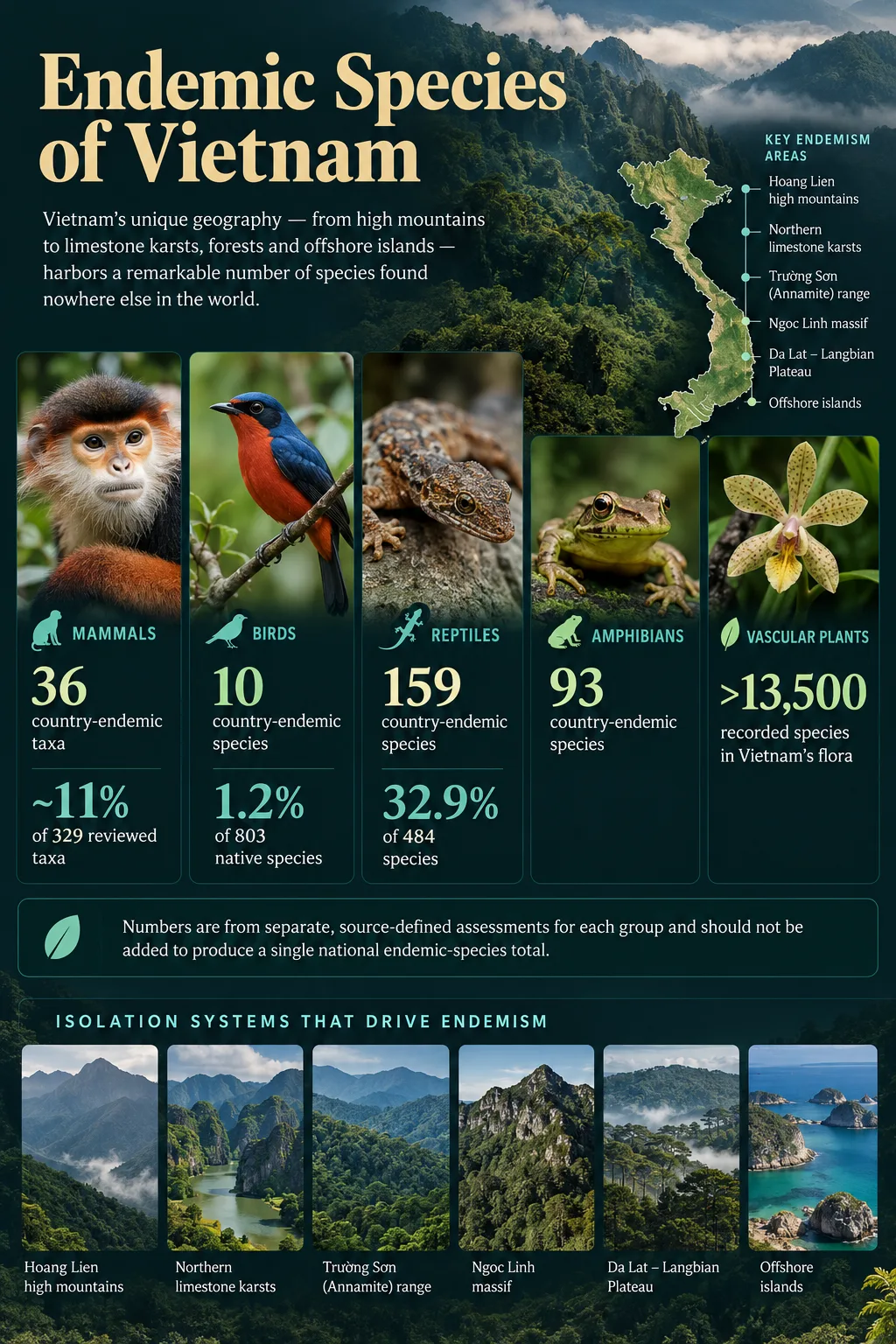
Vietnam’s country endemism is concentrated in several different isolation systems: the Hoang Lien high mountains, limestone karsts in the north, the Trường Sơn/Annamite chain, the Ngoc Linh massif, the Da Lat–Langbian Plateau and small offshore islands. National totals vary sharply among taxonomic treatments, so mammal, bird, reptile, amphibian and plant datasets are kept separate rather than combined into an artificial all-taxa total.
| Measure | Value |
|---|---|
| Mammal taxa reviewed in the 2024 national assessment | ~329 taxa [S1] |
| Country-endemic mammals in the 2024 assessment | 36 (~11%) [S1] |
| Micro-endemic mammals under the study definition | 9 [S1] |
| Native bird species in the 2025 assessment | 803 species [S2] |
| Country-endemic birds in the 2025 assessment | 10 species (1.2%) [S2] |
| Reptile species in the 2023 national assessment | 484 species [S3] |
| Country-endemic reptiles in that assessment | 159 species (32.9%) [S3] |
| Endemic reptiles known only from a local or type locality | 88 of 159 (55%) [S3] |
| Endemic reptiles not recorded from a protected area in the study analysis | 53 of 158 (33.5%) [S3] |
| Country-endemic amphibians after the 2023 review | 93 species [S4] |
| Sub-endemic amphibians in the same review | 32 species [S4] |
| Recorded vascular-plant flora | >13,500 species [S5] |
These values are separate source-defined measures. The mammal dataset includes six subspecies among approximately 329 reviewed taxa, while the bird, reptile and amphibian studies use their own species treatments. The vascular-plant figure is a flora inventory, not an endemic-plant total. The rows therefore should not be added to produce a national endemic-species count.
Why Vietnam has more than one endemic-species count
Standardized global databases and Vietnam-focused taxonomic studies do not recover identical endemic totals. The IUCN 2025-2 country table covers comprehensively assessed vertebrate groups under the Red List taxonomic and distribution treatment, whereas the specialist Vietnam studies incorporate other revisions, range interpretations and publication dates. The values remain useful when their boundaries are preserved.
| Group | IUCN 2025-2 country endemics | Vietnam-focused assessment |
|---|---|---|
| Mammals | 22 endemic; 7 threatened endemic [S6] | 36 country endemics [S1] |
| Birds | 7 endemic; 4 threatened endemic [S6] | 10 country endemics [S2] |
| Reptiles | 122 endemic; 35 threatened endemic [S6] | 159 country endemics [S3] |
| Amphibians | 65 endemic; 44 threatened endemic [S6] | 93 country endemics after the 2023 revision [S4] |
These columns are not alternative versions of one interchangeable dataset. Taxonomic splits, synonymy, new cross-border records and different assessment coverage can all change whether a species qualifies as country-endemic in a particular treatment.
Where Vietnam’s endemism concentrates
Vietnam’s elongated shape crosses several mountain systems and climatic zones, but many strict endemics occupy much smaller geographic units. High-elevation massifs, isolated karst blocks, plateaus and islands repeatedly appear in the native ranges of country-endemic species.
| Endemism zone | Isolation pattern | Examples in current or recent datasets |
|---|---|---|
| Hoang Lien Range | High-elevation montane isolation | Leptobrachella botsfordi; Napothera pasquieri |
| Northeastern limestone belt | Karst blocks separated by valleys and non-karst habitat | Rhinopithecus avunculus; several narrow-range reptiles and amphibians |
| Cat Ba and northeastern islands | Island isolation combined with limestone habitat | Trachypithecus poliocephalus; Liuixalus calcarius |
| Ngoc Linh and Central Annamites | High montane forest separated from neighboring mountain systems | Leptobrachium ngoclinhense; Theloderma nebulosum; Trochalopteron ngoclinhense |
| Da Lat–Langbian Plateau | Southern montane plateau and isolated highland forest | Rhacophorus vampyrus; Nanohyla pulchella; several endemic birds; Pinus krempfii |
| Southern offshore islands | Small-island isolation | Cnemaspis psychedelica on Hon Khoai; mammal micro-endemics on Phu Quoc, Hon Khoai and Con Son |
The Annamites cross the national border
The Trường Sơn or Annamite system is a major center of restricted-range biodiversity, but an Annamite endemic is not automatically a Vietnam endemic. Phong Nha–Ke Bang in Vietnam and Hin Nam No in Laos were recognized in 2025 as one transboundary World Heritage property covering 217,447 hectares. The property lies where the Annamite Range meets the Central Indochina Limestone Belt and contains more than 220 km of documented caves and subterranean rivers. [S7]
That landscape illustrates why ecological and evolutionary units cannot be treated as if they end at a political boundary. Species restricted to this limestone–mountain system may be regional endemics shared by Vietnam and Laos rather than strict Vietnam endemics.
Micro-endemic mammals occupy far smaller ranges than the country
The 2024 mammal assessment defined a micro-endemic as a country-endemic mammal confined to one biogeographic region with an estimated distribution covering at most 1% of Vietnam. Nine species met that study definition. [S1]
| Species | Micro-endemic range in the 2024 assessment |
|---|---|
| Tragulus versicolor | Southern Annamite Mountains, Ninh Thuan and Khanh Hoa |
| Murina harpioloides | Central Highland Mountains, Lam Dong |
| Crocidura annamitensis | Northern Annamite Mountains, Ha Tinh |
| Crocidura guy | Northeastern Vietnam, Tuyen Quang |
| Crocidura phuquocensis | Phu Quoc |
| Crocidura sokolovi | Ngoc Linh, Kon Tum |
| Trachypithecus poliocephalus | Cat Ba Island |
| Callosciurus honkhoaiensis | Hon Khoai Island |
| Rattus germaini | Con Son Island |
A country-endemic label therefore covers very different range sizes. A species restricted to one island, mountain or karst system has much less geographic redundancy than an endemic distributed across several Vietnamese regions.
Limestone isolation is visible in Vietnam’s endemic primates
Trachypithecus delacouri, the Delacour’s langur, is a Vietnam-endemic limestone specialist. A UNESCO tentative-list dossier submitted in 2026 for the Van Long–Kim Bang–Tam Chuc landscape reports roughly 350 wild individuals there, representing more than 90% of the remaining wild population cited by that dossier. [S8]
The Cat Ba langur, Trachypithecus poliocephalus, represents a still narrower pattern: the 2024 mammal assessment treats it as a micro-endemic restricted to Cat Ba. Northern limestone landscapes also hold the country-endemic Tonkin snub-nosed monkey, Rhinopithecus avunculus. [S1]
The silver-backed chevrotain is a southern micro-endemic
Tragulus versicolor is treated as country-endemic and micro-endemic in the national mammal analysis. Camera-trap work reported in 2026 expanded its documented distribution to five sites in Vietnam, including four newly documented sites from surveys conducted between 2018 and 2025. Its known populations remain fragmented in south-central Vietnam. [S9]
Reptiles form the largest endemic vertebrate set in the specialist assessment
The 2023 national reptile study classified 159 of 484 recorded species as endemic to Vietnam. Lizards account for most of that set, followed by snakes and three turtles. No crocodilian was classified as a Vietnam endemic in the dataset. [S3]
| Major reptile group | Vietnam-endemic species |
|---|---|
| Lizards | 119 |
| Snakes | 37 |
| Turtles | 3 |
| Crocodilians | 0 |
{
  "type": "bar",
  "title": "Vietnam-endemic reptiles by major group in the 2023 national assessment",
  "description": "Species classified as endemic to Vietnam within the same 484-species reptile dataset.",
  "unit": "species",
  "data": [
    {
      "label": "Lizards",
      "value": 119
    },
    {
      "label": "Snakes",
      "value": 37
    },
    {
      "label": "Turtles",
      "value": 3
    },
    {
      "label": "Crocodilians",
      "value": 0
    }
  ],
  "source": "[S3] Stenger et al. 2023"
}
More than half of the endemic reptiles had only local records
The same study classified endemic reptiles by estimated distribution scale. The local category consisted of species known only from their type locality, while wider categories represented progressively broader distributions. [S3]
| Range category | Endemic species | Share of 159 endemics |
|---|---|---|
| Local / type locality only | 88 | 55% |
| Subregional | 43 | 27% |
| Regional | 4 | 3% |
| Macroregional | 13 | 8% |
| Widespread | 8 | 5% |
| Countrywide | 3 | 2% |
Of the 159 endemic reptiles, 135 were recorded from only one region and 143 were confined to one of the study’s three macroregions. The Central Annamites held the highest endemic richness among the 13 subregions, with 32 species. [S3]
The protected-area analysis also exposes the problem created by very small ranges. Fifty-three of 158 endemics included in that analysis had no protected-area record, and 27 of those 53 were known only from their type locality. [S3]
Amphibian endemism changes as ranges and species limits are revised
A 2023 review reconciled taxonomic and distribution information from multiple datasets and recognized 93 Vietnam-endemic amphibian species plus 32 sub-endemics. The authors’ earlier compilation had contained 95 country endemics, showing that revisions can change a national count without any biological range expansion occurring at the same moment. [S4]
Current species accounts continue to alter the boundary between strict country endemism and wider Indochinese distribution. One 2026 addition moves in the opposite direction: Tylototriton vietnamirabilis, described from evergreen forest on Phu Xai Lai Leng Mountain in Nghe An Province, is currently known only from that mountain and is classified as endemic to Vietnam. [S10]
| Species | Current native-range treatment | Country-endemic result |
|---|---|---|
| Tylototriton vietnamirabilis | Known only from Phu Xai Lai Leng Mountain, Nghe An [S10] | Vietnam endemic |
| Quasipaa binhi | Central Vietnam and Xekong Province, Laos [S11] | Not Vietnam endemic |
| Quasipaa ohlerae | Vietnam, adjacent Yunnan in China, Laos and Thailand [S12] | Not Vietnam endemic |
| Odorrana yentuensis | Northeastern Vietnam and Guangxi, China [S13] | Not Vietnam endemic |
| Tylototriton ziegleri | Northern Vietnam and adjacent Yunnan, China [S14] | Not Vietnam endemic |
This turnover also affects historical species lists. A species originally described from Vietnam, or once known only from Vietnam, can leave the strict country-endemic set when a natural population is verified across a border. Conversely, newly resolved lineages can enter the set when species-level taxonomy and native distribution support a Vietnam-only range.
Synonyms can create false duplicate endemics
Liuixalus calcarius is a Cat Ba–Hai Phong endemic in the current Amphibian Species of the World treatment. Liuixalus catbaensis, described separately from Cat Ba, is treated there as a synonym of L. calcarius. Counting both names would create two checklist records for one accepted species. [S39]
Bird endemism is concentrated in a few montane regions
The 2025 bird assessment recognized 803 native species, including 10 country endemics and 17 near-endemics. Five of the 10 endemic species have the Da Lat Plateau explicitly within the ranges reported by that study: Chloris monguilloti, Garrulax annamensis, Laniellus langbianis, Trochalopteron yersini and Schoeniparus klossi. [S2]
Other country-endemic birds define separate montane centers. Trochalopteron ngoclinhense is associated with the Central Trường Sơn and Kon Tum Plateau, while Napothera pasquieri is associated with the Hoang Lien Mountains in northwestern Vietnam. Lophura edwardsi occupies a central-Vietnam distribution in the same assessment. [S2]
Plant records require species-rank and range control
More than 13,500 vascular-plant species have been recorded for Vietnam, but that flora total cannot be converted into a current endemic-species total without a compatible national endemic checklist. [S5] Current Kew range accounts nevertheless verify many individual species whose native distributions are confined to Vietnam, including endemic orchids, begonias, camellias and conifers.
A Vietnamese name or type locality is not enough to establish country endemism. Panax vietnamensis, for example, is currently accepted by Plants of the World Online with a native range extending from the eastern Himalaya through parts of China to Vietnam. The species therefore does not belong in a strict Vietnam-endemic species checklist. [S15]
Species rank also has to remain separate from varieties and other infraspecific ranks. A Vietnam-restricted variety does not make its parent species Vietnam-endemic if the species itself has a wider natural distribution.
Species closely associated with Vietnam that are not country endemics
Several animals strongly associated with Vietnam, the Annamites or Vietnamese conservation programs have natural ranges that cross an international border. They should not be inserted into a strict country-endemic checklist.
| Species | Range evidence | Result |
|---|---|---|
| Pseudoryx nghetinhensis — saola | The 2024 mammal treatment does not classify the species as endemic to Vietnam; its Annamite range crosses into Laos. [S1] | Regional endemic, not Vietnam-only |
| Nesolagus timminsi — Annamite striped rabbit | The 2024 mammal treatment does not classify it as country-endemic. [S1] | Not Vietnam-only |
| Muntiacus vuquangensis — large-antlered muntjac | The 2024 mammal treatment records it as non-endemic to Vietnam. [S1] | Not Vietnam-only |
| Quasipaa binhi | Natural populations are recorded in Vietnam and Laos. [S11] | Not Vietnam-only |
| Odorrana yentuensis | Natural resident of Vietnam and China in the current taxonomic account. [S13] | Not Vietnam-only |
| Tylototriton ziegleri | Natural resident of Vietnam and China in the current taxonomic account. [S14] | Not Vietnam-only |
| Panax vietnamensis | Native range extends outside Vietnam into the eastern Himalaya and China. [S15] | Not Vietnam-only |
Why narrow endemic ranges create concentrated exposure
The biological issue is often the amount of habitat represented by a species’ entire natural range. The reptile dataset found 88 endemics known only from a type locality and 53 of 158 species in its protected-area analysis without a protected-area record. Twenty-seven of those 53 were local/type-locality species. [S3]
| Range setting | Pressure concentrated in that setting | Vietnam examples |
|---|---|---|
| Limestone karst | Quarrying, forest removal and fragmentation can affect a large share of a species’ habitat when the range is confined to a few karst blocks. | Delacour’s langur; karst geckos and snakes |
| Southern Annamite forest | Snaring and forest loss act directly on small, fragmented terrestrial-mammal populations. | Tragulus versicolor [S9] |
| Small islands | A single island can contain the entire known natural range. | Cnemaspis psychedelica; Cat Ba langur; Hon Khoai squirrel |
| Single mountains and montane plateaus | Habitat conversion or degradation can affect species that lack another documented mountain population. | Tylototriton vietnamirabilis; Leptobrachium ngoclinhense; Theloderma nebulosum |
| Wildlife-trade targets | Collection pressure can combine with already small distributions. | Endemic turtles and geckos identified in the national reptile assessment [S3] |
Verified endemic species checklist
Vietnam’s endemic biota is larger than the records below: the specialist reptile assessment alone recognized 159 country endemics and the 2023 amphibian review recognized 93. The tables below are a source-bounded species-rank reference set. They include the complete 10-species bird set from the 2025 assessment, all nine mammal micro-endemics from the 2024 assessment, additional country-endemic mammals, and current range-verified records from plants, reptiles and amphibians. Subspecies, varieties and synonym duplicates are excluded as rows.
Verified species-level records shown: 57
Natural native range controls endemic status. Introduced, cultivated, naturalized or conservation-translocated occurrences do not enlarge the native range used here.
Plants with Vietnam-only native ranges
| Scientific name | Native endemic range | Evidence |
|---|---|---|
| Paphiopedilum vietnamense | Northern Vietnam | [S16] |
| Camellia dalatensis | Vietnam | [S17] |
| Begonia balansana | Northern Vietnam; Mt Ba Vi in the accepted-range account | [S18] |
| Pinus krempfii | Southern Vietnam | [S19] |
| Begonia vietnamensis | Vietnam | [S20] |
| Camellia bugiamapensis | Vietnam | [S21] |
| Aspidistra vietnamensis | Vietnam | [S22] |
Mammals treated as Vietnam endemics
The first nine records are the full micro-endemic set defined by the 2024 mammal assessment. Other rows retain the country-endemic treatment used by that study or a more specific current range source where available. [S1]
| Scientific name | Supported endemic range | Evidence |
|---|---|---|
| Tragulus versicolor | Southern Annamites of south-central Vietnam | [S9] |
| Murina harpioloides | Central Highlands, Lam Dong | [S1] |
| Crocidura annamitensis | Northern Annamites, Ha Tinh | [S1] |
| Crocidura guy | Northeastern Vietnam, Tuyen Quang | [S1] |
| Crocidura phuquocensis | Phu Quoc | [S1] |
| Crocidura sokolovi | Ngoc Linh, Kon Tum | [S1] |
| Trachypithecus poliocephalus | Cat Ba Island | [S1] |
| Callosciurus honkhoaiensis | Hon Khoai Island | [S1] |
| Rattus germaini | Con Son Island | [S1] |
| Hipposideros alongensis | Vietnam | [S1] |
| Hipposideros griffini | Vietnam | [S1] |
| Murina kontumensis | Vietnam in the 2024 mammal treatment | [S1] |
| Rhinopithecus avunculus | Northeastern Vietnam | [S1] |
| Hylopetes phayrei | Vietnam in the 2024 mammal treatment | [S1] |
| Trachypithecus delacouri | Northern Vietnam limestone karst | [S8] |
Birds treated as Vietnam endemics in the 2025 assessment
All 10 species in this table are the country-endemic bird set recognized by the 2025 Vietnam assessment. [S2]
| Scientific name | Range in the assessment |
|---|---|
| Prinia rocki | Central and south-central Vietnam |
| Chloris monguilloti | South-central Vietnam; Da Lat Plateau |
| Garrulax annamensis | South-central Vietnam; Da Lat Plateau |
| Laniellus langbianis | South-central Vietnam; Da Lat Plateau |
| Trochalopteron ngoclinhense | Central Trường Sơn; Kon Tum Plateau |
| Trochalopteron yersini | South-central Vietnam; Da Lat Plateau |
| Locustella idonea | South-central Vietnam |
| Napothera pasquieri | Northwestern Vietnam; Hoang Lien Mountains |
| Schoeniparus klossi | South-central Vietnam; Da Lat and Kon Tum plateau sectors |
| Lophura edwardsi | Central Vietnam |
Reptiles with current Vietnam-only range accounts
| Scientific name | Current native range | Evidence |
|---|---|---|
| Cyrtodactylus gialaiensis | Gia Lai Province | [S23] |
| Gekko truongi | Khanh Hoa Province | [S24] |
| Achalinus juliani | Cao Bang, northern Vietnam | [S25] |
| Calamaria gialaiensis | Gia Lai; type locality at Kon Ka Kinh | [S26] |
| Cuora picturata | Southern Vietnam | [S27] |
| Leiolepis guentherpetersi | Central Vietnam | [S28] |
| Boiga bourreti | Central Vietnam; Quang Binh | [S29] |
| Trimeresurus truongsonensis | Central Vietnam; documented from Quang Binh with a possible wider range toward Quang Tri | [S30] |
| Cnemaspis psychedelica | Hon Khoai Island, Ca Mau | [S31] |
| Sphenomorphus puhoatensis | Pu Hoat Nature Reserve, Nghe An; known from the type locality | [S32] |
Amphibians with current Vietnam-only range accounts
| Scientific name | Current native endemic range | Evidence |
|---|---|---|
| Leptobrachella botsfordi | Mount Fansipan and Mount Nam Kang Ho Tao, Lao Cai; 2,500–2,815 m | [S33] |
| Leptobrachella rowleyae | Son Tra Peninsula, Da Nang | [S34] |
| Nanohyla pulchella | Langbian Plateau; Bidoup–Nui Ba highlands | [S35] |
| Leptobrachium ngoclinhense | Known from Ngoc Linh Mountain, Kon Tum in the current account | [S36] |
| Leptobrachella tadungensis | Ta Dung Nature Reserve, Dak Nong | [S37] |
| Leptobrachium xanthospilum | Known only from its Gia Lai type locality | [S38] |
| Liuixalus calcarius | Hai Phong Province, including Cat Ba | [S39] |
| Rhacophorus vampyrus | Bidoup–Nui Ba and Ta Dung on the Langbian Plateau | [S40] |
| Tylototriton vietnamirabilis | Phu Xai Lai Leng Mountain, Nghe An | [S10] |
| Rhacophorus helenae | Southern Vietnam; Nui Ong and Tan Phu forest localities | [S41] |
| Theloderma ryabovi | Kon Plong area, Kon Tum | [S42] |
| Theloderma palliatum | Southern highlands, including Bidoup–Nui Ba and Chu Yang Sin | [S43] |
| Theloderma nebulosum | Ngoc Linh highlands | [S44] |
| Microhyla pineticola | Southern highlands from Chu Yang Sin to Bidoup–Nui Ba | [S45] |
| Leptobrachella nahangensis | Northern Vietnam; Tuyen Quang and Bac Kan | [S46] |
Sources
[S1] ↩ Höffner et al. — Conservation priorities for threatened mammals of Vietnam: Implementation of the IUCN´s One Plan Approach. National mammal endemism, micro-endemism and protected-area assessment published in 2024.
[S2] ↩ Ginal et al. — Assessment of the threat status of bird species from Vietnam – Implementation of the One Plan Approach to conservation. National bird treatment published in 2025.
[S3] ↩ Stenger et al. — Assessment of the threat status of reptile species from Vietnam – Implementation of the One Plan Approach to Conservation. National reptile endemism, range-size and protected-area analysis published in 2023.
[S4] ↩ Nesi, Luiselli & Vignoli — Heaven of Data Deficient Species: The Conservation Status of the Endemic Amphibian Fauna of Vietnam. Revised amphibian endemic and sub-endemic dataset published in 2023.
[S5] ↩ Luu-dam et al. — Classification of Vascular Plants in Vietnam According to Modern Classification Systems. National vascular-plant inventory context published in 2023.
[S6] ↩ IUCN Red List — 2025-2 Table 8a: endemic vertebrate species by country. Standardized country-endemic and threatened-endemic counts for comprehensively assessed groups.
[S7] ↩ UNESCO World Heritage Centre — Phong Nha-Ke Bang National Park and Hin Nam No National Park. Transboundary Vietnam–Laos karst and Annamite landscape.
[S8] ↩ UNESCO World Heritage Centre — Van Long-Kim Bang-Tam Chuc Sanctuary: Delacour’s Langur Bio-cultural Landscape. 2026 tentative-list range and population context for the Delacour’s langur.
[S9] ↩ Oryx — Distribution and conservation status of the silver-backed chevrotain Tragulus versicolor in Vietnam. Camera-trap distribution evidence reported in 2026.
[S10] ↩ Amphibian Species of the World — Tylototriton vietnamirabilis. Current accepted name and Vietnam-only native range.
[S11] ↩ Amphibian Species of the World — Quasipaa binhi. Current Vietnam–Laos native-range treatment.
[S12] ↩ Amphibian Species of the World — Quasipaa ohlerae. Current cross-border native-range treatment.
[S13] ↩ Amphibian Species of the World — Odorrana yentuensis. Current China–Vietnam native-range treatment.
[S14] ↩ Amphibian Species of the World — Tylototriton ziegleri. Current China–Vietnam native-range treatment.
[S15] ↩ Plants of the World Online — Panax vietnamensis. Accepted species and current native distribution outside Vietnam as well as within it.
[S16] ↩ Plants of the World Online — Paphiopedilum vietnamense. Accepted species with a northern Vietnam native range.
[S17] ↩ Plants of the World Online — Camellia dalatensis. Accepted species native to Vietnam.
[S18] ↩ Plants of the World Online — Begonia balansana. Accepted species native to northern Vietnam.
[S19] ↩ Plants of the World Online — Pinus krempfii. Accepted conifer native to southern Vietnam.
[S20] ↩ Plants of the World Online — Begonia vietnamensis. Accepted species native to Vietnam.
[S21] ↩ Plants of the World Online — Camellia bugiamapensis. Accepted species native to Vietnam.
[S22] ↩ Plants of the World Online — Aspidistra vietnamensis. Accepted species native to Vietnam.
[S23] ↩ The Reptile Database — Cyrtodactylus gialaiensis. Current taxonomy and Gia Lai distribution.
[S24] ↩ The Reptile Database — Gekko truongi. Current taxonomy and southern Vietnam range account.
[S25] ↩ The Reptile Database — Achalinus juliani. Current taxonomy and Cao Bang range.
[S26] ↩ The Reptile Database — Calamaria gialaiensis. Current taxonomy and Gia Lai range.
[S27] ↩ The Reptile Database — Cuora picturata. Current species treatment and southern Vietnam distribution.
[S28] ↩ The Reptile Database — Leiolepis guentherpetersi. Current taxonomy and central Vietnam distribution.
[S29] ↩ The Reptile Database — Boiga bourreti. Current taxonomy and Quang Binh range.
[S30] ↩ The Reptile Database — Trimeresurus truongsonensis. Current taxonomy and central Vietnam distribution.
[S31] ↩ The Reptile Database — Cnemaspis psychedelica. Current Hon Khoai Island range account.
[S32] ↩ The Reptile Database — Sphenomorphus puhoatensis. Species described in 2026 from Pu Hoat Nature Reserve.
[S33] ↩ Amphibian Species of the World — Leptobrachella botsfordi. Current Vietnam-endemic range account.
[S34] ↩ Amphibian Species of the World — Leptobrachella rowleyae. Current Son Tra endemic range account.
[S35] ↩ Amphibian Species of the World — Nanohyla pulchella. Current Langbian Plateau endemic range account.
[S36] ↩ Amphibian Species of the World — Leptobrachium ngoclinhense. Current Ngoc Linh endemic treatment.
[S37] ↩ Amphibian Species of the World — Leptobrachella tadungensis. Current Ta Dung endemic range account.
[S38] ↩ Amphibian Species of the World — Leptobrachium xanthospilum. Current Gia Lai endemic range account.
[S39] ↩ Amphibian Species of the World — Liuixalus calcarius. Current endemic range and synonym treatment for Liuixalus catbaensis.
[S40] ↩ Amphibian Species of the World — Rhacophorus vampyrus. Current Langbian Plateau endemic range account.
[S41] ↩ Amphibian Species of the World — Rhacophorus helenae. Current southern Vietnam endemic range account.
[S42] ↩ Amphibian Species of the World — Theloderma ryabovi. Current Kon Tum endemic range account.
[S43] ↩ Amphibian Species of the World — Theloderma palliatum. Current southern highland endemic range account.
[S44] ↩ Amphibian Species of the World — Theloderma nebulosum. Current Ngoc Linh endemic range account.
[S45] ↩ Amphibian Species of the World — Microhyla pineticola. Current southern highland endemic range account.
[S46] ↩ Amphibian Species of the World — Leptobrachella nahangensis. Current northern Vietnam endemic range account.